Center of Excellence in Structural and Computational Biology, Department of Biochemistry, Faculty of Science, Chulalongkorn University, Bangkok, 10330, Thailand.
Center of Excellence for Molecular Biology and Genomics of Shrimp, Department of Biochemistry, Faculty of Science, Chulalongkorn University, Bangkok, 10330, Thailand.
Sci Rep. 2023 Jan 18;13(1):996. doi: 10.1038/s41598-023-27906-8.
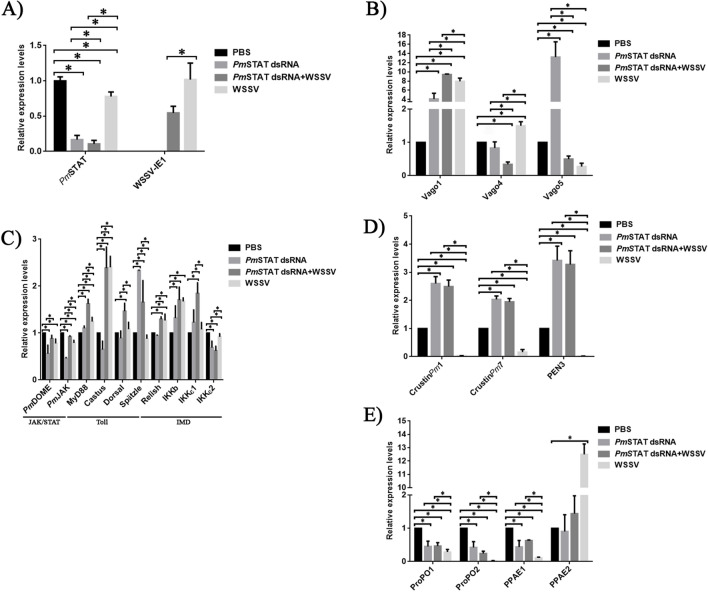
The gut microbiome plays an essential role in the immune system of invertebrates and vertebrates. Pre and pro-biotics could enhance the shrimp immune system by increasing the phenoloxidase (PO), prophenoloxidase (ProPO), and superoxide dismutase activities. During viral infection, the host immune system alteration could influence the gut microbiome composition and probably lead to other pathogenic infections. Since the JAK/STAT pathway is involved in white spot syndrome virus (WSSV) infection, we investigated the intestine immune genes of STAT-silenced shrimp. During WSSV infection, expression levels of PmVago1, PmDoral, and PmSpätzle in PmSTAT-silenced shrimp were higher than normal. In addition, the transcription levels of antimicrobial peptides, including crustinPm1, crustinPm7, and PmPEN3, were higher in WSSV-challenged PmSTAT-silenced shrimp than the WSSV-infected normal shrimp. Meanwhile, PmSTAT silencing suppressed PmProPO1, PmProPO2, and PmPPAE1 expressions during WSSV infection. The microbiota from four shrimp tested groups (control group, WSSV-infected, PmSTAT-silenced, and PmSTAT-silenced infected by WSSV) was significantly different, with decreasing richness and diversity due to WSSV infection. The relative abundance of Bacteroidetes, Actinobacteria, and Planctomycetes was reduced in WSSV-challenged shrimp. However, at the species level, P. damselae, a pathogen to human and marine animals, significantly increased in WSSV-challenged shrimp. In constrast, Shewanella algae, a shrimp probiotic, was decreased in WSSV groups. In addition, the microbiota structure between control and PmSTAT-silenced shrimp was significantly different, suggesting the importance of STAT to maintain the homeostasis interaction with the microbiota.
肠道微生物群在无脊椎动物和脊椎动物的免疫系统中起着至关重要的作用。益生菌和益生元可以通过增加酚氧化酶(PO)、原酚氧化酶(ProPO)和超氧化物歧化酶的活性来增强虾的免疫系统。在病毒感染期间,宿主免疫系统的改变可能会影响肠道微生物群的组成,并可能导致其他病原体感染。由于 JAK/STAT 途径参与了白斑综合征病毒(WSSV)的感染,我们研究了 STAT 沉默虾的肠道免疫基因。在 WSSV 感染期间,STAT 沉默的虾中的 PmVago1、PmDoral 和 PmSpätzle 的表达水平高于正常水平。此外,在 WSSV 感染的 STAT 沉默的虾中,抗菌肽(包括 crustinPm1、crustinPm7 和 PEN3)的转录水平高于正常的 WSSV 感染的虾。同时,在 WSSV 感染期间,PmSTAT 沉默抑制了 PmProPO1、PmProPO2 和 PmPPAE1 的表达。来自四个虾测试组(对照组、WSSV 感染组、PmSTAT 沉默组和 PmSTAT 沉默感染 WSSV 组)的微生物群有显著差异,由于 WSSV 感染,丰富度和多样性降低。在 WSSV 感染的虾中,厚壁菌门、放线菌门和浮霉菌门的相对丰度减少。然而,在物种水平上,对人类和海洋动物有致病性的 P. damselae 在 WSSV 感染的虾中显著增加。相反,虾的益生菌 Shewanella algae 在 WSSV 组中减少。此外,对照组和 PmSTAT 沉默的虾之间的微生物群结构存在显著差异,这表明 STAT 对维持与微生物群的平衡相互作用很重要。