
手指和耳垂不同位置测量的毛细血管再充盈时间的一致性:一项针对健康志愿者的初步前瞻性研究。
Agreement between Capillary Refill Time measured at Finger and Earlobe sites in different positions: a pilot prospective study on healthy volunteers.
机构信息
Department of Anesthesia and Intensive Care Medicine, Azienda Ospedaliero Universitaria "Policlinico - San Marco", 95123, Catania, Italy.
School of Specialization in Anesthesia and Intensive Care, University of Catania, 95123, Catania, Italy.
出版信息
BMC Anesthesiol. 2023 Jan 18;23(1):30. doi: 10.1186/s12871-022-01920-1.
BACKGROUND
Capillary Refill Time (CRT) is a marker of peripheral perfusion usually performed at fingertip; however, its evaluation at other sites/position may be advantageous. Moreover, arm position during CRT assessment has not been fully standardized.
METHODS
We performed a pilot prospective observational study in 82 healthy volunteers. CRT was assessed: a) in standard position with participants in semi-recumbent position; b) at 30° forearm elevation, c and d) at earlobe site in semi-recumbent and supine position. Bland-Altman analysis was performed to calculate bias and limits of agreement (LoA). Correlation was investigated with Pearson test.
RESULTS
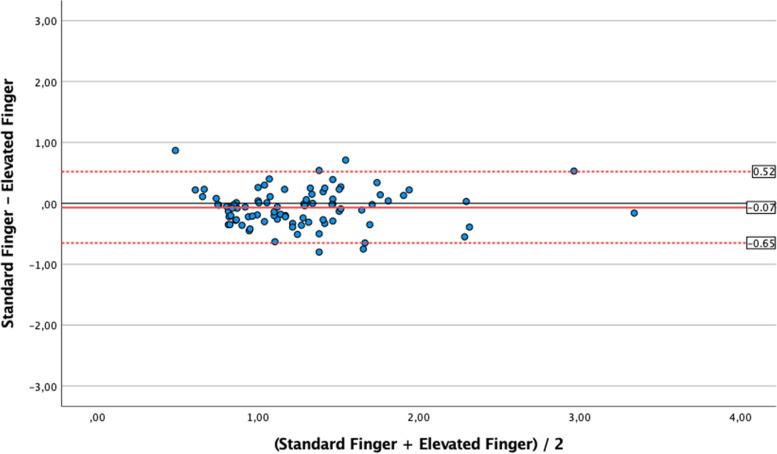
Standard finger CRT values (1.04 s [0.80;1.39]) were similar to the earlobe semi-recumbent ones (1.10 s [0.90;1.26]; p = 0.52), with Bias 0.02 ± 0.18 s (LoA -0.33;0.37); correlation was weak but significant (r = 0.28 [0.7;0.47]; p = 0.01). Conversely, standard finger CRT was significantly longer than earlobe supine CRT (0.88 s [0.75;1.06]; p < 0.001) with Bias 0.22 ± 0.4 s (LoA -0.56;1.0), and no correlation (r = 0,12 [-0,09;0,33]; p = 0.27]. As compared with standard finger CRT, measurement with 30° forearm elevation was significantly longer (1.17 s [0.93;1.41] p = 0.03), with Bias -0.07 ± 0.3 s (LoA -0.61;0.47) and with a significant correlation of moderate degree (r = 0.67 [0.53;0.77]; p < 0.001).
CONCLUSIONS
In healthy volunteers, the elevation of the forearm significantly prolongs CRT values. CRT measured at the earlobe in semi-recumbent position may represent a valid surrogate when access to the finger is not feasible, whilst earlobe CRT measured in supine position yields different results. Research is needed in critically ill patients to evaluate accuracy and precision at different sites/positions.
背景
毛细血管再充盈时间(CRT)是外周灌注的标志物,通常在指尖进行评估;然而,在其他部位/位置进行评估可能具有优势。此外,CRT 评估时手臂的位置尚未完全标准化。
方法
我们对 82 名健康志愿者进行了一项前瞻性观察性研究。评估 CRT:a)参与者处于半卧位时的标准位置;b)前臂抬高 30°时;c)和 d)半卧位和仰卧位时的耳屏部位。采用 Bland-Altman 分析计算偏倚和一致性界限(LoA)。采用 Pearson 检验进行相关性研究。
结果
标准手指 CRT 值(1.04 s [0.80;1.39])与耳屏半卧位 CRT 值(1.10 s [0.90;1.26])相似(p = 0.52),偏倚为 0.02 ± 0.18 s(LoA -0.33;0.37);相关性较弱但具有统计学意义(r = 0.28 [0.7;0.47];p = 0.01)。相反,标准手指 CRT 明显长于耳屏仰卧位 CRT(0.88 s [0.75;1.06]),偏倚为 0.22 ± 0.4 s(LoA -0.56;1.0),且无相关性(r = 0.12 [-0.09;0.33];p = 0.27])。与标准手指 CRT 相比,前臂抬高 30°时的测量值明显更长(1.17 s [0.93;1.41],p = 0.03),偏倚为-0.07 ± 0.3 s(LoA -0.61;0.47),且具有中度相关性(r = 0.67 [0.53;0.77];p < 0.001)。
结论
在健康志愿者中,前臂抬高会显著延长 CRT 值。半卧位时耳屏 CRT 测量可能是手指不可用时的有效替代指标,而仰卧位时耳屏 CRT 测量则会产生不同的结果。需要在危重症患者中进行研究,以评估不同部位/位置的准确性和精密度。


 Zotero 插件