Mauch Frieder, Huth Jochen
Departement für Obere Extremität/MRT, Sportklinik Stuttgart, Taubenheimstr. 8, 70327, Stuttgart, Deutschland.
Orthopadie (Heidelb). 2023 Feb;52(2):137-143. doi: 10.1007/s00132-022-04337-3. Epub 2023 Jan 19.
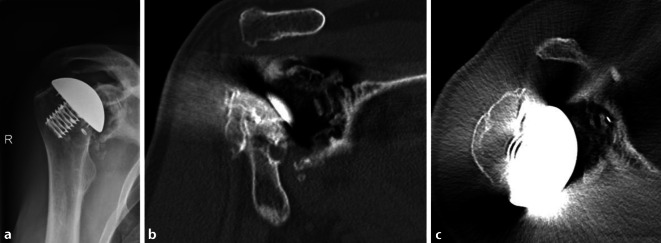
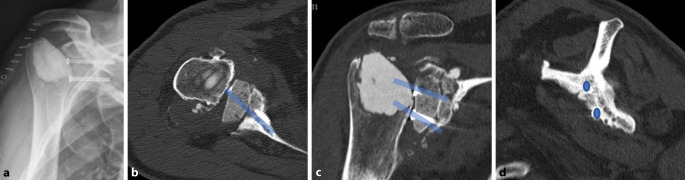
With the increasing number of primary arthroplasties, revisions of anatomical prostheses are becoming increasingly important. The most common reasons for revision are glenoid loosening, including protrusion, rotator cuff insufficiency, including instability, and early/late infection. The reconstruction of glenoid defects can be done with an autograft or allograft. Depending on the size and situation, it is carried out in one or two stages. The stemless humeral head replacement and the short-stem prostheses that have been used more frequently in recent years have significantly simplified humeral revision. Platform systems take a different approach with the option of conversion without major interventions on the glenoid or revision stem. Intraoperative complications mainly occur on the humeral side. Postoperative complications include dislocation, component loosening, and infection. Revision of anatomical to reverse arthroplasty shows better clinical outcomes and lower complication rates than anatomical revision.
随着初次关节置换手术数量的增加,解剖型假体的翻修变得越来越重要。翻修的最常见原因是肩胛盂松动,包括突出、肩袖功能不全,包括不稳定,以及早期/晚期感染。肩胛盂缺损的重建可采用自体移植或异体移植。根据大小和情况,分一或两个阶段进行。近年来更频繁使用的无柄肱骨头置换术和短柄假体显著简化了肱骨翻修。平台系统采用了不同的方法,可以在不对肩胛盂或翻修柄进行重大干预的情况下进行转换。术中并发症主要发生在肱骨侧。术后并发症包括脱位、假体松动和感染。解剖型假体翻修为反向置换术的临床效果优于解剖型翻修,并发症发生率更低。