State Key Laboratory of Microbial Technology, Institute of Microbial Technology, Helmholtz International Lab for Anti-infectives, Shandong University-Helmholtz Institute of Biotechnology, Shandong University, Binhai Rd 72, Qingdao, 266237, Shandong, China.
Microb Cell Fact. 2023 Jan 19;22(1):15. doi: 10.1186/s12934-023-02023-3.
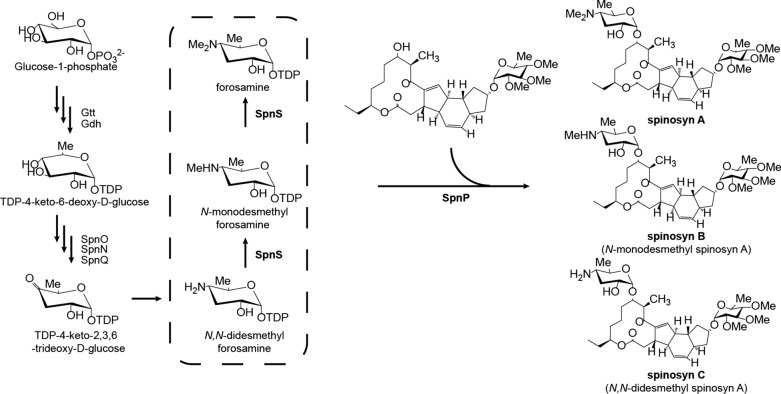
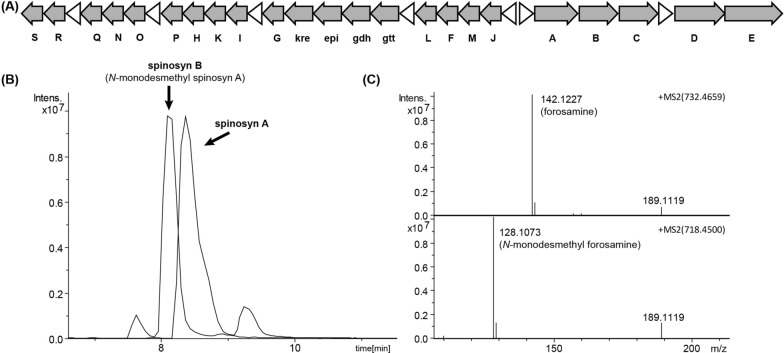
Spinosad is a macrolide insecticide with the tetracyclic lactone backbone to which forosamine and tri-O-methylrhamnose are attached. Both the sugar moieties are essential for its insecticidal activity. In biosynthesis of spinosad, the amino group of forosamine is dimethylated by SpnS and then transferred onto the lactone backbone by SpnP. Because the spinosad native producer is difficult to genetically manipulate, we previously changed promoters, ribosome binding sites and start codons of 23 spinosad biosynthetic genes to construct an artificial gene cluster which resulted in a 328-fold yield improvement in the heterologous host Streptomyces albus J1074 compared with the native gene cluster. However, in fermentation of J1074 with the artificial gene cluster, the N-monodesmethyl spinosad with lower insecticidal activity was always produced with the same titer as spinosad.
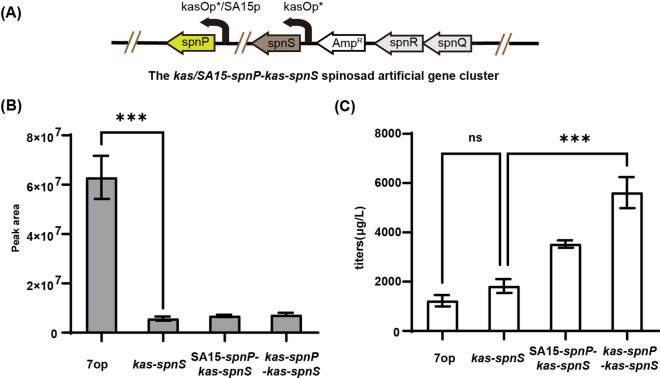
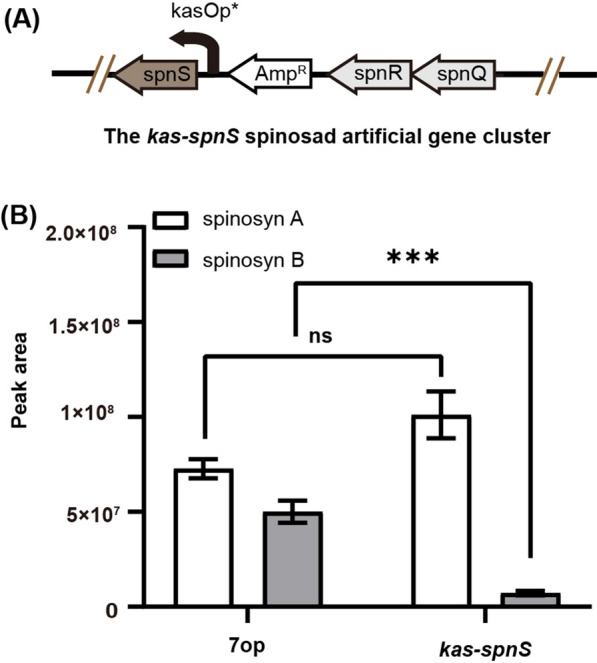
By tuning expression of SpnS with an inducible promotor, we found that the undesired less active byproduct N-monodesmethyl spinosad was produced when SpnS was expressed at low level. Although N-monodesmethyl spinosad can be almost fully eliminated with high SpnS expression level, the titer of desired product spinosad was only increased by less than 38%. When the forosaminyl transferase SpnP was further overexpressed together with SpnS, the titer of spinosad was improved by 5.3 folds and the content of N-desmethyl derivatives was decreased by ~ 90%.
N-monodesmethyl spinosad was produced due to unbalanced expression of spnS and upstream biosynthetic genes in the refactored artificial gene cluster. The accumulated N-desmethyl forosamine was transferred onto the lactone backbone by SpnP. This study suggested that balanced expression of biosynthetic genes should be considered in the refactoring strategy to avoid accumulation of undesired intermediates or analogues which may affect optimal production of desired compounds.
多杀菌素是一种大环内酯类杀虫剂,其四环内酯骨架上连接有福乐糖胺和三-O-甲基鼠李糖。这两个糖基部分对于其杀虫活性都是必不可少的。在多杀菌素的生物合成中,福乐糖胺的氨基被 SpnS 二甲基化,然后由 SpnP 将其转移到内酯骨架上。由于多杀菌素的天然产生菌难以进行遗传操作,我们之前改变了 23 个多杀菌素生物合成基因的启动子、核糖体结合位点和起始密码子,构建了一个人工基因簇,与天然基因簇相比,在异源宿主 Streptomyces albus J1074 中的产量提高了 328 倍。然而,在使用人工基因簇发酵 J1074 时,总是以与多杀菌素相同的浓度产生杀虫活性较低的 N-单去甲基多杀菌素。
通过诱导型启动子调控 SpnS 的表达,我们发现当 SpnS 表达水平较低时,会产生不需要的低活性副产物 N-单去甲基多杀菌素。虽然用高表达水平的 SpnS 几乎可以完全消除 N-单去甲基多杀菌素,但所需产物多杀菌素的浓度仅提高了不到 38%。当进一步与 SpnS 共表达福乐糖基转移酶 SpnP 时,多杀菌素的浓度提高了 5.3 倍,N-去甲基衍生物的含量降低了约 90%。
在重构的人工基因簇中,由于 spnS 和上游生物合成基因的表达不平衡,产生了 N-单去甲基多杀菌素。积累的 N-去甲基福乐糖胺被 SpnP 转移到内酯骨架上。这项研究表明,在重构策略中应考虑生物合成基因的平衡表达,以避免积累可能影响所需化合物最佳生产的不需要的中间体或类似物。