El-Sheikh Marwa, Mesalam Ayman, Khalil Atif Ali Khan, Idrees Muhammad, Ahn Mi-Jeong, Mesalam Ahmed Atef, Kong Il-Keun
Department of Microbial Biotechnology, Biotechnology Research Institute, National Research Centre (NRC), Dokki, Cairo 12622, Egypt.
Department of Theriogenology, Faculty of Veterinary Medicine, Zagazig University, Zagazig 44519, Egypt.
Antioxidants (Basel). 2023 Jan 3;12(1):114. doi: 10.3390/antiox12010114.
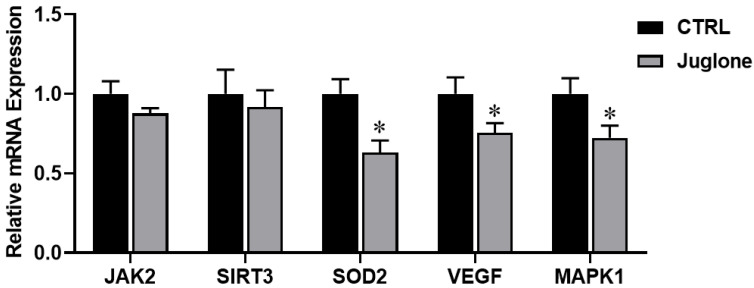
We have previously reported that juglone, a natural compound found in Juglandaceae with a wide range of biological activities, can reduces the developmental competence of bovine oocytes. In the current study, we investigated the possible mechanisms behind the toxicity of juglone and the relationship with PI3K/AKT/mTOR signaling during the in vitro maturation (IVM) of oocytes. Results show that oocyte exposure to juglone was associated with a significant decrease in filamentous actin (F-actin) accumulation. The RT-qPCR showed downregulation of the meiosis progression indicator GSK-3A, oocyte development marker BMP15, mitochondria fusion controlling MFN1, oxidative stress-related OGG1, and histone methylation-related EZH1, EZH2, SUZ12, G9a, and SUV39H2 genes in juglone-treated oocytes. In addition, glycolysis- (PFK1 and GLUT1), ATP synthesis- (ATPase8 and ATP5F1B), and OXPHOS-specific markers (SDHA and SDHD), as well as the oocyte survival regulators (SOD2, VEGF, and MAPK1) significantly decreased upon juglone treatment. Moreover, lower expression of PI3K, AKT, and mTOR was observed at the transcriptional and/or translational level(s). The autophagy markers LC3B and beclin-1 as well as the DNA damage-specific marker 8-OxoG displayed overexpression in juglone-exposed oocytes. Taken together, our results show that administration of juglone during the IVM can reduce the quality and developmental health of bovine oocytes through downregulation of the PI3K/AKT/mTOR pathway and its downstream signaling cascades.
我们之前曾报道过胡桃酮,一种存在于胡桃科植物中的具有广泛生物活性的天然化合物,能够降低牛卵母细胞的发育能力。在本研究中,我们探究了胡桃酮毒性背后的可能机制以及在卵母细胞体外成熟(IVM)过程中与PI3K/AKT/mTOR信号传导的关系。结果显示,卵母细胞暴露于胡桃酮与丝状肌动蛋白(F-肌动蛋白)积累的显著减少有关。RT-qPCR显示,在经胡桃酮处理的卵母细胞中,减数分裂进程指标GSK-3A、卵母细胞发育标志物BMP15、线粒体融合控制蛋白MFN1、氧化应激相关蛋白OGG1以及组蛋白甲基化相关基因EZH1、EZH2、SUZ12、G9a和SUV39H2的表达下调。此外,经胡桃酮处理后,糖酵解相关标志物(PFK1和GLUT1)、ATP合成相关标志物(ATPase8和ATP5F1B)以及氧化磷酸化特异性标志物(SDHA和SDHD),还有卵母细胞存活调节因子(SOD2、VEGF和MAPK1)均显著降低。此外,在转录和/或翻译水平观察到PI3K、AKT和mTOR的表达较低。自噬标志物LC3B和贝林1以及DNA损伤特异性标志物8-氧代鸟嘌呤在暴露于胡桃酮的卵母细胞中过度表达。综上所述,我们的结果表明,在IVM过程中给予胡桃酮可通过下调PI3K/AKT/mTOR途径及其下游信号级联反应来降低牛卵母细胞的质量和发育健康状况。