Department of Ruminant Science, West Pomeranian University of Technology, Klemensa Janickiego 29, 71-270 Szczecin, Poland.
Department of Environment Hygiene and Animal Welfare, Wroclaw University of Environmental and Life Sciences, Chelmonskiego 38C, 50-576 Wroclaw, Poland.
Int J Mol Sci. 2023 Jul 6;24(13):11164. doi: 10.3390/ijms241311164.
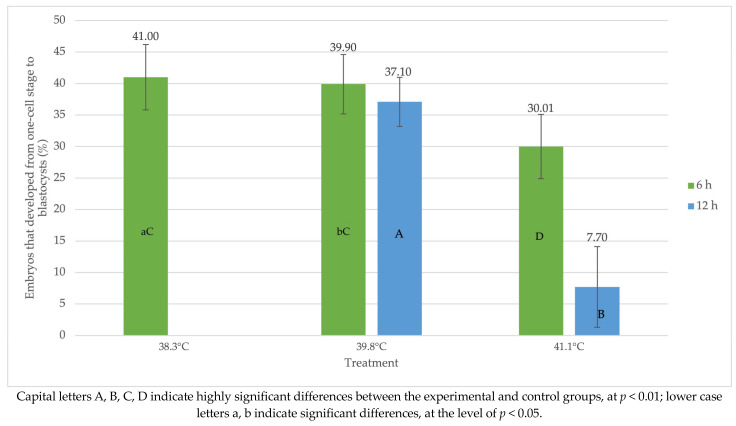
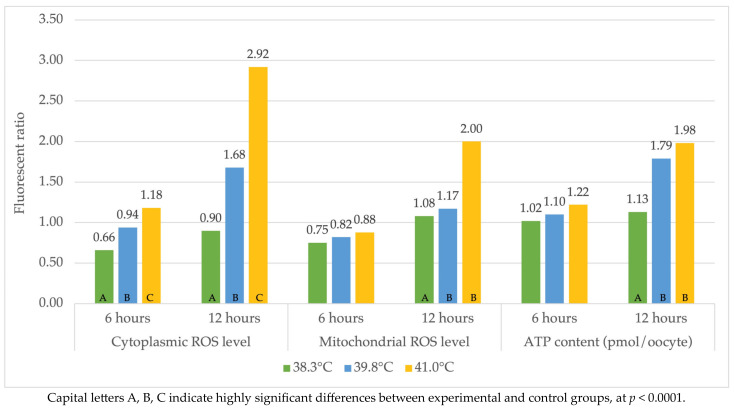
The main problem in dairy herds is reproductive disorders, which are influenced by many factors, including temperature. Heat stress reduces the quality of oocytes and their maturation through the influence of, e.g., mitochondrial function. Mitochondria are crucial during oocyte maturation as well as the process of fertilization and embryonic development. Disturbances related to high temperature will be increasingly observed due to global warming. In present studies, we have proven that exposure to high temperatures during the cleaving of embryos statistically significantly (at the level of < 0.01) reduces the percentage of oocytes that cleaved and developed into blastocysts eight days after insemination. The study showed the highest percentage of embryos that underwent division in the control group (38.3 °C). The value was 88.10 ± 6.20%, while the lowest was obtained in the study group at 41.0 °C (52.32 ± 8.40%). It was also shown that high temperature has a statistically significant ( < 0.01) effect on the percentage of embryos that developed from the one-cell stage to blastocysts. The study showed that exposure to a temperature of 41.0 °C significantly reduced the percentage of embryos that split relative to the control group (38.3 °C; 88.10 ± 6.20%). Moreover, it was noted that the highest tested temperature limits the development of oocytes to the blastocyst stage by 5.00 ± 9.12% compared to controls (33.33 ± 7.10%) and cleaved embryos to blastocysts by 3.52 ± 6.80%; the control was 39.47 ± 5.40%. There was also a highly significant ( < 0.0001) effect of temperature on cytoplasmic ROS levels after 6 and 12 h IVM. The highest level of mitochondrial ROS was found in the group of oocytes after 6 h IVM at 41.0 °C and the lowest was found in the control group. In turn, at 41.0 °C after 12 h of IVM, the mitochondrial ROS level had a 2.00 fluorescent ratio, and the lowest in the group was 38.3 °C (1.08). Moreover, with increasing temperature, a decrease in the expression level of both LC3 and SIRT1 protein markers was observed. It was proved that the autophagy process was impaired as a result of high temperature. Understanding of the cellular and molecular responses of oocytes to elevated temperatures will be helpful in the development of heat resistance strategies in dairy cattle.
奶牛群中主要存在生殖障碍问题,其受多种因素影响,包括温度。热应激会通过影响线粒体功能等降低卵母细胞的质量及其成熟。线粒体在卵母细胞成熟、受精和胚胎发育过程中至关重要。由于全球变暖,与高温相关的干扰将越来越多。在目前的研究中,我们已经证明,胚胎分裂过程中暴露于高温会显著降低( < 0.01 水平)卵母细胞分裂并发育为受精后 8 天囊胚的比例。在对照组中,胚胎分裂的比例最高(38.3°C)。该值为 88.10±6.20%,而在实验组中,温度为 41.0°C 时获得的比例最低(52.32±8.40%)。研究还表明,高温对从单细胞阶段发育到囊胚的胚胎比例有显著影响( < 0.01)。研究表明,与对照组(38.3°C;88.10±6.20%)相比,暴露于 41.0°C 会显著降低胚胎分裂的比例。此外,值得注意的是,与对照组(33.33±7.10%)相比,最高测试温度将卵母细胞发育到囊胚阶段的比例限制在 5.00±9.12%,将分裂胚胎发育到囊胚的比例限制在 3.52±6.80%;对照组为 39.47±5.40%。IVM 后 6 和 12 小时细胞质 ROS 水平也受到温度的高度显著影响( < 0.0001)。在 41.0°C 组中,IVM 后 6 小时的卵母细胞中发现线粒体 ROS 水平最高,对照组中发现的水平最低。相反,在 IVM 后 12 小时,41.0°C 组的线粒体 ROS 水平为 2.00 荧光比值,而最低的组为 38.3°C(1.08)。此外,随着温度的升高,LC3 和 SIRT1 蛋白标记物的表达水平均降低。证明高温会损害自噬过程。了解卵母细胞对高温的细胞和分子反应将有助于开发奶牛耐热策略。