Alabdullh Hussam Almesto, Pflaum Michael, Mälzer Marisa, Kipp Marcel, Naghilouy-Hidaji Hossein, Adam Denise, Kühn Christian, Natanov Russlan, Niehaus Adelheid, Haverich Axel, Wiegmann Bettina
Department for Cardiothoracic, Transplantation and Vascular Surgery, Hannover Medical School, 30625 Hannover, Germany.
Lower Saxony Center for Biomedical Engineering, Implant Research and Development (NIFE), Stadtfelddamm 34, 30625 Hannover, Germany.
Bioengineering (Basel). 2023 Jan 5;10(1):72. doi: 10.3390/bioengineering10010072.
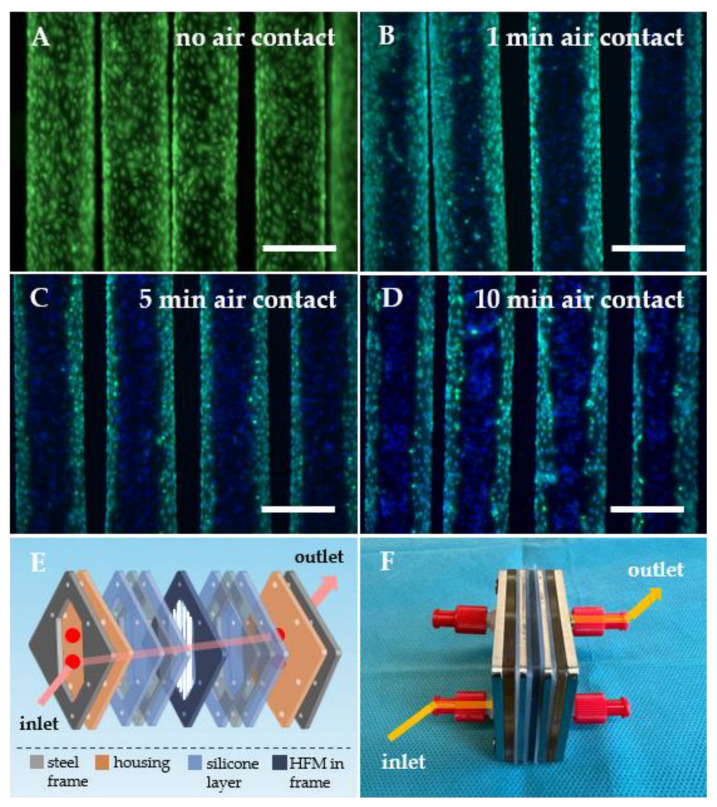
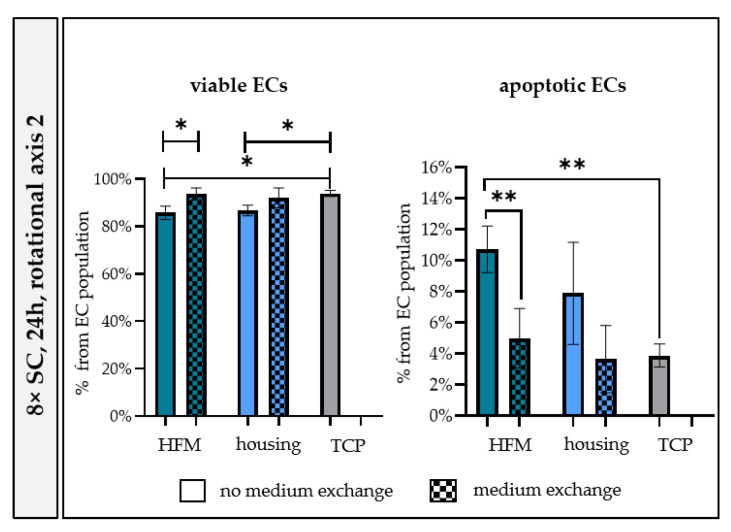
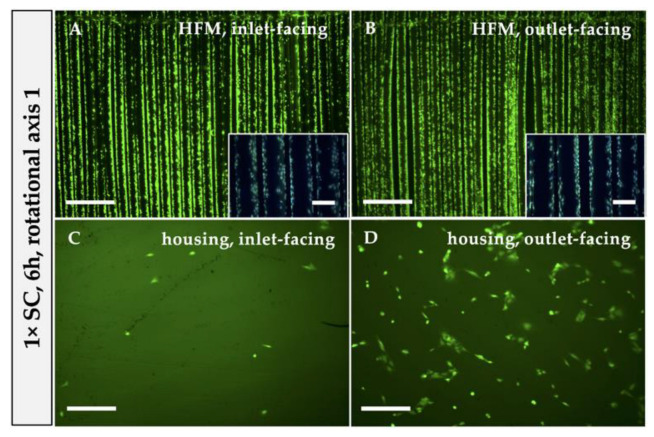
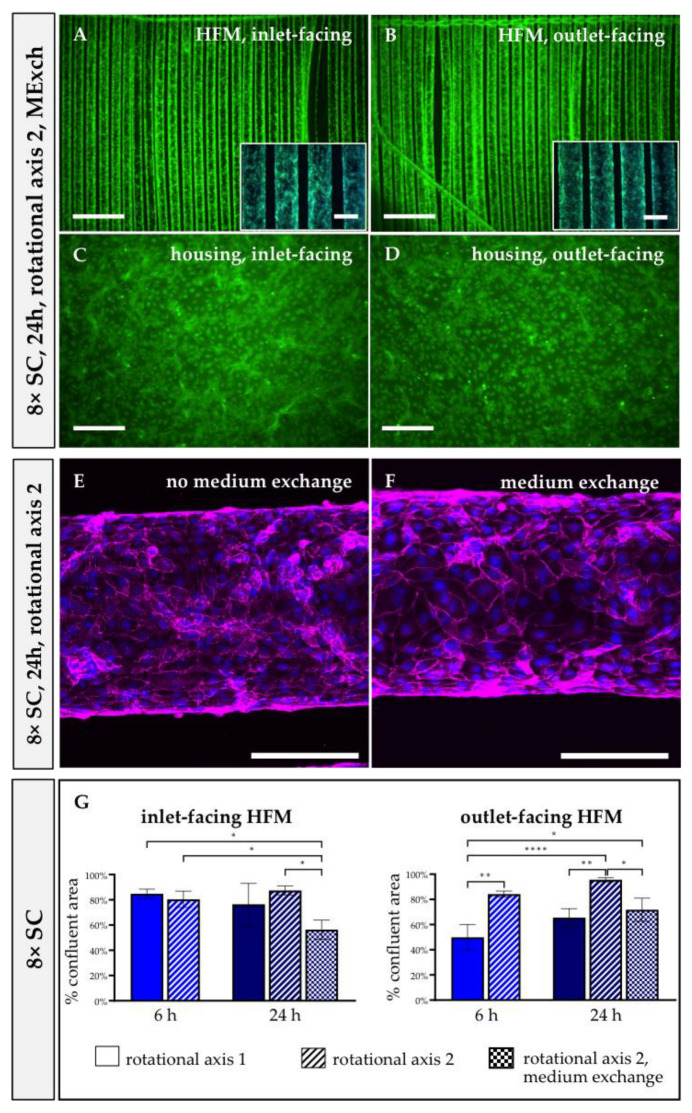
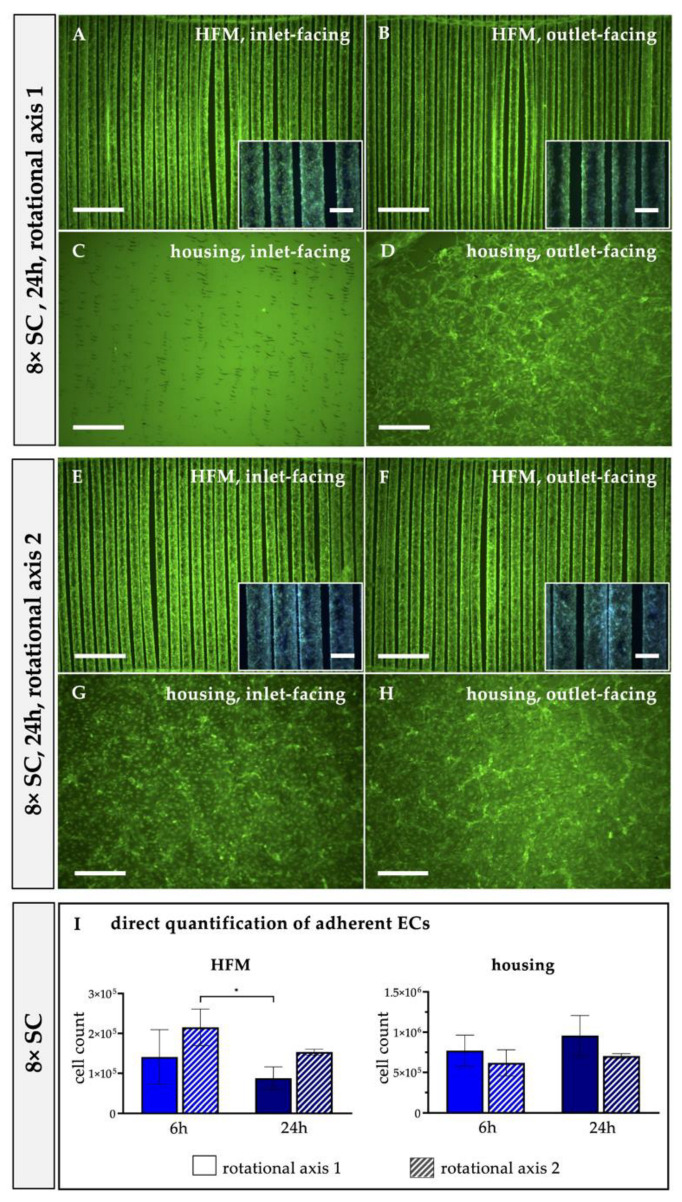
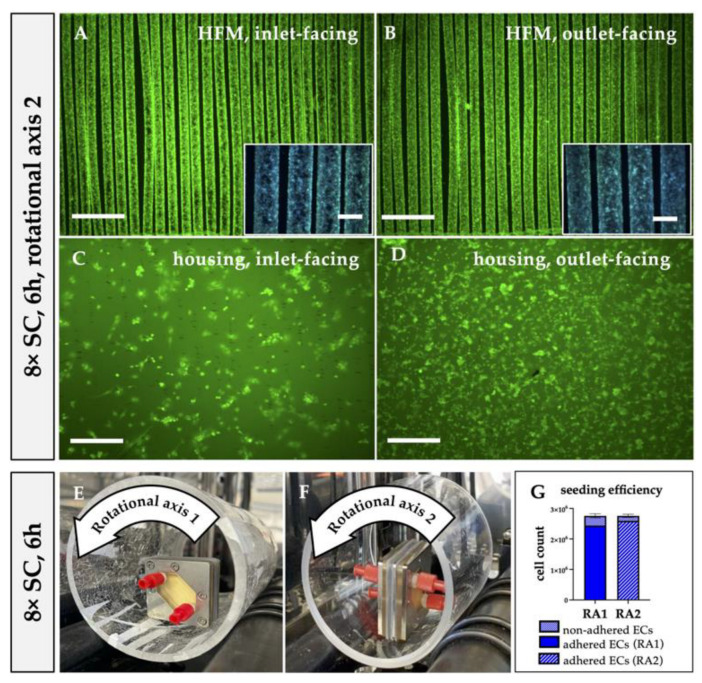
Towards the establishment of a long-term lung-assist device to be used both as a bridge and as an alternative to lung transplantation according to final destination therapy, we develop the biohybrid lung (BHL) on the technical basis of contemporary extracorporeal membrane oxygenation (ECMO). Here, to overcome the significant drawbacks of ECMO, in particular the missing hemocompatibility of the artificial surfaces, all blood-contacting areas need to be endothelialized sufficiently. In continuation of our recent accomplishments, demonstrating the feasibility of establishing a physiological acting endothelial cell (EC) monolayer on the hollow fiber membranes (HFMs) of the ECMO in vitro, the next step towards BHL translation is the endothelialization of the complete oxygenator, consisting of HFMs and the surrounding housing. Therefore, we assessed EC seeding inside our model oxygenator (MOx), which simulated the conditions in the assembled HFM oxygenators in order to identify the most important factors influencing efficient endothelialization, such as cell seeding density, cell distribution, incubation time and culture medium consumption. Overall, upon adjusting the concentration of infused ECs to 15.2 × 10/cm and ensuring optimal dispersion of cells in the MOx, viable and confluent EC monolayers formed on all relevant surfaces within 24 h, even though they comprised different polymers, i.e., the fibronectin-coated HFMs and the polysulfone MOx housing. Periodic medium change ensured monolayer survival and negligible apoptosis rates comparable to the reference within the assembled system. By means of these results, revealing essential implications for BHL development, their clinical translation is coming one step closer to reality.
为了建立一种长期的肺辅助装置,根据最终治疗目的,既用作肺移植的桥梁,又作为肺移植的替代方案,我们在当代体外膜肺氧合(ECMO)的技术基础上开发了生物杂交肺(BHL)。在此,为了克服ECMO的重大缺点,特别是人工表面缺乏血液相容性,所有血液接触区域都需要充分内皮化。延续我们最近的成果,即证明在体外ECMO的中空纤维膜(HFM)上建立具有生理作用的内皮细胞(EC)单层的可行性,向BHL转化的下一步是对由HFM和周围外壳组成的完整氧合器进行内皮化。因此,我们评估了在我们的模型氧合器(MOx)内接种EC,该模型模拟了组装好的HFM氧合器中的条件,以确定影响有效内皮化的最重要因素,如细胞接种密度、细胞分布、孵育时间和培养基消耗。总体而言,将注入的EC浓度调整至15.2×10⁶/cm³并确保细胞在MOx中最佳分散后,即使它们由不同的聚合物组成,即纤连蛋白包被的HFM和聚砜MOx外壳,在24小时内所有相关表面上都形成了有活力且融合的EC单层。定期更换培养基确保了单层的存活,且凋亡率可忽略不计,与组装系统中的对照相当。通过这些结果,揭示了对BHL开发的重要意义,它们的临床转化正朝着现实迈进了一步。