Hu Zhengyan, Gao Rui, Huang Wanrong, Wang Huiqing, Qin Lang
The Reproductive Medical Center, Department of Obstetrics and Gynecology, West China Second University Hospital, Sichuan University, Chengdu 610041, China.
Key Laboratory of Birth Defects and Related of Women and Children of Ministry of Education, West China Second University Hospital, Sichuan University, Chengdu 610041, China.
J Clin Med. 2023 Jan 6;12(2):485. doi: 10.3390/jcm12020485.
Hydroxychloroquine (HCQ) has been used in the treatment of systematic lupus erythematosus (SLE) and antiphospholipid syndrome (APS), but its effect on lupus activity during pregnancy, preeclampsia and intrauterine growth restriction (IUGR) remains unclear.
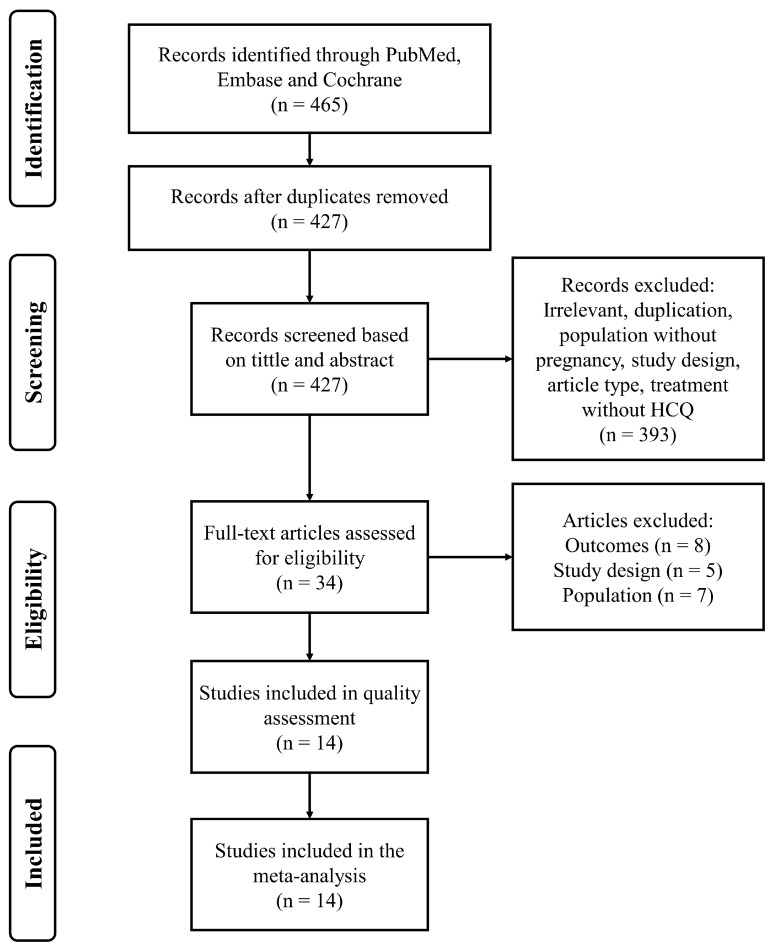
PubMed, Embase and Cochrane databases were searched before 11 September 2022 for randomized clinical trials (RCT) or observational studies involving additional HCQ treatment and pregnant women diagnosed as having SLE and/or APS/positive antiphospholipid antibodies (aPLs). Risks of high lupus activity, preeclampsia and IUGR were explored.
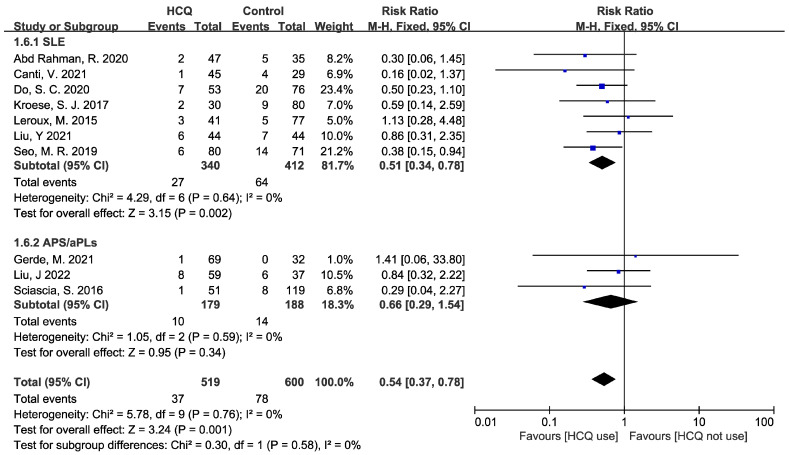
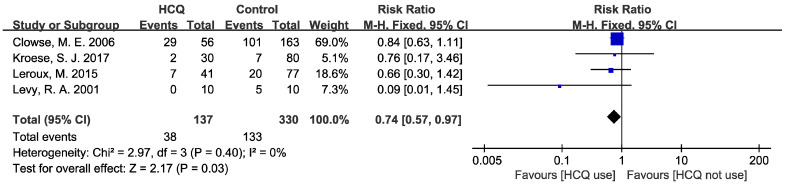
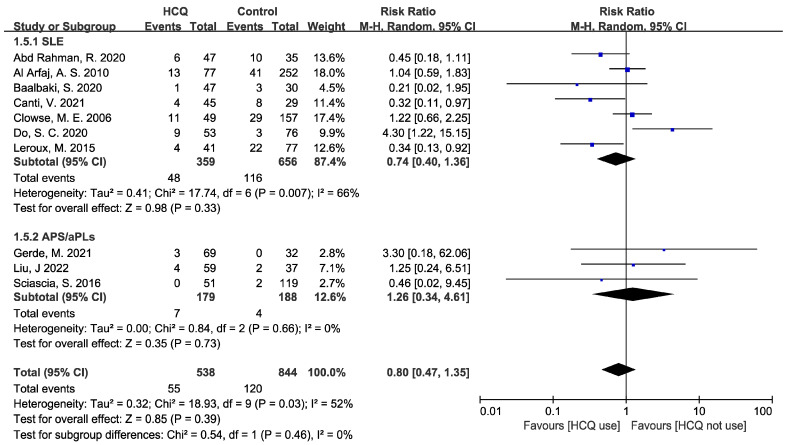
One RCT and 13 cohort studies were included. A total of 1764 pregnancies were included in the pooled meta-analysis (709 in the HCQ group vs. 1055 in the control group). After the additional use of HCQ, the risk of high lupus activity decreased (RR: 0.74, 95% CI: 0.57-0.97, = 0.03). For preeclampsia, the total incidence decreased (RR: 0.54, 95% CI: 0.37-0.78, = 0.001). The subgroup analysis showed statistical significance in the SLE subgroup (RR: 0.51, 95% CI: 0.34-0.78, = 0.002) but not in the APS/aPLs subgroup (RR: 0.66, 95% CI: 0.29-1.54, = 0.34). For IUGR, the decrease in incidence was not statistically significant (RR: 0.80, 95% CI: 0.47-1.35, = 0.46), neither in the SLE subgroup (RR: 0.74, 95% CI: 0.40-1.36, = 0.33) nor in the APS/aPLs subgroup (RR: 1.26, 95% CI: 0.34-4.61, = 0.73).
The additional use of HCQ may decrease the risk of high lupus activity during pregnancy and the incidence of preeclampsia for SLE patients, but the results do not support that using HCQ decreases the incidence of preeclampsia for APS/aPLs patients or reduces IUGR risk for SLE and/or APS/aPLs patients.
羟氯喹(HCQ)已用于治疗系统性红斑狼疮(SLE)和抗磷脂综合征(APS),但其对妊娠期间狼疮活动、先兆子痫和胎儿生长受限(IUGR)的影响仍不明确。
在2022年9月11日前检索PubMed、Embase和Cochrane数据库,查找涉及额外使用HCQ治疗且被诊断为患有SLE和/或APS/抗磷脂抗体(aPLs)阳性的孕妇的随机临床试验(RCT)或观察性研究。探讨狼疮高活动、先兆子痫和IUGR的风险。
纳入1项RCT和13项队列研究。汇总的荟萃分析共纳入1764例妊娠(HCQ组709例,对照组1055例)。额外使用HCQ后,狼疮高活动风险降低(RR:0.74,95%CI:0.57-0.97,P = 0.03)。对于先兆子痫,总发生率降低(RR:0.54,95%CI:0.37-0.78,P = 0.001)。亚组分析显示,在SLE亚组中有统计学意义(RR:0.51,95%CI:0.34-0.78,P = 0.002),但在APS/aPLs亚组中无统计学意义(RR:0.66,95%CI:0.29-1.54,P = 0.34)。对于IUGR,发生率的降低无统计学意义(RR:0.80,95%CI:0.47-1.35,P = 0.46),在SLE亚组(RR:0.74,95%CI:0.40-1.36,P = 0.33)和APS/aPLs亚组(RR:1.26,95%CI:0.34-4.61,P = 0.73)中均无统计学意义。
额外使用HCQ可能降低妊娠期间狼疮高活动的风险以及SLE患者先兆子痫的发生率,但结果不支持使用HCQ可降低APS/aPLs患者先兆子痫的发生率或降低SLE和/或APS/aPLs患者IUGR风险。