Graduate School of Biomedical Engineering, Tohoku University, 6-6-12 Aramaki-Aoba, Aoba-ku, Sendai 980-8579, Japan.
Graduate School of Dentistry, Tohoku University, 4-1, Seiryo-machi, Aoba-ku, Sendai 980-8575, Japan.
Molecules. 2023 Jan 9;28(2):650. doi: 10.3390/molecules28020650.
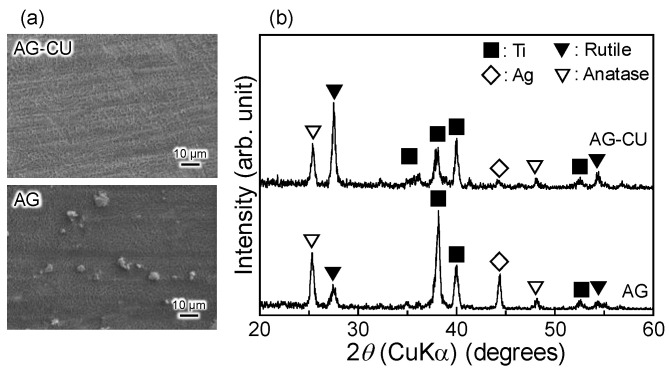
Dental implants made of titanium (Ti) are used in dentistry, but peri-implantitis is a serious associated problem. Antibacterial and osteoconductive Ti dental implants may decrease the risk of peri-implantitis. In this study, titania (TiO) co-doped with silver (Ag) at 2.5 at.% and copper (Cu) at 4.9 at.% was formed on Ti substrates via chemical and thermal treatments. The Ag and Cu co-doped TiO formed apatite in a simulated body fluid, which suggests osteoconductivity. It also showed antibacterial activity against , which was enhanced by visible-light irradiation. This enhancement might be caused by the synergistic effect of the release of Ag and Cu and the generation of •OH from the sample. Dental implants with such a Ag and Cu co-doped TiO formed on their surface may reduce the risk of peri-implantitis.
钛(Ti)制成的牙科植入物在牙科中得到广泛应用,但种植体周围炎是一个严重的相关问题。具有抗菌和骨诱导性的 Ti 牙科植入物可能会降低种植体周围炎的风险。在这项研究中,通过化学和热处理在 Ti 基底上形成了掺银(Ag)2.5 原子%和掺铜(Cu)4.9 原子%的二氧化钛(TiO)。Ag 和 Cu 共掺杂的 TiO 在模拟体液中形成了磷灰石,表明其具有骨诱导性。它还对 表现出抗菌活性,可见光照射进一步增强了其抗菌活性。这种增强可能是由于 Ag 和 Cu 的释放以及样品中产生的 •OH 的协同作用所致。在其表面形成这种掺 Ag 和 Cu 的 TiO 的牙科植入物可能会降低种植体周围炎的风险。