Li Meijie, Watanabe Shunsuke, Gao Fei, Dubos Christian
IPSiM, University Montpellier, CNRS, INRAE, Institut Agro, Montpellier, France.
College of Agronomy, Hunan Agricultural University, Changsha 410128, China.
Plants (Basel). 2023 Jan 13;12(2):384. doi: 10.3390/plants12020384.
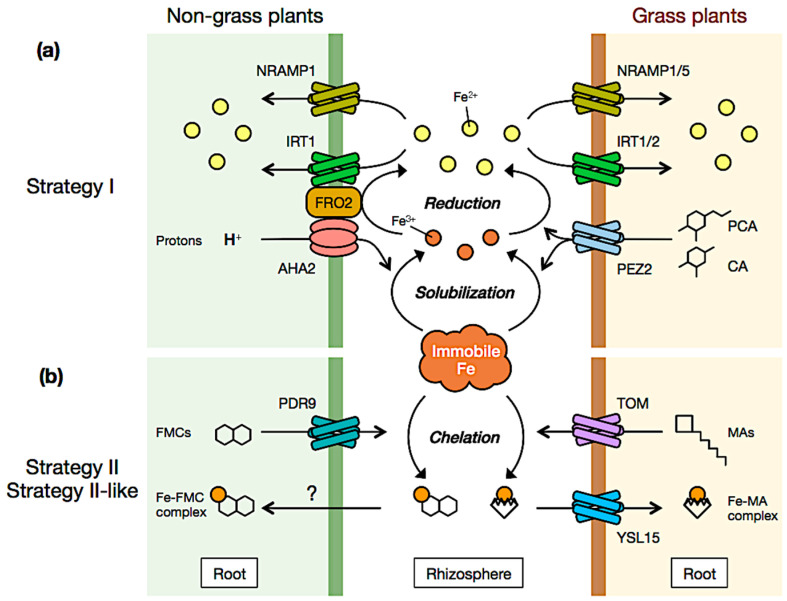
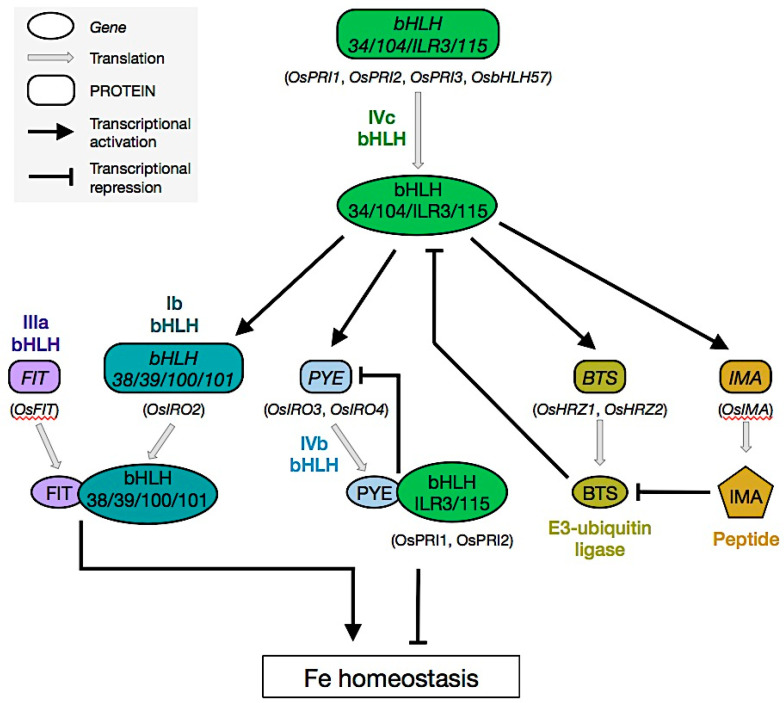
Iron (Fe) is an essential micronutrient for plant growth and development. Fe availability affects crops' productivity and the quality of their derived products and thus human nutrition. Fe is poorly available for plant use since it is mostly present in soils in the form of insoluble oxides/hydroxides, especially at neutral to alkaline pH. How plants cope with low-Fe conditions and acquire Fe from soil has been investigated for decades. Pioneering work highlighted that plants have evolved two different strategies to mine Fe from soils, the so-called Strategy I (Fe reduction strategy) and Strategy II (Fe chelation strategy). Strategy I is employed by non-grass species whereas graminaceous plants utilize Strategy II. Recently, it has emerged that these two strategies are not fully exclusive and that the mechanism used by plants for Fe uptake is directly shaped by the characteristics of the soil on which they grow (e.g., pH, oxygen concentration). In this review, recent findings on plant Fe uptake and the regulation of this process will be summarized and their impact on our understanding of plant Fe nutrition will be discussed.
铁(Fe)是植物生长发育所必需的微量营养元素。铁的有效性影响作物的生产力及其衍生产品的质量,进而影响人类营养。由于铁在土壤中大多以不溶性氧化物/氢氧化物的形式存在,尤其是在中性至碱性pH条件下,植物难以利用。几十年来,人们一直在研究植物如何应对低铁条件并从土壤中获取铁。开创性的研究表明,植物已经进化出两种从土壤中获取铁的不同策略,即所谓的策略I(铁还原策略)和策略II(铁螯合策略)。非禾本科植物采用策略I,而禾本科植物利用策略II。最近发现,这两种策略并非完全相互排斥,植物吸收铁的机制直接受其生长土壤特性(如pH值、氧气浓度)的影响。在这篇综述中,将总结植物铁吸收及其过程调控的最新研究结果,并讨论它们对我们理解植物铁营养的影响。