Paolone Gaetano, Mandurino Mauro, De Palma Francesca, Mazzitelli Claudia, Scotti Nicola, Breschi Lorenzo, Gherlone Enrico, Cantatore Giuseppe, Vichi Alessandro
Dental School, IRCCS San Raffaele Hospital, Vita-Salute University, 20132 Milan, Italy.
Department of Biomedical and Neuromotor Sciences, DIBINEM, Alma Mater University of Bologna, Via S. Vitale 59, 40125 Bologna, Italy.
Polymers (Basel). 2023 Jan 16;15(2):464. doi: 10.3390/polym15020464.
This systematic review aims to evaluate the color stability of resin composite CAD/CAM blocks (CCB) when submitted to staining solutions.
A systematic search was performed on different databases (Embase, Medline, Scopus, Web of Science). Search terms were: 'polymer infiltrated', 'polymer-based', 'resin nanoceramic', 'resin ceramic', 'hybrid composite', 'hybrid ceramic', 'composite ceramic', 'resin infiltrated', 'CAD-CAM', 'CAD/CAM', 'color stability', 'staining', 'staining susceptibility', 'color change', 'color difference'.
in vitro articles published in the English language until 18 September 2022 without initial time restriction evaluating the color stability of CCB when submitted to staining solutions.
studies investigating color change induced by smoke or whitening treatments; studies not including a clinical evaluation of the results using the thresholds for color perceptibility and acceptability. Risk of bias assessment using the QUIN tool.
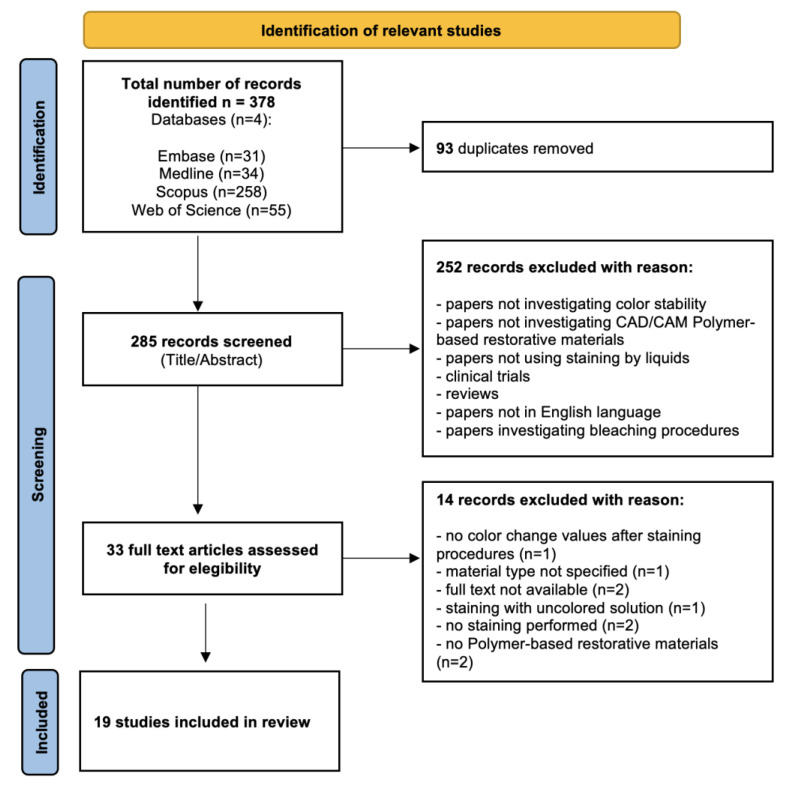
Out of the 378 initially retrieved articles, 19 were included in this review. They investigated 17 different CCBs and different artificial staining by liquid protocols, including coffee, red wine, tea, and cola. CCBs exceeded clinical acceptability thresholds for color shift in 18 out of 19 studies, with a significantly higher color stability than conventional hybrid resin-based composites (RBCs), and a significantly lower color stability than ceramic materials. The identified differences in CCBs in color stability can be attributed to the material's composition, but also to the heterogeneity of staining procedures. Interpretation and clinical implication: Clinicians should be aware that, although to a lower degree when compared to RBCs used in direct or indirect procedures, CCBs undergo color changes to a higher degree in comparison to ceramic materials.
本系统评价旨在评估树脂复合计算机辅助设计/计算机辅助制造(CAD/CAM)块材(CCB)在接触染色溶液时的颜色稳定性。
在不同数据库(Embase、Medline、Scopus、Web of Science)中进行系统检索。检索词为:“聚合物渗透的”、“聚合物基的”、“树脂纳米陶瓷”、“树脂陶瓷”、“混合复合材料”、“混合陶瓷”、“复合陶瓷”、“树脂渗透的”、“CAD-CAM”、“CAD/CAM”、“颜色稳定性”、“染色”、“染色敏感性”、“颜色变化”、“色差”。
截至2022年9月18日发表的英文体外研究文章,无初始时间限制,评估CCB在接触染色溶液时的颜色稳定性。
研究烟雾或美白处理引起的颜色变化;未使用颜色感知和可接受性阈值对结果进行临床评估的研究。使用QUIN工具进行偏倚风险评估。
在最初检索到的378篇文章中,19篇被纳入本评价。它们研究了17种不同的CCB以及通过液体方案进行的不同人工染色,包括咖啡、红酒、茶和可乐。在19项研究中的18项中,CCB的颜色变化超过了临床可接受阈值,其颜色稳定性显著高于传统混合树脂基复合材料(RBC),但显著低于陶瓷材料。CCB在颜色稳定性方面的差异可归因于材料组成,也可归因于染色程序的异质性。解释与临床意义:临床医生应意识到,尽管与直接或间接操作中使用的RBC相比程度较低,但与陶瓷材料相比,CCB的颜色变化程度更高。