LAM-Motion Analysis Laboratory, S. Sebastiano Hospital, Neuromotor and Rehabilitation Department, Azienda USL-IRCCS di Reggio Emilia, Via Circondaria 29, 42015 Correggio, Italy.
Merlo Bioengineering, 43121 Parma, Italy.
Sensors (Basel). 2023 Jan 12;23(2):866. doi: 10.3390/s23020866.
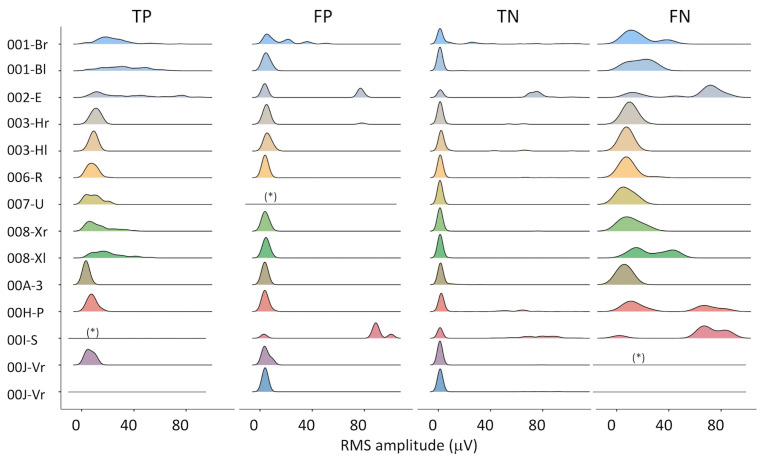
Sustained involuntary muscle activity (IMA) is a highly disabling phenomenon that arises in the acute phase of an upper motor neuron lesion (UMNL). Wearable probes for long-lasting surface EMG (sEMG) recordings have been recently recommended to detect IMA insurgence and to quantify its evolution over time, in conjunction with a complex algorithm for IMA automatic identification and classification. In this study, we computed sensitivity (), specificity (), and overall accuracy () of this algorithm by comparing it with the classification provided by two expert assessors. Based on sample size estimation, 6020 10 s-long sEMG epochs were classified by both the algorithm and the assessors. Epochs were randomly extracted from long-lasting sEMG signals collected in-field from 14 biceps brachii (BB) muscles of 10 patients (5F, age range 50-71 years) hospitalized in an acute rehabilitation ward following a stroke or a post-anoxic coma and complete upper limb (UL) paralysis. Among the 14 BB muscles assessed, was 85.6% (83.6-87.4%); was 89.7% (88.6-90.7%), and overall was 88.5% (87.6-89.4%) and ranged between 78.6% and 98.7%. The presence of IMA was detected correctly in all patients. These results support the algorithm's use for in-field IMA assessment based on data acquired with wearable sensors. The assessment and monitoring of IMA in acute and subacute patients with UMNL could improve the quality of care needed by triggering early treatments to lessen long-term complications.
持续性不随意肌肉活动(IMA)是一种在上运动神经元损伤(UMNL)急性期出现的高度致残现象。最近,人们推荐使用可穿戴探头进行长时间的表面肌电图(sEMG)记录,以检测 IMA 的发作,并结合 IMA 自动识别和分类的复杂算法来量化其随时间的演变。在这项研究中,我们通过将该算法与两名专家评估员提供的分类进行比较,计算了该算法的敏感性()、特异性()和总体准确性()。基于样本量估计,算法和评估员对 6020 个 10 秒长的 sEMG 时段进行了分类。从在急性康复病房住院的 10 名中风或缺氧后昏迷后完全上肢(UL)瘫痪患者的 14 块肱二头肌(BB)肌肉中采集的长时间 sEMG 信号中随机提取了这些时段。在所评估的 14 块 BB 肌肉中,为 85.6%(83.6-87.4%);为 89.7%(88.6-90.7%),总体为 88.5%(87.6-89.4%),范围为 78.6%-98.7%。所有患者均正确检测到 IMA 的存在。这些结果支持基于可穿戴传感器采集的数据,在现场使用该算法进行 IMA 评估。在急性和亚急性 UMNL 患者中对 IMA 的评估和监测可以通过触发早期治疗来减轻长期并发症,从而提高所需的护理质量。