Choi Min Joo, Heo Jung Yeon, Seo Yu Bin, Yoon Young Kyung, Sohn Jang Wook, Noh Ji Yun, Cheong Hee Jin, Kim Woo Joo, Choi Ju-Yeon, Lee Young Jae, Lee Hye Won, Kim Sung Soon, Kim Byoungguk, Song Joon Young
Department of Internal Medicine, International St. Mary's Hospital, Catholic Kwandong University College of Medicine, Incheon 22711, Republic of Korea.
Department of Infectious Diseases, Ajou University School of Medicine, Suwon 16499, Republic of Korea.
Vaccines (Basel). 2023 Jan 3;11(1):120. doi: 10.3390/vaccines11010120.
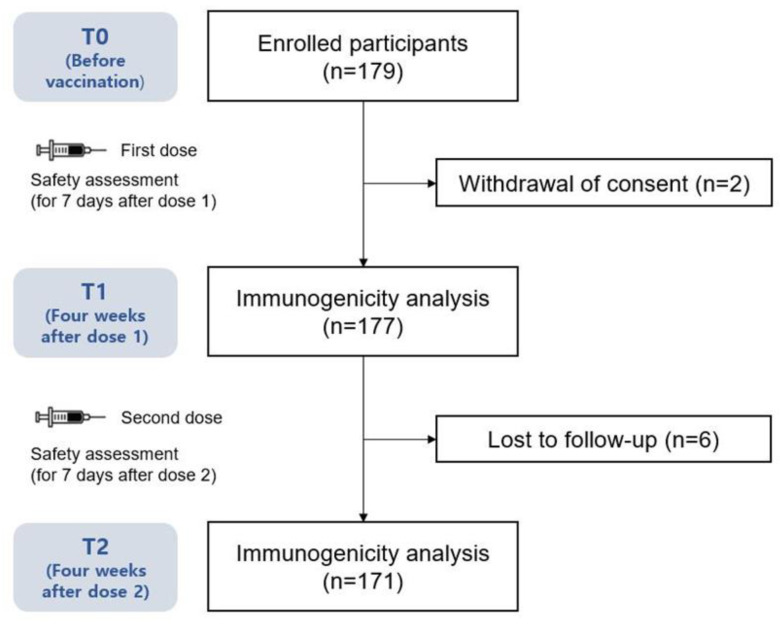
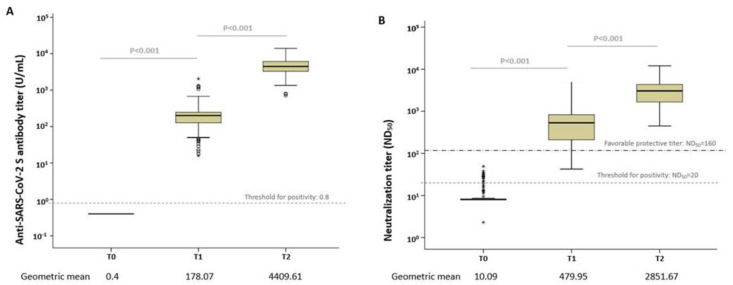
Messenger RNA (mRNA) vaccination was developed to mitigate the coronavirus disease 2019 pandemic. However, data on antibody kinetics and factors influencing these vaccines' immunogenicity are limited. We conducted a prospective study on healthy young adults who received two doses of the mRNA-1273 vaccine at 28-day intervals. After each dose, adverse events were prospectively evaluated, and blood samples were collected. The correlation between humoral immune response and reactogenicity after vaccination was determined. In 177 participants (19-55 years), the geometric mean titers of anti-S IgG antibody were 178.07 and 4409.61 U/mL, while those of 50% neutralizing titers were 479.95 and 2851.67 U/mL four weeks after the first and second vaccine doses, respectively. Anti-S IgG antibody titers were not associated with local reactogenicity but were higher in participants who experienced systemic adverse events (headache and muscle pain). Antipyretic use was an independent predictive factor of a robust anti-SARS-CoV-2 antibody response after receiving both vaccine doses. Systemic reactogenicity after the first dose influenced antibody response after the second dose. In conclusion, mRNA-1273 induced a robust antibody response in healthy young adults. Antipyretic use did not decrease the anti-SARS-CoV-2 antibody response after mRNA-1273 vaccination.
信使核糖核酸(mRNA)疫苗是为缓解2019年冠状病毒病大流行而研发的。然而,关于抗体动力学以及影响这些疫苗免疫原性的因素的数据有限。我们对健康的年轻成年人进行了一项前瞻性研究,这些人每隔28天接种两剂mRNA-1273疫苗。每次接种后,对不良事件进行前瞻性评估,并采集血样。确定了接种疫苗后体液免疫反应与反应原性之间的相关性。在177名参与者(19至55岁)中,第一剂和第二剂疫苗接种四周后,抗S IgG抗体的几何平均滴度分别为178.07和4409.61 U/mL,而50%中和滴度分别为479.95和2851.67 U/mL。抗S IgG抗体滴度与局部反应原性无关,但在经历全身不良事件(头痛和肌肉疼痛)的参与者中更高。使用退烧药是接种两剂疫苗后产生强大的抗SARS-CoV-2抗体反应的独立预测因素。第一剂后的全身反应原性影响第二剂后的抗体反应。总之,mRNA-1273在健康年轻成年人中诱导了强大的抗体反应。接种mRNA-1273疫苗后使用退烧药并未降低抗SARS-CoV-2抗体反应。