Department of Clinical Research, National Hospital Organization, Shinshu Ueda Medical Center, Japan.
Department of Infection Control, National Hospital Organization, Shinshu Ueda Medical Center, Japan.
Intern Med. 2022 Nov 1;61(21):3205-3210. doi: 10.2169/internalmedicine.9699-22. Epub 2022 Aug 20.
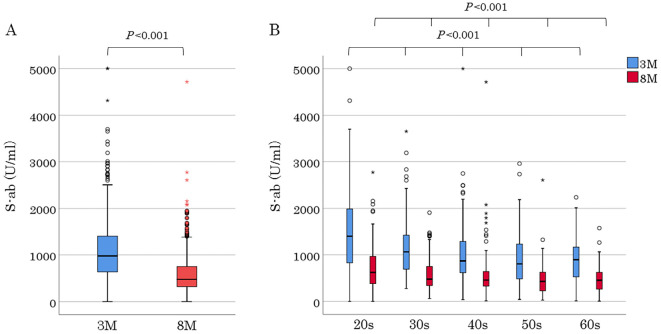
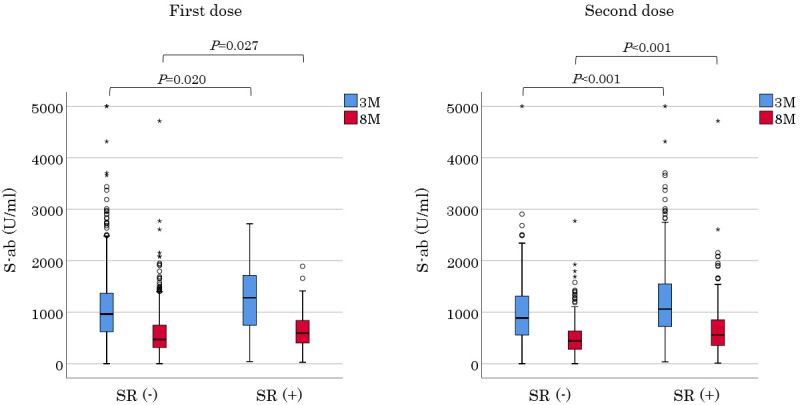
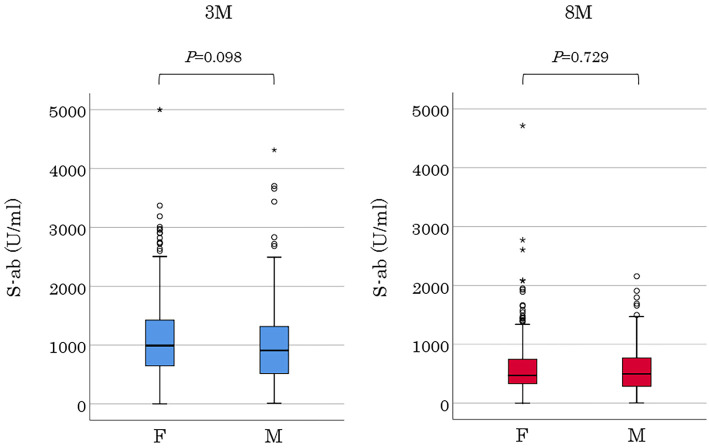
Objectives The influential factors for anti-severe acute respiratory syndrome coronavirus 2 spike protein antibody (S-ab) levels were assessed after the administration of BNT162b2 mRNA coronavirus disease-2019 (COVID-19) vaccine at short and medium terms. Methods A total of 470 healthcare workers (118 males, mean age 41.0±11.9 years) underwent serum S-ab level measurement at 3 and 8 months after two inoculations of BNT162b2 vaccine given 3 weeks apart, who had no history of COVID-19 were enrolled in this study. The changes and differences after vaccination due to gender and adverse reactions of S-ab were analyzed. Results Systemic adverse reactions incidence (48%) was significantly higher after the second dose than after the first dose (8%). S-ab levels decreased as the age increased (from the 20s to 60s) in both measurements. S-ab level 8 months after the second inoculation [median 476.3 (interquartile range (IQR) 322.4-750.6) U/mL] was significantly lower than that after 3 months [977.5 (637.2-1,409.0) U/mL; p<0.001]. The median decrease rate of S-ab levels in 5 months was 50.3% (IQR 40.3-62.6) and those differences were not observed among all generations. Gender-associated differences in S-ab levels were not observed; however, a significant relationship between higher S-ab levels and the systemic adverse reactions was observed at both measurements. Conclusions The systemic adverse reaction is an independent factor for higher S-ab levels at short and medium terms after BNT162b2 vaccination as demonstrated in our data.
评估在接种 BNT162b2 mRNA 疫苗后短期和中期内,影响针对严重急性呼吸综合征冠状病毒 2 刺突蛋白抗体(S-ab)水平的因素。
本研究共纳入 470 名医护人员(男 118 名,平均年龄 41.0±11.9 岁),他们在相隔 3 周的时间内接受了两剂 BNT162b2 疫苗接种,在接种后 3 个月和 8 个月测量血清 S-ab 水平,且均无 COVID-19 病史。分析接种疫苗后因性别和不良反应而导致的 S-ab 变化和差异。
第二次接种后的全身性不良反应发生率(48%)明显高于第一次接种(8%)。在两次测量中,S-ab 水平均随年龄增长而降低(从 20 多岁到 60 多岁)。第二次接种后 8 个月的 S-ab 水平[中位数 476.3(IQR 322.4-750.6)U/mL]明显低于 3 个月[977.5(637.2-1,409.0)U/mL;p<0.001]。5 个月内 S-ab 水平的中位下降率为 50.3%(IQR 40.3-62.6),且在所有年龄段中均未观察到差异。性别与 S-ab 水平之间无差异;然而,在两次测量中均观察到 S-ab 水平与全身性不良反应之间存在显著关系。
在我们的数据中,全身性不良反应是 BNT162b2 疫苗接种后短期和中期内 S-ab 水平升高的独立因素。