Infectious Diseases Department, Faculty of Medicine, Atatürk Training and Research Hospital, Katip Celebi University, Basin Sitesi/Karabaglar, 35360, Izmir, Turkey.
Anesthesia and Reanimation Department, Faculty of Medicine, Katip Celebi University, Izmir, Turkey.
Eur J Med Res. 2023 Jan 21;28(1):43. doi: 10.1186/s40001-023-01004-x.
There are limited data about nosocomial coinfections of COVID-19 cases monitored in the intensive care unit. This study aims to investigate coinfections in COVID-19 patients followed in an intensive care unit of a university hospital.
This study analyzed retrospectively the data of coinfections of 351 COVID-19 patients in the period 28.02.2020-15.01.2021 in a tertiary care intensive care unit in a university hospital.
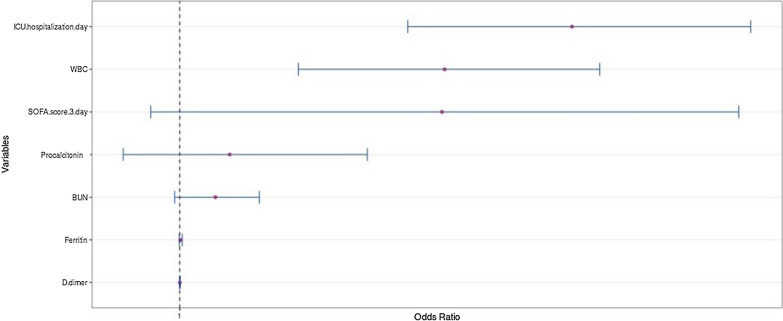
Bacterial coinfections were present in 216 of the 351 cases. One hundred and thirty of these cases were evaluated as nosocomial infections. On the third day the Sequential Organ Failure Assessment Score, usage of invasive mechanical ventilation and presence of septic shock were significantly higher in the coinfected group. The neutrophil/lymphocyte ratio, polymorphonuclear leukocyte count, procalcitonin, ferritin, and blood urea nitrogen values were significantly higher in the coinfection group. White blood cells (WBC) (OR: 1.075, 95% CI 1.032-1.121, p = 0.001) and ICU hospitalization day (OR: 1.114, 95% CI 1.063-1.167, p < 0.001) were found to be independent risk factors for coinfection in the multivariate logistic regression analysis. The rates of hospitalization day on the day of arrival, the 21st day, as well as total mortality (p = 0.004), were significantly higher in the coinfected group.
Bacterial coinfections of COVID-19 patients in the intensive care unit remain a problem. Identifying the infectious agent, classifying colonizations and infections, and using the proper treatment of antibiotics are of great importance in the case management of COVID-19 patients in the intensive care unit.
关于在重症监护病房监测的 COVID-19 病例的医院获得性合并感染,数据有限。本研究旨在调查一家大学医院重症监护病房 COVID-19 患者的合并感染情况。
本研究回顾性分析了 2020 年 2 月 28 日至 2021 年 1 月 15 日期间,一家三级护理大学医院重症监护病房的 351 例 COVID-19 患者的合并感染数据。
351 例患者中,有 216 例存在细菌合并感染。其中 130 例被评估为医院获得性感染。在第 3 天,合并感染组的序贯器官衰竭评估评分、有创机械通气使用率和感染性休克发生率明显更高。中性粒细胞/淋巴细胞比值、多形核白细胞计数、降钙素原、铁蛋白和血尿素氮值在合并感染组中明显更高。白细胞(WBC)(OR:1.075,95%CI 1.032-1.121,p=0.001)和重症监护病房住院天数(OR:1.114,95%CI 1.063-1.167,p<0.001)在多变量逻辑回归分析中被发现是合并感染的独立危险因素。在合并感染组中,入院当天、第 21 天和总死亡率(p=0.004)的住院天数明显更高。
重症监护病房 COVID-19 患者的细菌合并感染仍然是一个问题。在重症监护病房 COVID-19 患者的病例管理中,识别病原体、对定植和感染进行分类以及正确使用抗生素治疗非常重要。