Cappelletto Ambra, Allan Harriet E, Crescente Marilena, Schneider Edoardo, Bussani Rossana, Ali Hashim, Secco Ilaria, Vodret Simone, Simeone Roberto, Mascaretti Luca, Zacchigna Serena, Warner Timothy D, Giacca Mauro
British Heart Foundation Centre of Research Excellence, School of Cardiovascular Medicine & Sciences, King's College London, London, United Kingdom.
Barts and the London School of Medicine and Dentistry, Blizard Institute, Queen Mary University of London, London, United Kingdom.
Front Cardiovasc Med. 2023 Jan 4;9:1013262. doi: 10.3389/fcvm.2022.1013262. eCollection 2022.
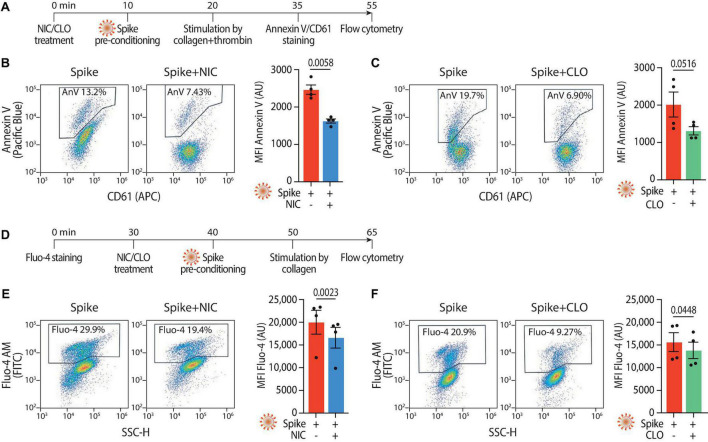
Thrombosis of the lung microvasculature is a characteristic of COVID-19 disease, which is observed in large excess compared to other forms of acute respiratory distress syndrome and thus suggests a trigger for thrombosis that is endogenous to the lung. Our recent work has shown that the SARS-CoV-2 Spike protein activates the cellular TMEM16F chloride channel and scramblase. Through a screening on >3,000 FDA/EMA approved drugs, we identified Niclosamide and Clofazimine as the most effective molecules at inhibiting Spike-induced TMEM16 activation. As TMEM16F plays an important role in stimulating the procoagulant activity of platelets, we investigated whether Spike directly affects platelet activation and pro-thrombotic function and tested the effect of Niclosamide and Clofazimine on these processes. Here we show that Spike, present either on the virion envelope or on the cell plasma membrane, promotes platelet activation, adhesion and spreading. Spike was active as a sole agonist or, even more effectively, by enhancing the function of known platelet activators. In particular, Spike-induced a marked procoagulant phenotype in platelets, by enhancing Ca flux, phosphatidylserine externalization on the platelet outer cell membrane, and thrombin generation. Eventually, this increased thrombin-induced clot formation and retraction. Both Niclosamide and Clofazimine blocked this Spike-induced procoagulant response. These findings provide a pathogenic mechanism to explain lung thrombosis-associated with severe COVID-19 infection. We propose that Spike, present in SARS-CoV-2 virions or exposed on the surface of infected cells in the lungs, enhances the effects of inflammation and leads to local platelet stimulation and subsequent activation of the coagulation cascade. As platelet TMEM16F is central in this process, these findings reinforce the rationale of repurposing Niclosamide for COVID-19 therapy.
肺微血管血栓形成是新冠病毒疾病的一个特征,与其他形式的急性呼吸窘迫综合征相比,其发生率极高,因此提示存在一种源自肺部的血栓形成触发因素。我们最近的研究表明,新冠病毒刺突蛋白可激活细胞的TMEM16F氯通道和磷脂翻转酶。通过对3000多种美国食品药品监督管理局/欧洲药品管理局批准的药物进行筛选,我们确定氯硝柳胺和氯法齐明是抑制刺突蛋白诱导的TMEM16激活最有效的分子。由于TMEM16F在刺激血小板促凝血活性中起重要作用,我们研究了刺突蛋白是否直接影响血小板激活和促血栓形成功能,并测试了氯硝柳胺和氯法齐明对这些过程的影响。在此我们表明,存在于病毒粒子包膜或细胞质膜上的刺突蛋白可促进血小板激活、黏附和铺展。刺突蛋白作为单一激动剂具有活性,或者更有效地是通过增强已知血小板激活剂的功能来发挥作用。特别是,刺突蛋白通过增强钙通量、使血小板外细胞膜上的磷脂酰丝氨酸外翻以及凝血酶生成,在血小板中诱导出明显的促凝血表型。最终,这增加了凝血酶诱导的血栓形成和收缩。氯硝柳胺和氯法齐明均可阻断这种刺突蛋白诱导的促凝血反应。这些发现提供了一种致病机制,以解释与严重新冠病毒感染相关的肺血栓形成。我们提出,存在于新冠病毒粒子中或暴露于肺部感染细胞表面的刺突蛋白会增强炎症作用,导致局部血小板刺激以及随后凝血级联反应的激活。由于血小板TMEM16F在这一过程中起核心作用,这些发现强化了将氯硝柳胺重新用于新冠病毒治疗的理论依据。