Tonelli Michele, Sparatore Anna, Bassanini Ivan, Francesconi Valeria, Sparatore Fabio, Maina Kevin K, Delbue Serena, D'Alessandro Sarah, Parapini Silvia, Basilico Nicoletta
Dipartimento di Farmacia, Università degli Studi di Genova, Viale Benedetto XV, 3, 16132 Genova, Italy.
Dipartimento di Scienze Farmaceutiche, Università degli Studi di Milano, Via Mangiagalli 25, 20133 Milano, Italy.
Pharmaceuticals (Basel). 2024 Dec 11;17(12):1668. doi: 10.3390/ph17121668.
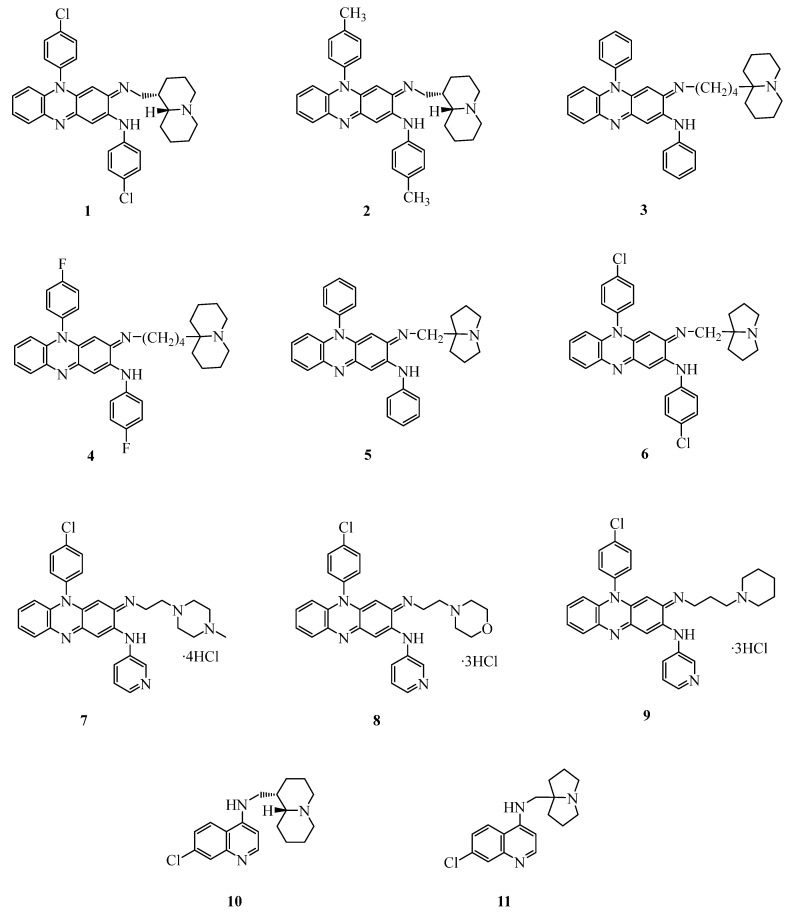
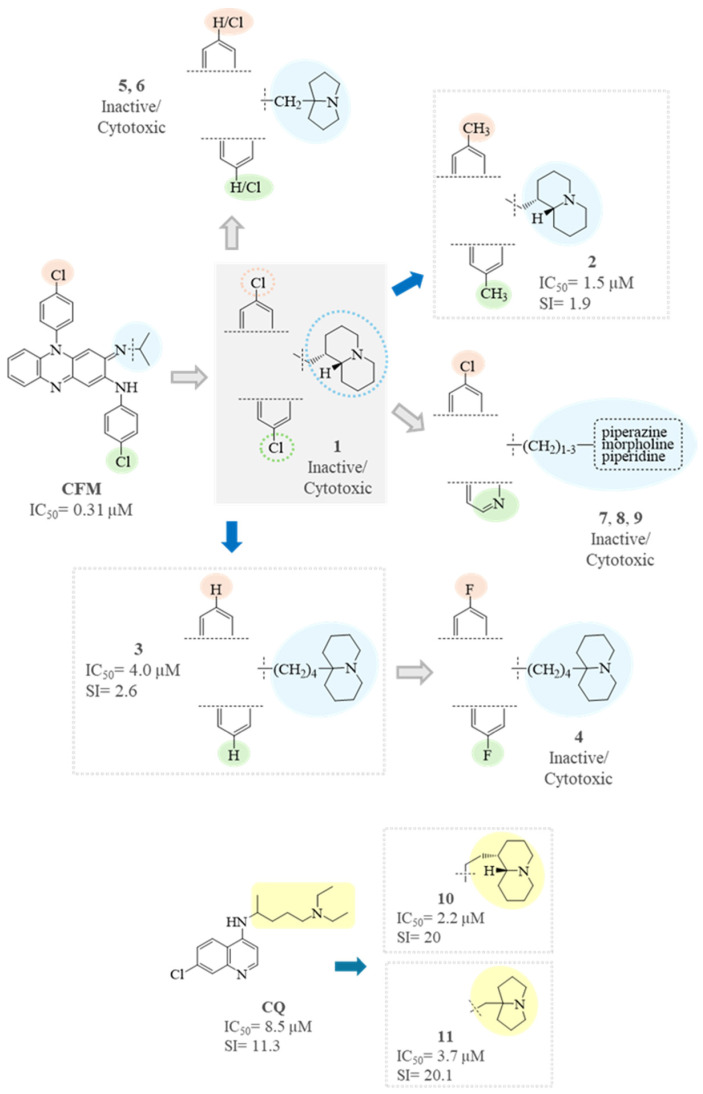
Four years after the COVID-19 pandemic, a very limited number of drugs has been marketed; thus, the search for new medications still represents a compelling need. In our previous work on antiviral, antiparasitic, and antiproliferative agents, we described several compounds (- and -) structurally related to clofazimine, chloroquine, and benzimidazole derivatives. Thus, we deemed it worthwhile to test them against the replication of SARS-CoV-2, together with a few other compounds (, and -), which showed some analogy to miscellaneous anti-coronavirus agents. : Twenty-five structurally assorted compounds were evaluated in vitro for cytotoxicity against Vero E6 and for their ability to inhibit SARS-CoV-2 replication. : Several compounds (, , , , -, -) demonstrated antiviral activity (IC range 1.5-28 µM) and six of them exhibited an interesting selectivity index in the range 4.5-20. The chloroquine analogs and were more potent than the reference chloroquine itself and doubled its SI value (20 versus 11). Also, the benzimidazole ring emerged as a valuable scaffold, originating several compounds (- and -) endowed with anti-SARS-CoV-2 activity. Despite the modest activity, the cytisine and the arylamino enone derivatives and , respectively, also deserve further consideration as model compounds. : The investigated chemotypes may represent valuable hit compounds, deserving further in-depth biological studies to define their mechanisms of action. The derived information will guide the subsequent chemical optimization towards the development of more efficient anti-SARS-CoV-2 agents.
在新冠疫情爆发四年后,上市的药物数量非常有限;因此,寻找新药物仍然是迫切需求。在我们之前关于抗病毒、抗寄生虫和抗增殖剂的研究中,我们描述了几种与氯法齐明、氯喹和苯并咪唑衍生物结构相关的化合物(- 和 -)。因此,我们认为值得将它们与其他几种与各类抗冠状病毒药物有一定相似性的化合物(、 和 -)一起针对严重急性呼吸综合征冠状病毒2(SARS-CoV-2)的复制进行测试。:对25种结构各异的化合物进行了体外细胞毒性评估,以确定它们对非洲绿猴肾细胞系(Vero E6)的细胞毒性以及抑制SARS-CoV-2复制的能力。:几种化合物(、 、 、 、 -、 -)表现出抗病毒活性(半数抑制浓度(IC)范围为1.5 - 28 μM),其中六种化合物的选择性指数在4.5 - 20范围内,表现出有趣的特性。氯喹类似物 和 比参考药物氯喹本身更有效,其选择性指数值翻倍(分别为20和11)。此外,苯并咪唑环被证明是一种有价值的骨架,产生了几种具有抗SARS-CoV-2活性的化合物(- 和 -)。尽管金雀花碱以及芳基氨基烯酮衍生物 和 的活性一般,但它们作为模型化合物也值得进一步研究。:所研究的化学类型可能代表有价值的先导化合物,值得进一步深入开展生物学研究以确定其作用机制。所获得的信息将指导后续的化学优化,以开发更有效的抗SARS-CoV-2药物。