Dalmasso María C, Arán Martín, Galeano Pablo, Perin Silvina, Giavalisco Patrick, Martino Adami Pamela V, Novack Gisela V, Castaño Eduardo M, Cuello A Claudio, Scherer Martin, Maier Wolfgang, Wagner Michael, Riedel-Heller Steffi, Ramirez Alfredo, Morelli Laura
Laboratory of Brain Aging and Neurodegeneration-Fundación Instituto Leloir-IIBBA-National Scientific and Technical Research Council (CONICET). Ciudad Autónoma de Buenos Aires, Buenos Aires, Argentina.
Division of Neurogenetics and Molecular Psychiatry, Department of Psychiatry and Psychotherapy, Faculty of Medicine and University Hospital Cologne, University of Cologne, Cologne, Germany.
Front Mol Biosci. 2023 Jan 6;9:1067296. doi: 10.3389/fmolb.2022.1067296. eCollection 2022.
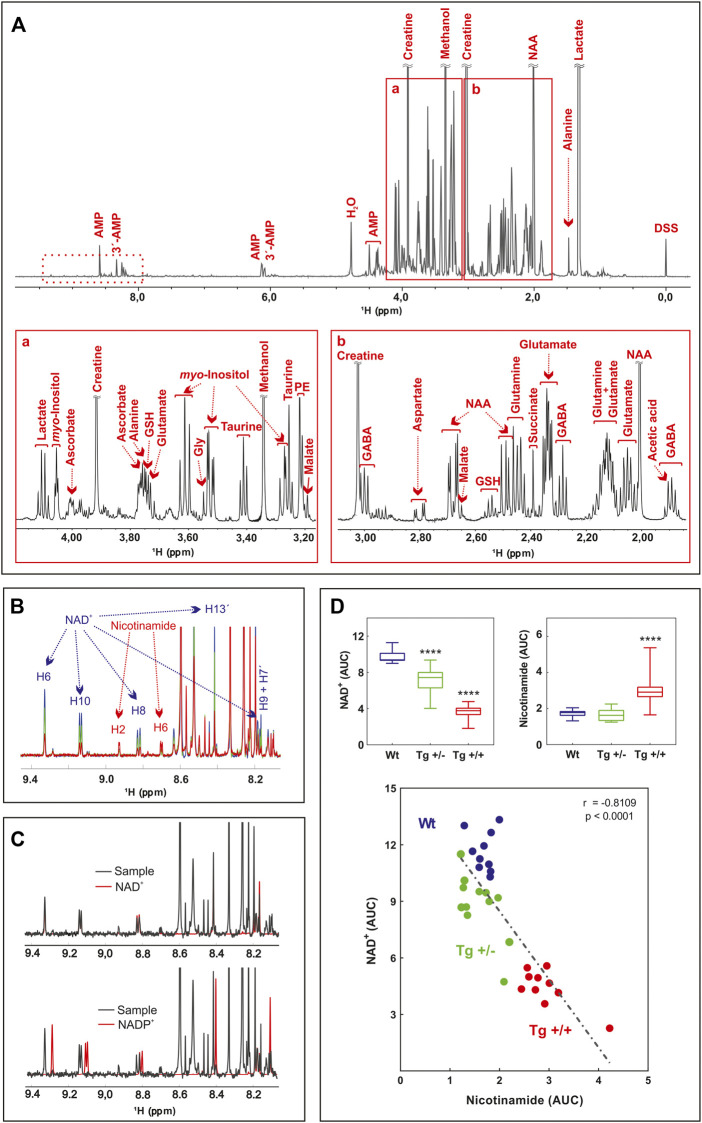
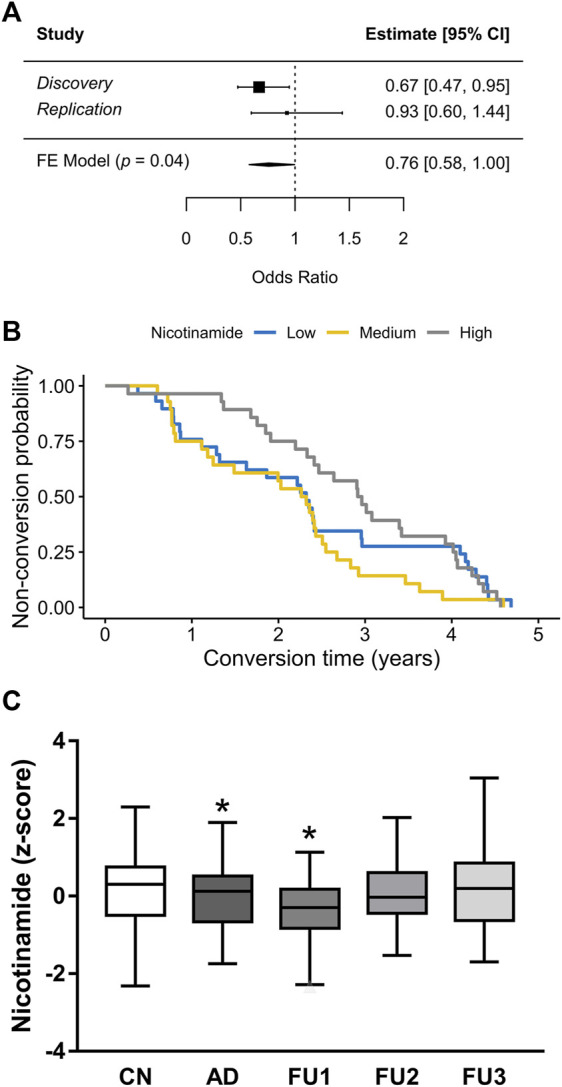
The metabolic routes altered in Alzheimer's disease (AD) brain are poorly understood. As the metabolic pathways are evolutionarily conserved, the metabolic profiles carried out in animal models of AD could be directly translated into human studies. We performed untargeted Nuclear Magnetic Resonance metabolomics in hippocampus of McGill-R-Thy1-APP transgenic (Tg) rats, a model of AD-like cerebral amyloidosis and the translational potential of these findings was assessed by targeted Gas Chromatography-Electron Impact-Mass Spectrometry in plasma of participants in the German longitudinal cohort AgeCoDe. In rat hippocampus 26 metabolites were identified. Of these 26 metabolites, nine showed differences between rat genotypes that were nominally significant. Two of them presented partial least square-discriminant analysis (PLS-DA) loadings with the larger absolute weights and the highest Variable Importance in Projection (VIP) scores and were specifically assigned to nicotinamide adenine dinucleotide (NAD) and nicotinamide (Nam). NAD levels were significantly decreased in Tg rat brains as compared to controls. In agreement with these results, plasma of AD patients showed significantly reduced levels of Nam in respect to cognitively normal participants. In addition, high plasma levels of Nam showed a 27% risk reduction of progressing to AD dementia within the following 2.5 years, this hazard ratio is lost afterwards. To our knowledge, this is the first report showing that a decrease of Nam plasma levels is observed couple of years before conversion to AD, thereby suggesting its potential use as biomarker for AD progression.
人们对阿尔茨海默病(AD)大脑中改变的代谢途径了解甚少。由于代谢途径在进化上是保守的,因此在AD动物模型中进行的代谢谱分析结果可以直接转化应用于人体研究。我们对麦吉尔-R-Thy1-APP转基因(Tg)大鼠的海马体进行了非靶向核磁共振代谢组学研究,该大鼠是一种类似AD脑淀粉样变性的模型,并通过靶向气相色谱-电子轰击-质谱法对德国纵向队列AgeCoDe参与者的血浆进行分析,评估了这些研究结果的转化潜力。在大鼠海马体中鉴定出26种代谢物。在这26种代谢物中,有9种在大鼠基因型之间存在名义上显著的差异。其中两种代谢物在偏最小二乘判别分析(PLS-DA)中的载荷具有较大的绝对权重和最高的投影变量重要性(VIP)得分,分别被明确鉴定为烟酰胺腺嘌呤二核苷酸(NAD)和烟酰胺(Nam)。与对照组相比,Tg大鼠大脑中的NAD水平显著降低。与这些结果一致,AD患者血浆中的Nam水平相对于认知正常的参与者显著降低。此外,血浆中Nam水平较高表明在接下来的2.5年内发展为AD痴呆症的风险降低了27%,但之后这种风险比就消失了。据我们所知,这是第一份报告表明在转化为AD的前几年观察到血浆Nam水平下降,从而表明其作为AD进展生物标志物的潜在用途。