Chen Wenhui, Zhang Xiaotao, Parmar Chetan, Wang Yucheng, Yang Wah, Pan Jiyang, Dong Zhiyong, Wang Cunchuan
Department of Bariatric Surgery, The First Affiliated Hospital of Jinan University, Guangzhou, China.
Department of Respiratory and Sleep, The First Affiliated Hospital of Jinan University, Guangzhou, China.
J Metab Bariatr Surg. 2021 Jun;10(1):14-22. doi: 10.17476/jmbs.2021.10.1.14. Epub 2021 Jun 30.
The purpose of the study is to determine the prevalence and predictors of OSA in Chinese bariatric surgery candidates.
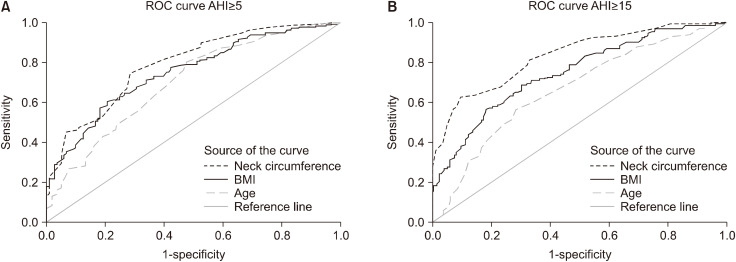
The clinical data were collected from 326 patients evaluated for bariatric surgery and referred for polysomnography. Multiple logistic regression was used for identifying independent predictors of presence of OSA and ROC curve analysis to determine the best cut-off value for continuous variable.
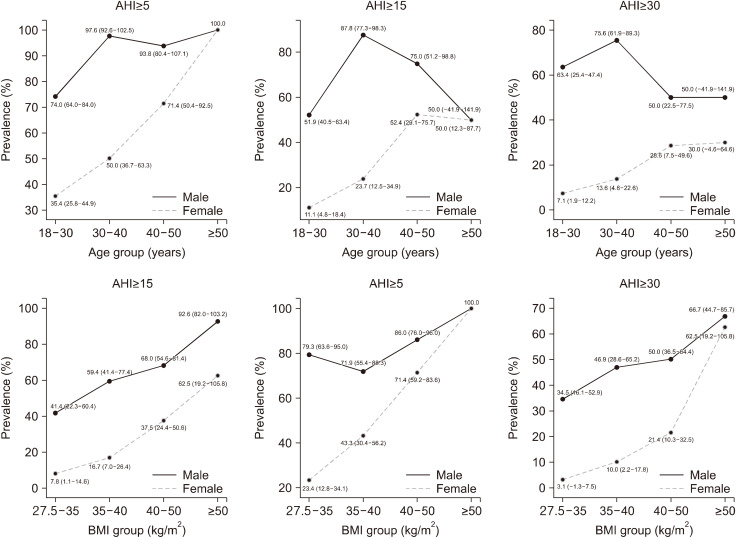
Baseline BMI and age were 33.3±3.7 kg/m and 24.3±3.1 years. 62.9% of the patients fulfilled the diagnostic criteria for OSA; Of these, 22.7% had mild OSA; 11.3% had moderate OSA, and 28.8% had severe OSA. The prevalence was significantly higher in males (84.2%) than in females (47.3%) (P<0.001). The superobese patients and the obese patients aged older than 50 years that all of those were diagnosed with OSA. A multivariate logistic regression model displayed that increasing age, BMI and neck circumference together with presence of habitual snoring and male sex were identified as risk factors of OSA. The best cut-off values for the presence of OSA for age, BMI, neck circumference were 24.5 years, 39.45 kg/m, 40.40 cm.
The prevalence of OSA is very prevalent (62.9%) in Chinese bariatric surgery candidates, especially in male patients (84%). Age, BMI and neck circumference together with presence of habitual snoring and male sex are independent predictors of OSA in these patients. As clinical predictors are not enough to be a properly screening for OSA, routine PSG testing should be recommended to bariatric surgery candidates.
本研究旨在确定中国肥胖症手术候选患者中阻塞性睡眠呼吸暂停(OSA)的患病率及预测因素。
收集326例接受肥胖症手术评估并转诊进行多导睡眠图检查的患者的临床资料。采用多因素逻辑回归分析确定OSA存在的独立预测因素,并通过ROC曲线分析确定连续变量的最佳截断值。
基线体重指数(BMI)和年龄分别为33.3±3.7kg/m²和24.3±3.1岁。62.9%的患者符合OSA诊断标准;其中,22.7%为轻度OSA,11.3%为中度OSA,28.8%为重度OSA。男性患病率(84.2%)显著高于女性(47.3%)(P<0.001)。所有超肥胖患者及年龄大于50岁的肥胖患者均被诊断为OSA。多因素逻辑回归模型显示,年龄增加、BMI和颈围增大以及习惯性打鼾和男性性别是OSA的危险因素。年龄、BMI、颈围诊断OSA的最佳截断值分别为24.5岁、39.45kg/m²、40.40cm。
中国肥胖症手术候选患者中OSA患病率很高(62.9%),尤其是男性患者(84%)。年龄、BMI、颈围以及习惯性打鼾和男性性别是这些患者OSA的独立预测因素。由于临床预测因素不足以对OSA进行充分筛查,建议对肥胖症手术候选患者进行常规多导睡眠图检查。