Laboratory of Retrovirology, Rockefeller University, New York, United States.
Howard Hughes Medical Institute, The Rockefeller University, New York, New York, United States.
Elife. 2023 Jan 23;12:e83548. doi: 10.7554/eLife.83548.
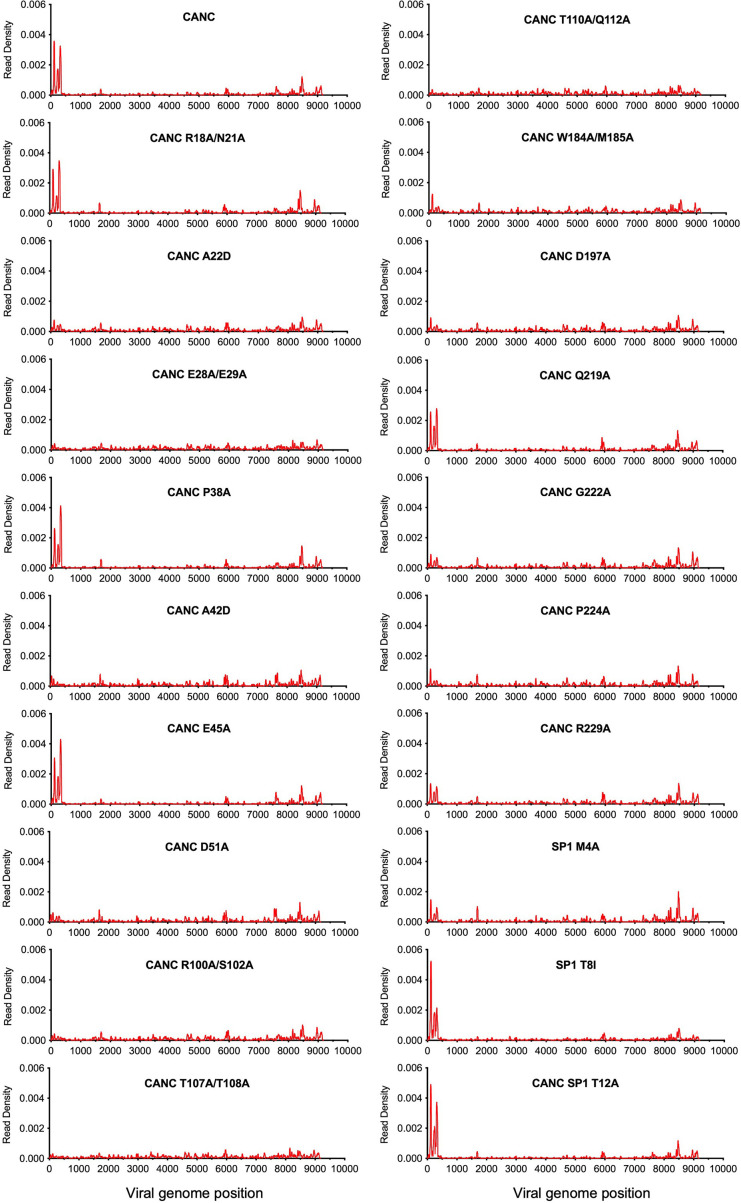
The encapsidation of HIV-1 gRNA into virions is enabled by the binding of the nucleocapsid (NC) domain of the HIV-1 Gag polyprotein to the structured viral RNA packaging signal (Ψ) at the 5' end of the viral genome. However, the subcellular location and oligomeric status of Gag during the initial Gag-Ψ encounter remain uncertain. Domains other than NC, such as capsid (CA), may therefore indirectly affect RNA recognition. To investigate the contribution of Gag domains to Ψ recognition in a cellular environment, we performed protein-protein crosslinking and protein-RNA crosslinking immunoprecipitation coupled with sequencing (CLIP-seq) experiments. We demonstrate that NC alone does not bind specifically to Ψ in living cells, whereas full-length Gag and a CANC subdomain bind to Ψ with high specificity. Perturbation of the Ψ RNA structure or NC zinc fingers affected CANC:Ψ binding specificity. Notably, CANC variants with substitutions that disrupt CA:CA dimer, trimer, or hexamer interfaces in the immature Gag lattice also affected RNA binding, and mutants that were unable to assemble a nascent Gag lattice were unable to specifically bind to Ψ. Artificially multimerized NC domains did not specifically bind Ψ. CA variants with substitutions in inositol phosphate coordinating residues that prevent CA hexamerization were also deficient in Ψ binding and second-site revertant mutants that restored CA assembly also restored specific binding to Ψ. Overall, these data indicate that the correct assembly of a nascent immature CA lattice is required for the specific interaction between Gag and Ψ in cells.
HIV-1 gRNA 的包装是通过 HIV-1 Gag 多聚蛋白的核衣壳(NC)结构域与病毒基因组 5' 端的结构病毒 RNA 包装信号(Ψ)结合来实现的。然而,在最初的 Gag-Ψ 相互作用过程中,Gag 的亚细胞定位和寡聚状态仍然不确定。因此,NC 以外的结构域,如衣壳(CA),可能会间接影响 RNA 的识别。为了在细胞环境中研究 Gag 结构域对 Ψ 识别的贡献,我们进行了蛋白质-蛋白质交联和蛋白质-RNA 交联免疫沉淀结合测序(CLIP-seq)实验。我们证明,NC 本身并不能在活细胞中特异性结合 Ψ,而全长 Gag 和 CANC 亚结构域则以高特异性结合 Ψ。Ψ RNA 结构或 NC 锌指的扰动会影响 CANC:Ψ 结合特异性。值得注意的是,破坏不成熟 Gag 晶格中 CA:CA 二聚体、三聚体或六聚体界面的 CANC 变体也会影响 RNA 结合,并且无法组装成核蛋白晶格的突变体无法特异性结合 Ψ。人工多聚化的 NC 结构域不能特异性地结合 Ψ。在肌醇磷酸盐配位残基中发生取代的 CA 变体,这些取代阻止 CA 六聚体形成,也不能结合 Ψ,并且恢复 CA 组装的第二位点回复突变体也恢复了对 Ψ 的特异性结合。总的来说,这些数据表明,在细胞中,新生不成熟 CA 晶格的正确组装是 Gag 和 Ψ 之间特异性相互作用所必需的。