Division of Oncology, Department of Medicine, Washington University School of Medicine in St. Louis, Missouri.
Division of Public Health Science, Department of Surgery, Biostatistics Shared Resource, Washington University in St. Louis, Missouri.
Clin Cancer Res. 2023 May 1;29(9):1719-1729. doi: 10.1158/1078-0432.CCR-22-2177.
Clinical biomarkers to identify patients unlikely to benefit from CDK4/6 inhibition (CDK4/6i) in combination with endocrine therapy (ET) are lacking. We implemented a comprehensive circulating tumor DNA (ctDNA) analysis to identify genomic features for predicting and monitoring treatment resistance.
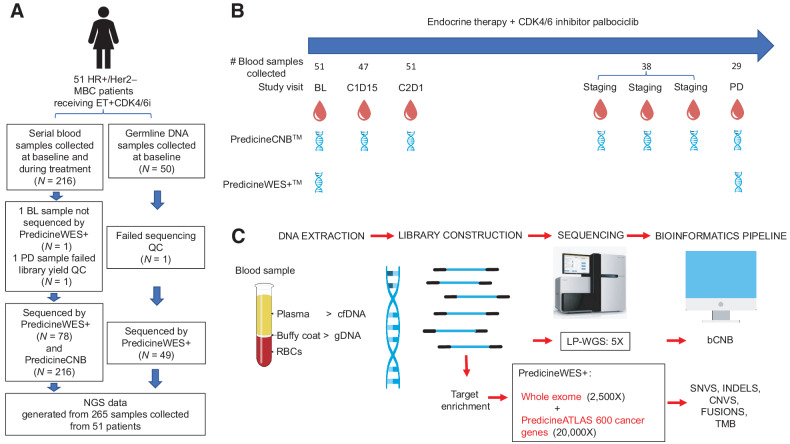
ctDNA was isolated from 216 plasma samples collected from 51 patients with hormone receptor-positive (HR+)/HER2-negative (HER2-) metastatic breast cancer (MBC) on a phase II trial of palbociclib combined with letrozole or fulvestrant (NCT03007979). Boosted whole-exome sequencing (WES) was performed at baseline and clinical progression to evaluate genomic alterations, mutational signatures, and blood tumor mutational burden (bTMB). Low-pass whole-genome sequencing was performed at baseline and serial timepoints to assess blood copy-number burden (bCNB).
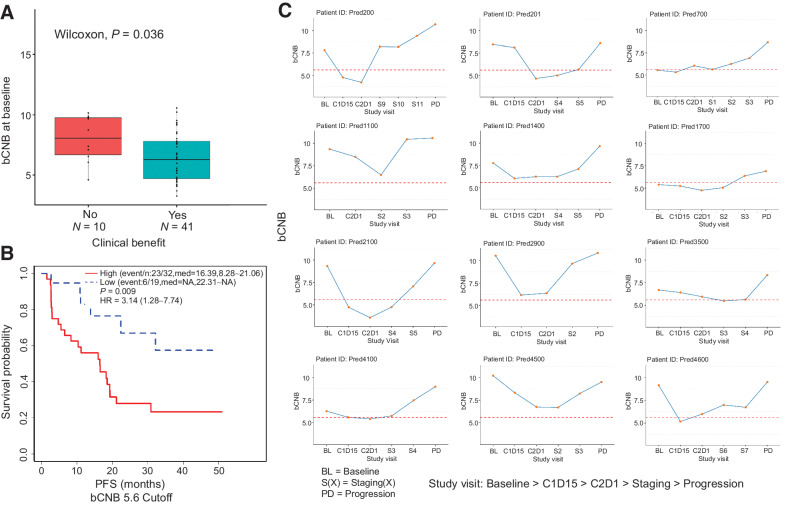
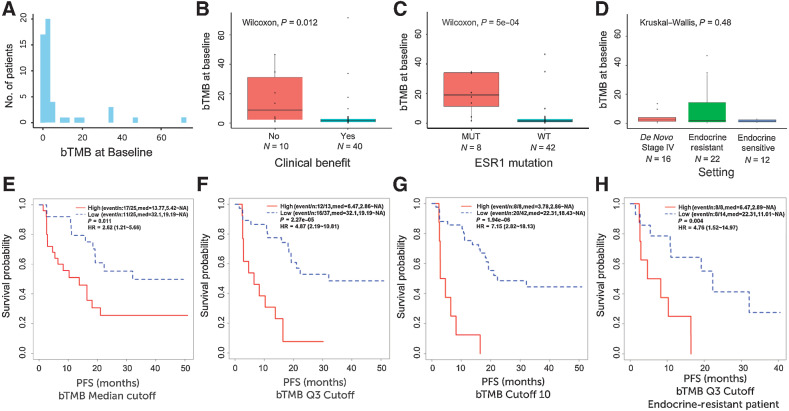
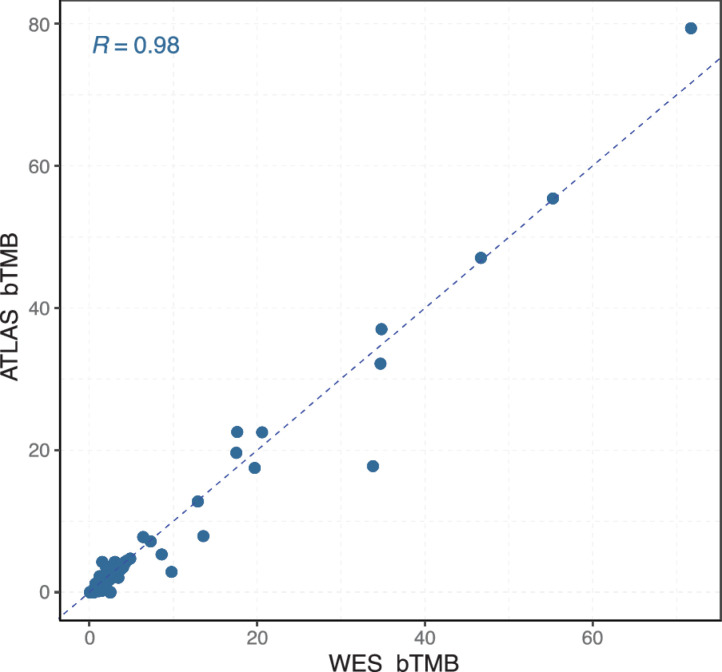
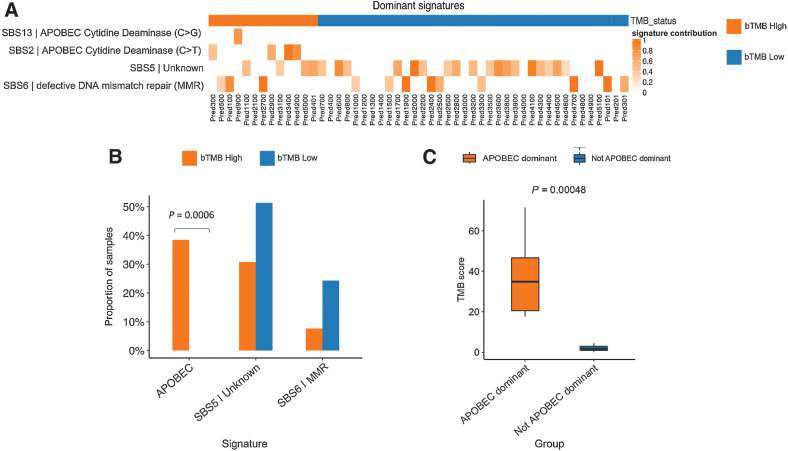
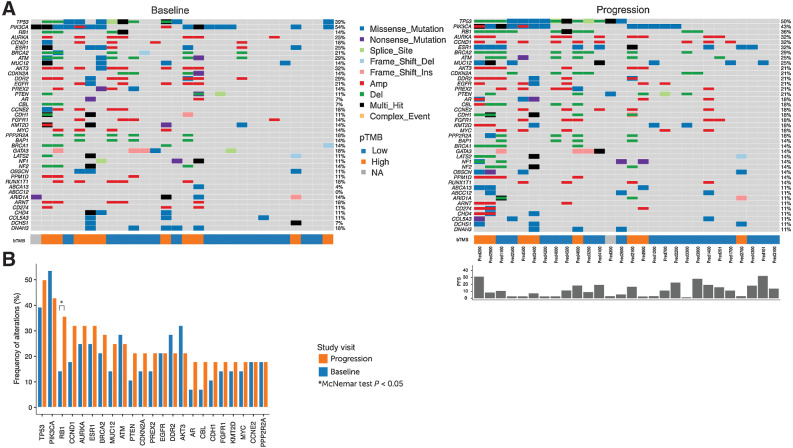
High bTMB and bCNB were associated with lack of clinical benefit and significantly shorter progression-free survival (PFS) compared with patients with low bTMB or low bCNB (all P < 0.05). Dominant APOBEC signatures were detected at baseline exclusively in cases with high bTMB (5/13, 38.5%) versus low bTMB (0/37, 0%; P = 0.0006). Alterations in ESR1 were enriched in samples with high bTMB (P = 0.0005). There was a high correlation between bTMB determined by WES and bTMB determined using a 600-gene panel (R = 0.98). During serial monitoring, an increase in bCNB score preceded radiographic progression in 12 of 18 (66.7%) patients.
Genomic complexity detected by noninvasive profiling of bTMB and bCNB predicted poor outcomes in patients treated with ET and CDK4/6i and identified early disease progression before imaging. Novel treatment strategies including immunotherapy-based combinations should be investigated in this population.
缺乏用于识别不太可能从 CDK4/6 抑制(CDK4/6i)联合内分泌治疗(ET)中获益的患者的临床生物标志物。我们实施了全面的循环肿瘤 DNA(ctDNA)分析,以确定预测和监测治疗耐药性的基因组特征。
对 51 例激素受体阳性(HR+)/HER2 阴性(HER2-)转移性乳腺癌(MBC)患者的 216 个血浆样本进行 ctDNA 分离,这些患者参加了 palbociclib 联合来曲唑或氟维司群的 II 期试验(NCT03007979)。在基线和临床进展时进行了增强型全外显子组测序(WES),以评估基因组改变、突变特征和血液肿瘤突变负担(bTMB)。在基线和连续时间点进行低通全基因组测序,以评估血液拷贝数负担(bCNB)。
高 bTMB 和 bCNB 与缺乏临床获益以及显著较短的无进展生存期(PFS)相关,与低 bTMB 或低 bCNB 的患者相比(所有 P<0.05)。仅在高 bTMB(5/13,38.5%)而非低 bTMB(0/37,0%)的病例中,基线时检测到主导的 APOBEC 特征(P=0.0006)。ESR1 改变在高 bTMB 样本中富集(P=0.0005)。WES 确定的 bTMB 与使用 600 基因面板确定的 bTMB 高度相关(R=0.98)。在连续监测期间,在 18 例(66.7%)患者中,bCNB 评分的增加先于影像学进展。
通过非侵入性 bTMB 和 bCNB 谱分析检测到的基因组复杂性预测了接受 ET 和 CDK4/6i 治疗的患者的不良结局,并在影像学之前识别出早期疾病进展。应在该人群中研究包括免疫治疗联合在内的新型治疗策略。