Translational Sciences and Diagnostics, Translation Medicine, Bristol Myers Squibb, Summit, New Jersey, United States of America.
Translational Bioinformatics, Informatics and Predictive Sciences, Bristol Myers Squibb, Summit, New Jersey, United States of America.
PLoS One. 2022 Apr 28;17(4):e0266889. doi: 10.1371/journal.pone.0266889. eCollection 2022.
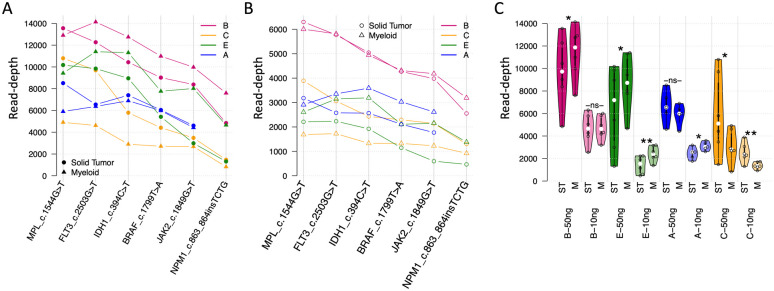
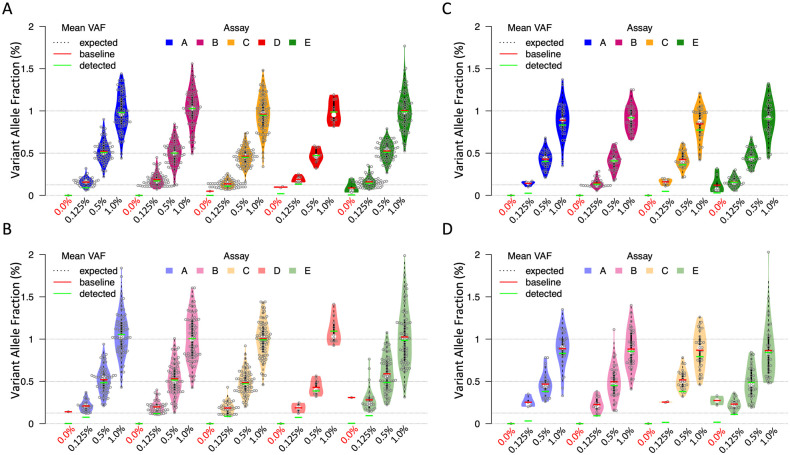
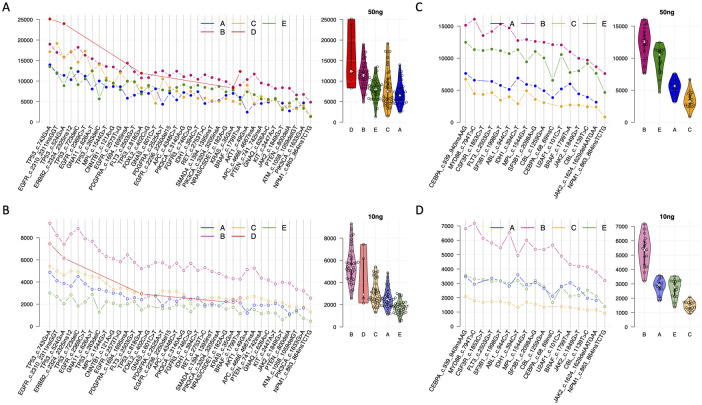
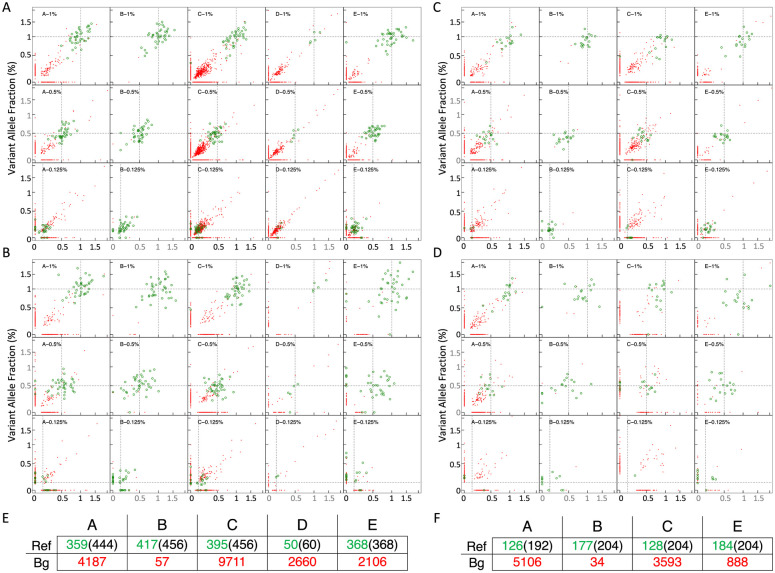
Next generation sequencing (NGS) assays with large targeted gene panels can comprehensively profile cancer somatic mutations in a tumor sample. Given the rapid adoption of such assays for circulating tumor DNA (ctDNA) analysis in clinical oncology, it is essential for the community to understand their analytical performance in liquid biopsy settings. Here, we directly compared five ctDNA NGS assays, most of which having a panel of 400 or more genes, with simulated samples harboring mutations relevant to solid tumors or myeloid malignancy. Our results indicate that the detection sensitivity and reproducibility of all five assays was 90% or higher when the mutations were at 0.5% or 1.0% allele frequency, and with optimal DNA input of 30 ng or 50 ng per vendor's protocol. The performances decreased and varied dramatically, when mutations were at a 0.1% allele frequency and/or when a lower genomic input of 10 ng DNA was used. Interestingly, one of the assays repeatedly showed higher rate of false positivity than the others across two different sample sets. Multiple intrinsic technical factors pertaining to the NGS assays were further investigated. Notable differences among the assays were seen for depth of coverage and background noise, which profoundly impacted assay performance. The results derived from this study are highly informative and provide a framework to assess and select suitable assays for specific application in cancer monitoring and potential clinical use.
下一代测序(NGS)检测技术与大型靶向基因检测面板可以全面检测肿瘤样本中的癌症体细胞突变。鉴于此类检测技术在临床肿瘤学中对循环肿瘤 DNA(ctDNA)分析的快速采用,了解其在液体活检环境中的分析性能对整个领域至关重要。在此,我们直接比较了五种 ctDNA NGS 检测技术,其中大多数的检测面板都有 400 个或更多的基因,这些检测技术针对的是模拟样本中的与实体瘤或髓系恶性肿瘤相关的突变。我们的结果表明,当突变等位基因频率为 0.5%或 1.0%,且按照每个供应商的方案最佳输入量为 30ng 或 50ng 时,所有五种检测技术的检测灵敏度和重现性都在 90%或更高。当突变等位基因频率为 0.1%,或使用 10ng DNA 等较低的基因组输入时,性能会下降且差异显著。有趣的是,有一个检测技术在两个不同的样本组中都表现出比其他技术更高的假阳性率。我们进一步研究了与 NGS 检测技术相关的多个内在技术因素。在覆盖深度和背景噪声方面,检测技术之间存在显著差异,这对检测技术的性能有深远的影响。本研究的结果提供了一个评估和选择合适的检测技术的框架,以用于癌症监测和潜在临床应用的特定目的。