Laboratory of Virology, Department of Translational Physiology, Infectiology and Public Health, Faculty of Veterinary Medicine, Ghent University, Salisburylaan 133, 9820, Merelbeke, Belgium.
Laboratory of Veterinary Pathology, Faculty of Veterinary Medicine, Ghent University, Salisburylaan 133, 9820, Merelbeke, Belgium.
Vet Res. 2023 Jan 24;54(1):4. doi: 10.1186/s13567-022-01133-x.
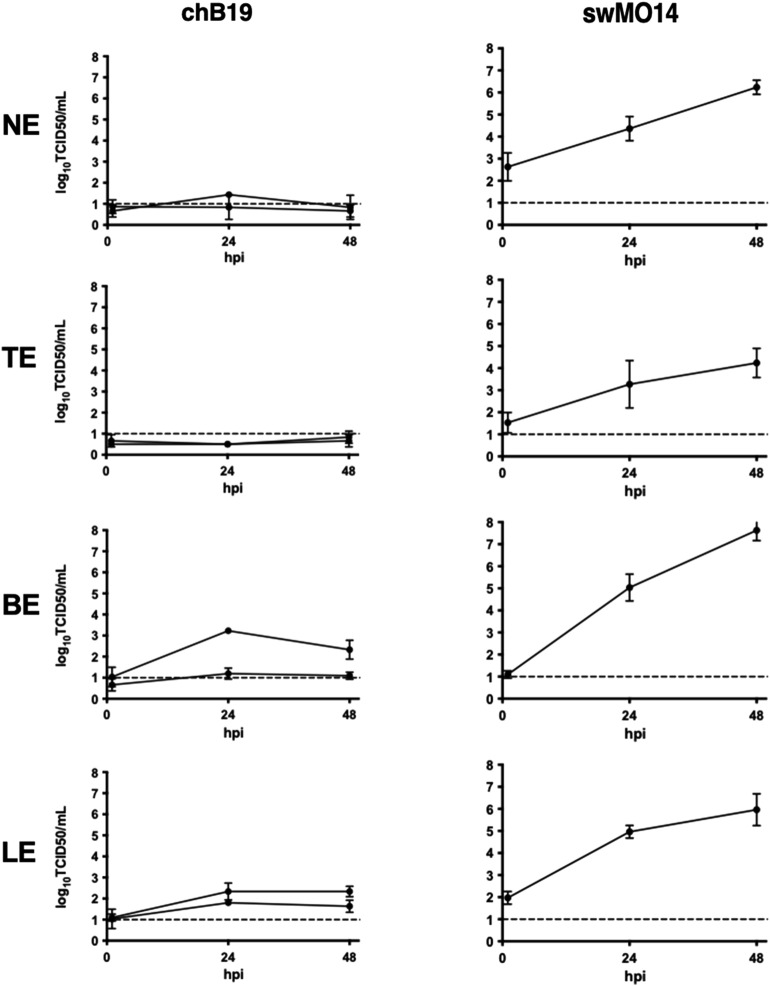
In 2019 a low pathogenic H3N1 avian influenza virus (AIV) caused an outbreak in Belgian poultry farms, characterized by an unusually high mortality in chickens. Influenza A viruses of the H1 and H3 subtype can infect pigs and become established in swine populations. Therefore, the H3N1 epizootic raised concern about AIV transmission to pigs and from pigs to humans. Here, we assessed the replication efficiency of this virus in explants of the porcine respiratory tract and in pigs, using virus titration and/or RT-qPCR. We also examined transmission from directly, intranasally inoculated pigs to contact pigs. The H3N1 AIV replicated to moderate titers in explants of the bronchioles and lungs, but not in the nasal mucosa or trachea. In the pig infection study, infectious virus was only detected in a few lung samples collected between 1 and 3 days post-inoculation. Virus titers were between 1.7 and 4.8 log TCID. In line with the ex vivo experiment, no virus was isolated from the upper respiratory tract of pigs. In the transmission experiment, we could not detect virus transmission from directly inoculated to contact pigs. An increase in serum antibody titers was observed only in the inoculated pigs. We conclude that the porcine respiratory tract tissue explants can be a useful tool to assess the replication efficiency of AIVs in pigs. The H3N1 AIV examined here is unlikely to pose a risk to swine populations. However, continuous risk assessment studies of emerging AIVs in pigs are necessary, since different virus strains will have different genotypic and phenotypic traits.
2019 年,低致病性 H3N1 禽流感病毒(AIV)在比利时家禽养殖场引发疫情,其特征是鸡的死亡率异常高。H1 和 H3 亚型的流感病毒可感染猪,并在猪群中建立。因此,H3N1 爆发引起了对 AIV 传播给猪以及从猪传播给人类的关注。在这里,我们使用病毒滴定和/或 RT-qPCR 评估了该病毒在猪呼吸道外植体和猪中的复制效率。我们还检查了直接经鼻腔接种的猪向接触猪的传播情况。H3N1 AIV 在细支气管和肺的外植体中复制到中等滴度,但在鼻黏膜或气管中不复制。在猪感染研究中,仅在接种后 1 至 3 天收集的少数肺样本中检测到感染性病毒。病毒滴度在 1.7 到 4.8 logTCID 之间。与离体实验一致,猪上呼吸道未分离到病毒。在传播实验中,我们无法从直接接种的猪检测到病毒传播到接触猪。仅在接种猪中观察到血清抗体滴度增加。我们得出结论,猪呼吸道组织外植体可以作为评估 AIV 在猪中的复制效率的有用工具。这里研究的 H3N1 AIV 不太可能对猪群构成风险。然而,需要对猪中新兴 AIV 进行持续的风险评估研究,因为不同的病毒株将具有不同的基因型和表型特征。