Shah Aren, Muddana Pooja Sai, Halabi Safwan
College of Literature, Science, and the Arts, University of Michigan, Ann Arbor, USA.
Radiodiagnosis, Jawaharlal Institute of Postgraduate Medical Education and Research, Puducherry, IND.
Cureus. 2022 Dec 22;14(12):e32828. doi: 10.7759/cureus.32828. eCollection 2022 Dec.
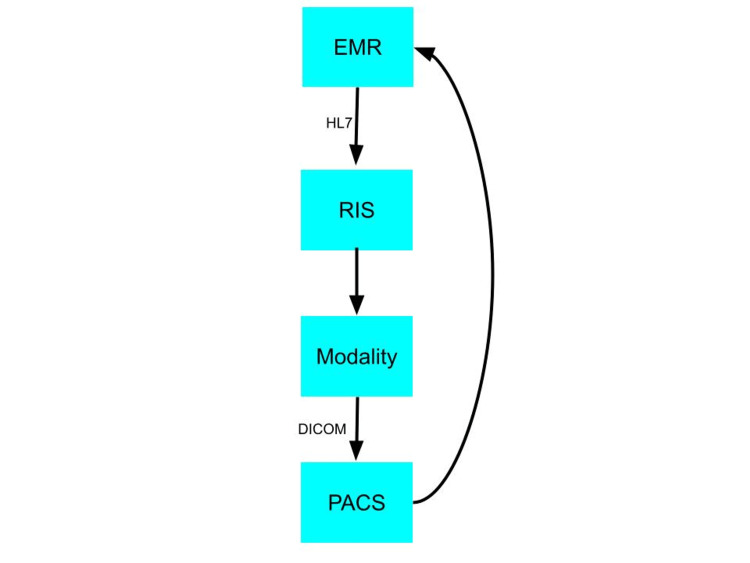
There are myriad systems and standards used in imaging informatics. Digital Imaging and Communications in Medicine (DICOM) is the standard for displaying, transferring, and storing medical images. Health Level Seven International (HL7) develops and maintains standards for exchanging, integrating, and sharing medical data. Picture archiving and communication system (PACS) serves as the health provider's primary tool for viewing and interpreting medical images. Medical imaging depends on the interoperability of several of these systems. From entering the order into the electronic medical record (EMR), several systems receive and share medical data, including the radiology information system (RIS) and hospital information system (HIS). After acquiring an image, transformations may be performed to better focus on a specific area. The workflow from entering the order to receiving the report depends on many systems. Having disaster recovery and business continuity procedures is important should any issues arise. This article intends to review these essential concepts of imaging informatics.
影像信息学中使用了无数的系统和标准。医学数字成像和通信(DICOM)是用于显示、传输和存储医学图像的标准。健康级别七国际组织(HL7)制定并维护用于交换、整合和共享医学数据的标准。图像存档与通信系统(PACS)是医疗服务提供者查看和解读医学图像的主要工具。医学成像依赖于其中多个系统的互操作性。从将医嘱录入电子病历(EMR)开始,多个系统接收并共享医学数据,包括放射信息系统(RIS)和医院信息系统(HIS)。获取图像后,可能会进行一些变换以更好地聚焦于特定区域。从录入医嘱到接收报告的工作流程依赖于许多系统。制定灾难恢复和业务连续性程序对于应对可能出现的任何问题至关重要。本文旨在回顾影像信息学的这些基本概念。