Department of Geosciences, Guyot Hall, Princeton University, Princeton, NJ 08544, USA.
Université de Paris/Institut de Physique du Globe de Paris, UMR CNRS 7154, Paris, France.
Sci Adv. 2023 Jan 25;9(4):eade3723. doi: 10.1126/sciadv.ade3723.
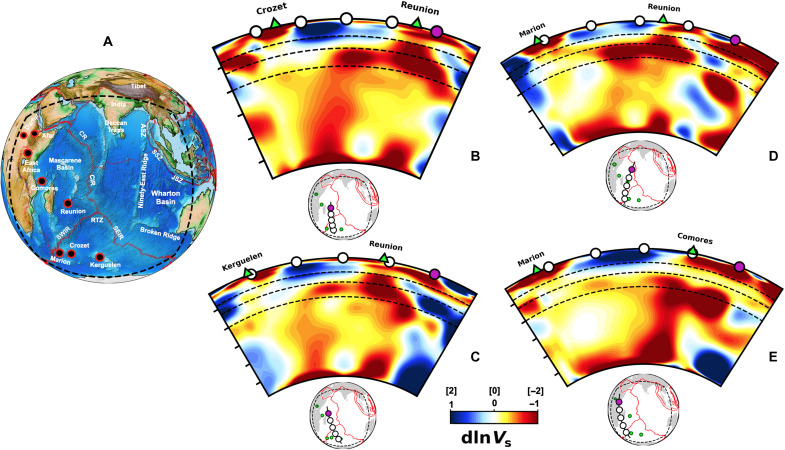
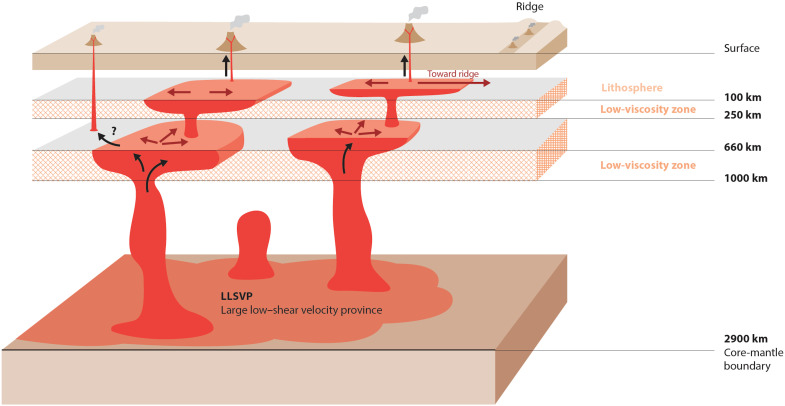
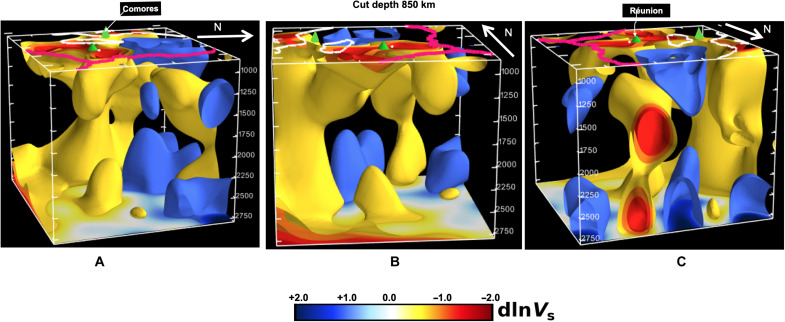
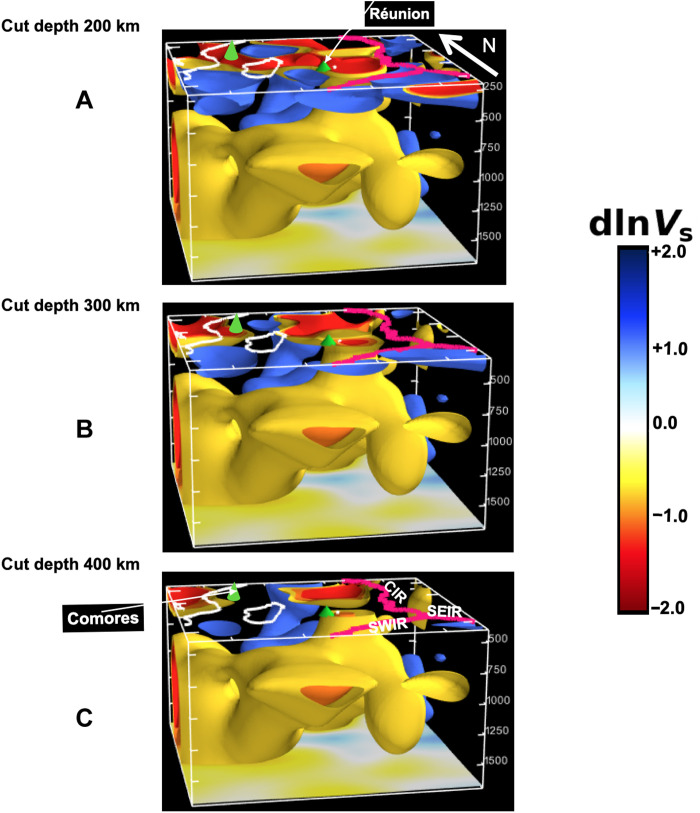
Whether the two large low-shear velocity provinces (LLSVPs) at the base of Earth's mantle are wide compact structures extending thousands of kilometers upward or bundles of distinct mantle plumes is the subject of debate. Full waveform shear wave tomography of the deep mantle beneath the Indian Ocean highlights the presence of several separate broad low-velocity conduits anchored at the core-mantle boundary in the eastern part of the African LLSVP, most clearly beneath La Réunion and Comores hot spots. The deep plumbing system beneath these hot spots may also include alternating vertical conduits and horizontal ponding zones, from 1000-km depth to the top of the asthenosphere, reminiscent of dyke and sills in crustal volcanic systems, albeit at a whole-mantle scale.
这两个位于地幔底部的大型低速剪切波省(LLSVPs)是向上延伸数千公里的宽阔紧凑结构,还是离散的地幔羽束,这是一个有争议的问题。印度洋深部地幔的全波形剪切波层析成像突出显示了几个独立的宽阔低速管道的存在,这些管道在非洲 LLSVP 的东部固定在核幔边界处,在留尼汪和科摩罗热点下方最为明显。这些热点下方的深部管道系统可能还包括从 1000 公里深处到软流圈顶部的交替垂直管道和水平积水区,这让人联想到地壳火山系统中的岩脉和岩床,尽管是在整个地幔尺度上。