
城市舒适度:城市红松鼠对外界温度变化的代谢反应较弱。
City comfort: weaker metabolic response to changes in ambient temperature in urban red squirrels.
机构信息
Functional Ecology, Institute of Cell and Systems Biology of Animals, Universität Hamburg, Martin-Luther-King-Platz 3, 20146, Hamburg, Germany.
Biodiversity Research Institute (CSIC, Oviedo University, Principality of Asturias), Campus of Mieres, University of Oviedo, 33600, Mieres, Spain.
出版信息
Sci Rep. 2023 Jan 25;13(1):1393. doi: 10.1038/s41598-023-28624-x.
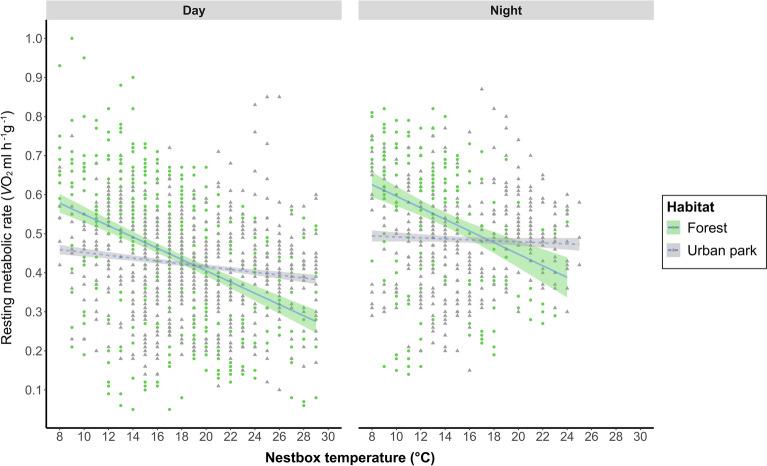
The ecophysiological responses of species to urbanisation reveal important information regarding the processes of successful urban colonization and biodiversity patterns in urban landscapes. Investigating these responses will also help uncover whether synurban species are indeed urban 'winners'. Yet we still lack basic knowledge about the physiological costs and overall energy budgets of most species living in urban habitats, especially for mammals. Within this context, we compared the energetic demands of Eurasian red squirrels (Sciurus vulgaris) from the core of an urban environment with those from a nearby forest. We measured oxygen consumption as a proxy for resting metabolic rate (RMR) of 20 wild individuals (13 urban, 7 forest), at naturally varying ambient temperature (T) in an outdoor-enclosure experiment. We found that the variation in RMR was best explained by the interaction between T and habitat, with a significant difference between populations. Urban squirrels showed a shallower response of metabolic rate to decreasing T than woodland squirrels. We suggest that this is likely a consequence of urban heat island effects, as well as widespread supplemental food abundance. Our results indicate energy savings for urban squirrels at cooler temperatures, yet with possible increased costs at higher temperatures compared to their woodland conspecifics. Thus, the changed patterns of metabolic regulation in urban individuals might not necessarily represent an overall advantage for urban squirrels, especially in view of increasing temperatures globally.
物种对城市化的生态生理响应揭示了有关成功城市定居和城市景观中生物多样性模式的重要信息。研究这些响应也将有助于揭示是否共生物种确实是城市的“赢家”。然而,我们仍然缺乏关于生活在城市栖息地的大多数物种(尤其是哺乳动物)的生理成本和总体能量预算的基本知识。在这种情况下,我们比较了城市环境核心区的欧亚红松鼠(Sciurus vulgaris)和附近森林的欧亚红松鼠的能量需求。我们通过在户外围栏实验中测量氧气消耗来估算 20 只野生个体(13 只城市,7 只森林)的静息代谢率(RMR),T 自然变化。我们发现,RMR 的变化最好通过 T 和栖息地之间的相互作用来解释,种群之间存在显著差异。城市松鼠的代谢率对 T 降低的反应比林地松鼠浅。我们认为,这可能是城市热岛效应以及广泛存在的补充食物丰度的结果。我们的结果表明,城市松鼠在较冷的温度下节省能量,但与林地同类动物相比,在较高温度下可能会增加成本。因此,与全球气温上升相比,城市个体中代谢调节模式的变化不一定代表城市松鼠的整体优势。
 Zotero 插件