Yim King-Him, Yeung Chi-Tung, Probert Michael R, Chan Wesley Ting Kwok, Mackenzie Lewis E, Pal Robert, Wong Wing-Tak, Law Ga-Lai
State Key Laboratory of Chemical Biology and Drug Discovery, Department of Applied Biology and Chemical Technology, The Hong Kong Polytechnic University, Kowloon, Hong Kong.
Chemistry, School of Natural and Environmental Sciences, Newcastle University, Newcastle Upon Tyne, UK.
Commun Chem. 2021 Aug 5;4(1):116. doi: 10.1038/s42004-021-00553-8.
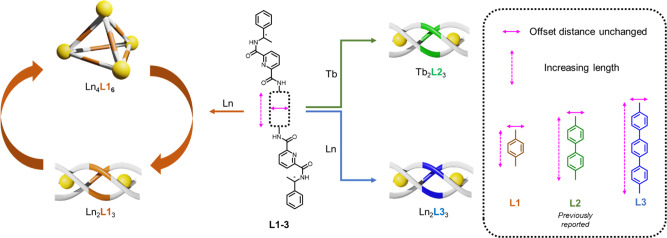
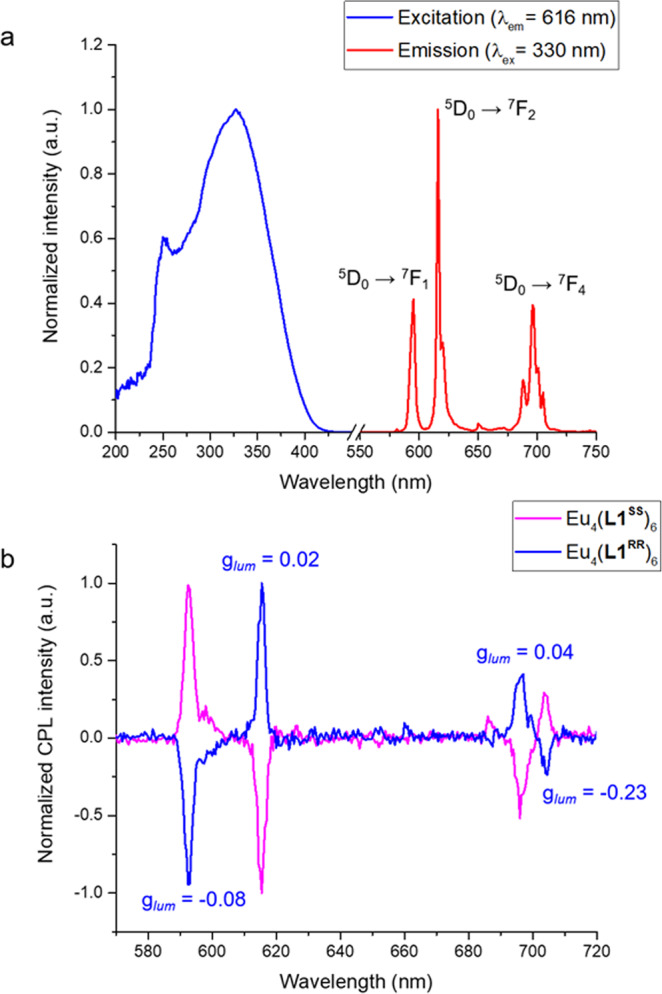
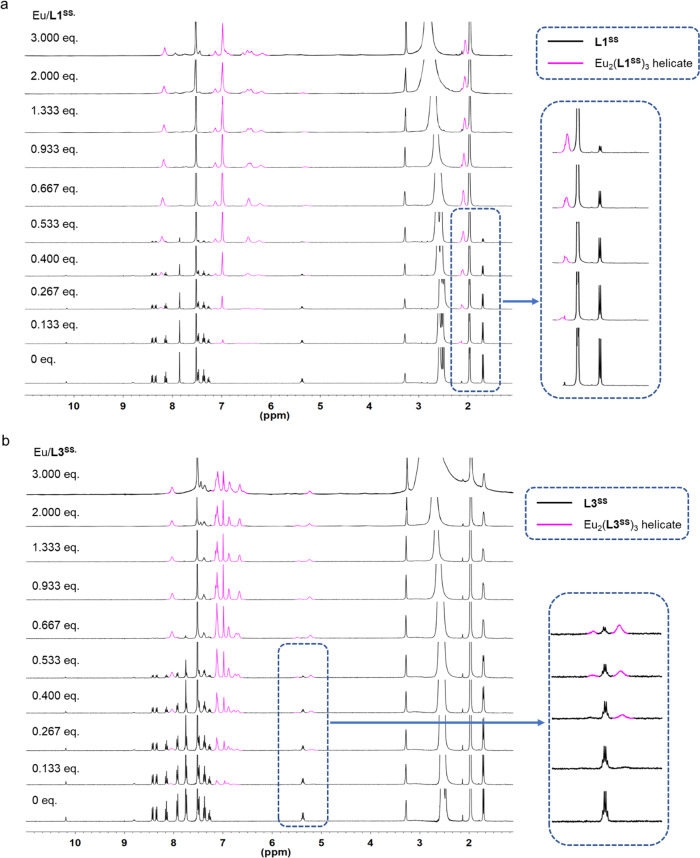
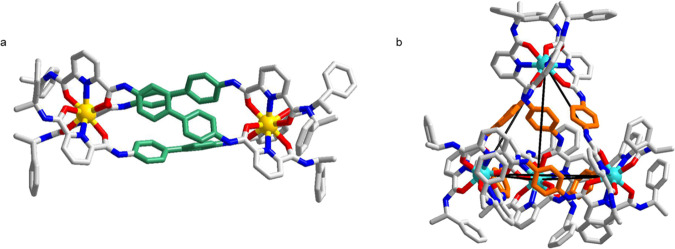
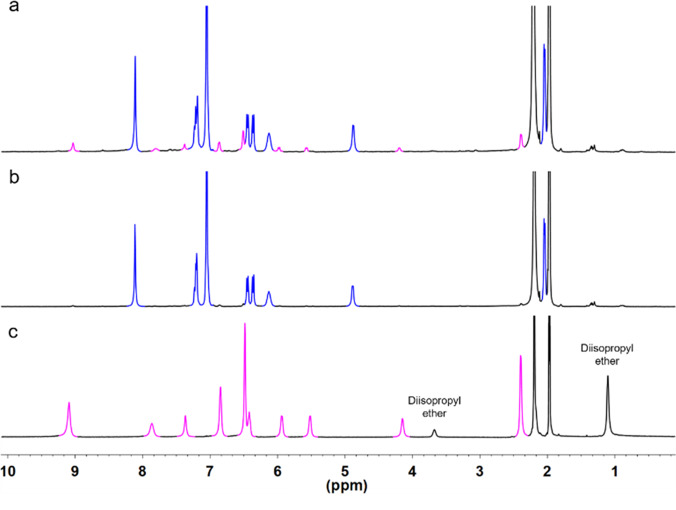
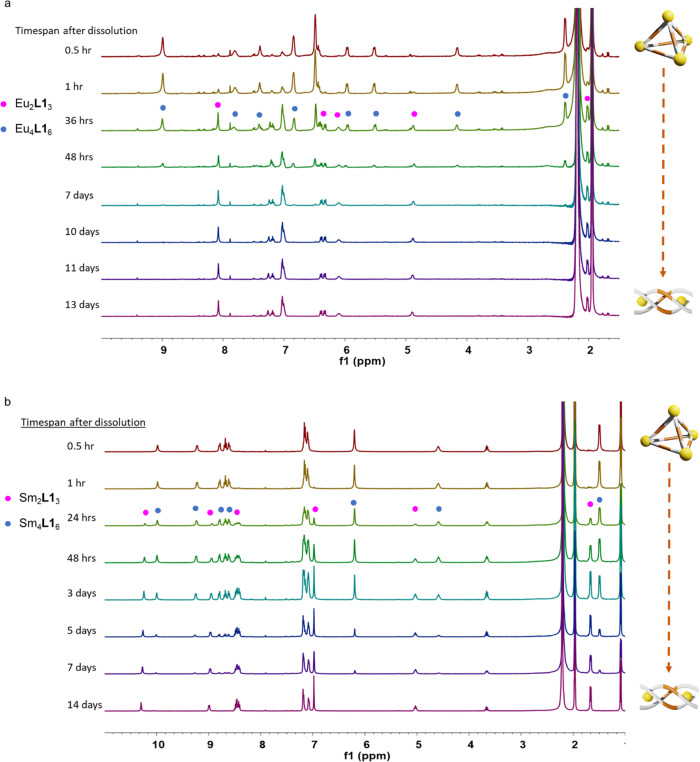
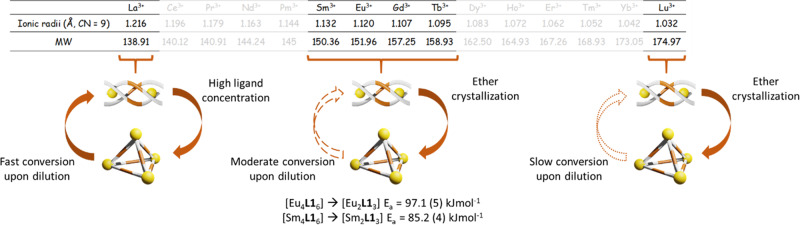
Controlled formation of desired lanthanide supramolecular complexes is challenging because of the difficulties in predicting coordination geometry, as well as a labile coordination number. Herein, we explore the effect of ionic radii and linker length on supramolecular species formation. A helicate-to-tetrahedron transformation occurred between [LnL1] and [LnL1] (Ln = La, Sm, Eu, Gd, Tb and Lu). For six lanthanide ions, the unfavored tetrahedron [LaL1] can only be observed in a concentrated mixture with the helicate [LaL1] where no pure [LaL1] species was isolated via crystallization. For Sm, Eu, Gd, Tb, the [LnL1] supramolecular tetrahedron can be isolated via crystallization from diisopropyl ether. A similar result was also observed for Lu, but the tetrahedral structure was found to be relatively stable and transformed back to [LuL1] much slower upon dissolution. No tetrahedron formation was observed with L3 giving rise to only [LnL3] species, in which L3 contains a longer and more flexible linker compared with that of L1. Results show that the supramolecular transformation in these systems is governed by both the ionic radii as well as the ligand design. Special focus is on both [EuL1] and [EuL1] which form chiral entities and exhibit interesting circular polarized luminescence.
由于预测配位几何结构存在困难以及配位数不稳定,可控地形成所需的镧系超分子配合物具有挑战性。在此,我们探究了离子半径和连接体长度对超分子物种形成的影响。在[LnL1]和[LnL1](Ln = La、Sm、Eu、Gd、Tb和Lu)之间发生了螺旋体到四面体的转变。对于六种镧系离子,不占优势的四面体[LaL1]只能在与螺旋体[LaL1]的浓混合物中观察到,其中通过结晶未分离出纯的[LaL1]物种。对于Sm、Eu、Gd、Tb,[LnL1]超分子四面体可以通过从二异丙醚中结晶分离出来。对于Lu也观察到了类似的结果,但发现四面体结构相对稳定,在溶解时变回[LuL1]的速度要慢得多。使用L3时未观察到四面体形成,仅产生[LnL3]物种,其中L3与L1相比含有更长且更灵活的连接体。结果表明,这些体系中的超分子转变受离子半径和配体设计的共同控制。特别关注[EuL1]和[EuL1],它们形成手性实体并表现出有趣的圆偏振发光。