Oka Minami, Honda Satoshi
Department of Basic Science, Graduate School of Arts and Sciences, The University of Tokyo, 3-8-1 Komaba, Meguro-ku, Tokyo, 153-8902, Japan.
Commun Chem. 2021 Sep 15;4(1):130. doi: 10.1038/s42004-021-00570-7.
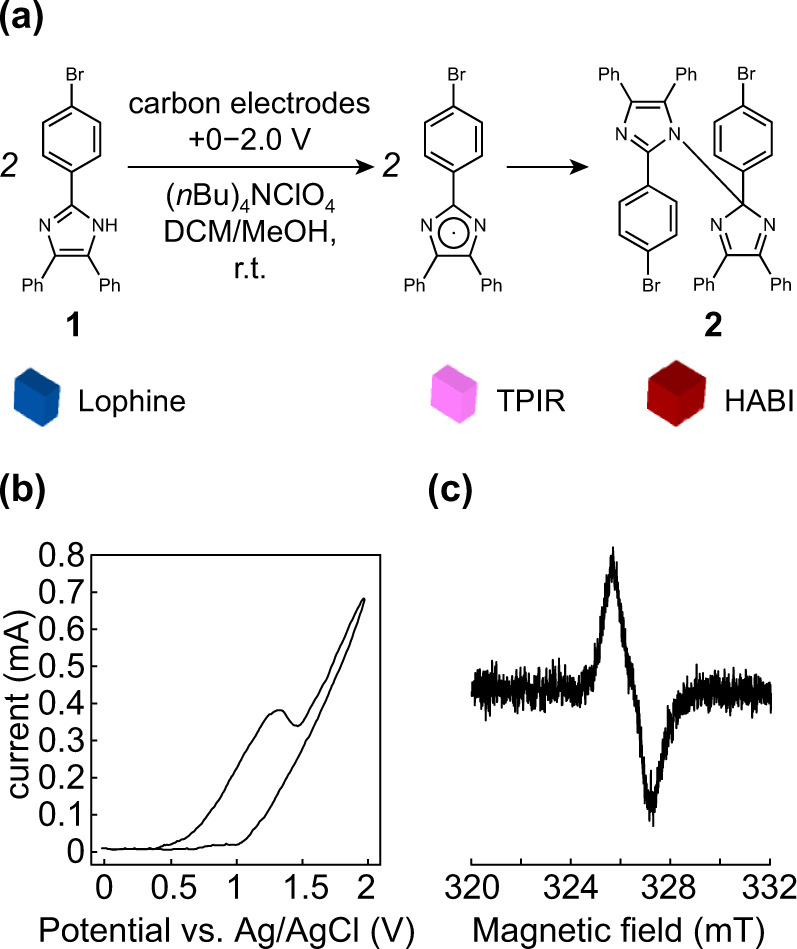
Coupling reactions between polymers are an important class of chemical modifications for changing, enhancing, and tuning the properties of polymeric materials. In particular, transformation of polymer topologies based on efficient, facile and less wasted coupling reactions remains a significant challenge. Here, we report coupling reactions based on electrochemical oxidation of 2,4,5-triphenylimidazole into a 2,4,5-triphenylimidazolyl radical and its spontaneous dimerization into hexaarylbiimidazole. Based on this chemistry, electrochemical topological transformation (ETT) and electrochemical chain extension have been realized with siloxane-based oligomers and polymers. Moreover, this approach enables one step ETT of star-shaped poly(dimethyl siloxane)s (PDMSs) into network PDMSs, running in an ionic liquid solvent and requiring no purification steps.
聚合物之间的偶联反应是一类重要的化学修饰,可用于改变、增强和调节聚合物材料的性能。特别是,基于高效、简便且浪费较少的偶联反应来转变聚合物拓扑结构仍然是一项重大挑战。在此,我们报道了基于将2,4,5-三苯基咪唑电化学氧化为2,4,5-三苯基咪唑基自由基及其自发二聚形成六芳基联咪唑的偶联反应。基于此化学原理,已经实现了硅氧烷基低聚物和聚合物的电化学拓扑转变(ETT)和电化学链增长。此外,这种方法能够将星形聚二甲基硅氧烷(PDMS)一步转变为网络状PDMS,反应在离子液体溶剂中进行,无需纯化步骤。