Li Rongyang, Huang Bing, Tian Hui, Sun Zhenguo
Department of Thoracic Surgery, Qilu Hospital of Shandong University, Jinan, Shandong, China.
Front Oncol. 2023 Jan 9;12:1096717. doi: 10.3389/fonc.2022.1096717. eCollection 2022.
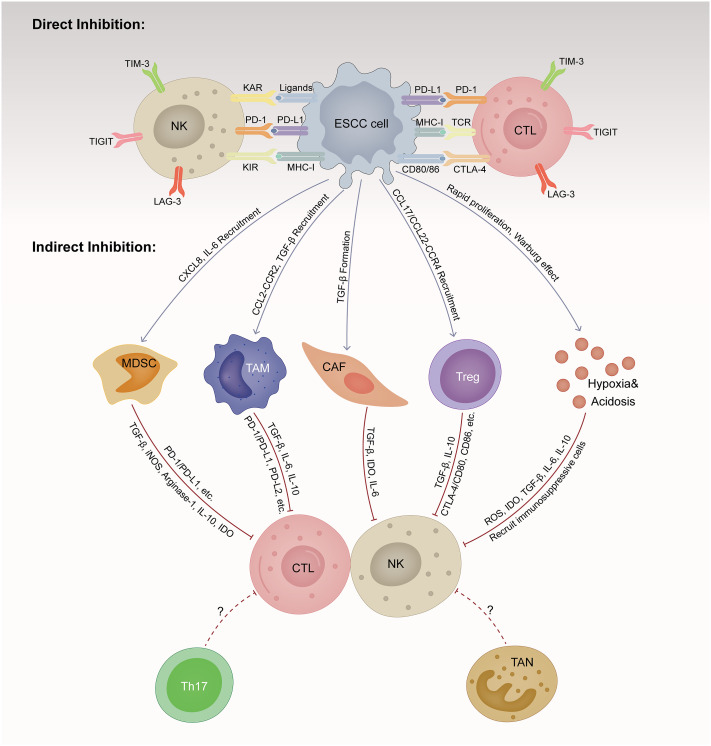
Esophageal cancer (EC) is one of the most life-threatening malignancies worldwide. Esophageal squamous cell carcinoma (ESCC) is the dominant subtype, accounting for approximately 90% of new incident EC each year. Although multidisciplinary treatment strategies have advanced rapidly, patients with ESCC are often diagnosed at advanced stage and the long-term prognosis remains unsatisfactory. In recent decades, immunotherapy, such as immune checkpoint inhibitors (ICIs), tumor vaccines, and chimeric antigen receptor T-cell (CAR-T) therapy, has been successfully used in clinical practice as a novel therapy for treating tumors, bringing new hope to ESCC patients. However, only a small fraction of patients achieved clinical benefits due to primary or acquired resistance. Immune evasion plays a pivotal role in the initiation and progression of ESCC. Therefore, a thorough understanding of the mechanisms by which ESCC cells escape from anti-tumor immunity is necessary for a more effective multidisciplinary treatment strategy. It has been widely recognized that immune evasion is closely associated with the crosstalk between tumor cells and the tumor microenvironment (TME). TME is a dynamic complex and comprehensive system including not only cellular components but also non-cellular components, which influence hallmarks and fates of tumor cells from the outside. Novel immunotherapy targeting tumor-favorable TME represents a promising strategy to achieve better therapeutic responses for patients with ESCC. In this review, we provide an overview of immune evasion in ESCC, mainly focusing on the molecular mechanisms that underlie the role of TME in immune evasion of ESCC. In addition, we also discuss the challenges and opportunities of precision therapy for ESCC by targeting TME.
食管癌(EC)是全球最具生命威胁的恶性肿瘤之一。食管鳞状细胞癌(ESCC)是主要亚型,每年约占新发病例的90%。尽管多学科治疗策略发展迅速,但ESCC患者常被诊断为晚期,长期预后仍不尽人意。近几十年来,免疫疗法,如免疫检查点抑制剂(ICIs)、肿瘤疫苗和嵌合抗原受体T细胞(CAR-T)疗法,已作为一种新型肿瘤治疗方法成功应用于临床实践,为ESCC患者带来了新希望。然而,由于原发性或获得性耐药,只有一小部分患者获得了临床益处。免疫逃逸在ESCC的发生和发展中起关键作用。因此,深入了解ESCC细胞逃避抗肿瘤免疫的机制对于制定更有效的多学科治疗策略至关重要。人们普遍认识到,免疫逃逸与肿瘤细胞和肿瘤微环境(TME)之间的相互作用密切相关。TME是一个动态的复杂综合系统,不仅包括细胞成分,还包括非细胞成分,它们从外部影响肿瘤细胞的特征和命运。针对有利于肿瘤的TME的新型免疫疗法是为ESCC患者实现更好治疗反应的一种有前景的策略。在这篇综述中,我们概述了ESCC中的免疫逃逸,主要关注TME在ESCC免疫逃逸中作用的分子机制。此外,我们还讨论了通过靶向TME对ESCC进行精准治疗的挑战和机遇。