Yu Jia-Ting, Mao Qiu-Fang, Ji Feng-Ping, Zhao Ying, Hu Hui-Jie, Zhang Yan-Ping, Yang Jing, Wang Qing-Wei, Lu Wei, Wen Jian Guo
Henan Joint International Pediatric Urodynamic Laboratory, The First Affiliated Hospital of Zhengzhou University, Zhengzhou, China.
Department of Urology, Third Affiliated Hospital of Xinxiang Medical University, Xinxiang, China.
Front Pediatr. 2023 Jan 9;10:1053118. doi: 10.3389/fped.2022.1053118. eCollection 2022.
Elimination communication (EC) is considered to be a milestone in a child's development. Nowadays, a trend toward an older age at EC initiation has been observed globally, probably due to the convenience of disposable diaper use in daily life. The study aimed to identify potential risk factors for disposable diaper dependence (DDD) and evaluate whether an early/proper EC can reduce the risk of DDD among children in China.
A cross-sectional study was performed on 13,500 children in mainland China from October 2019 to March 2020. An anonymous questionnaire was used to collect information including the sociodemographic characteristics, details about DDD and EC, and the effect of DDD on the quality of life of children. Data were analyzed by SPSS and R software.
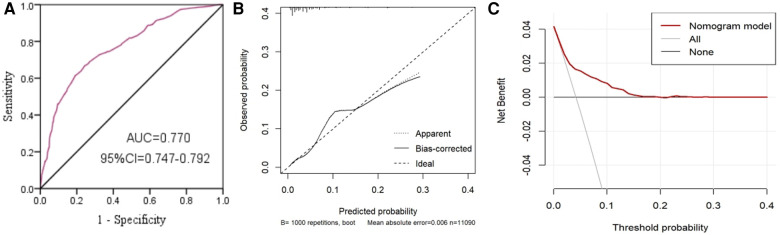
The overall prevalence of DDD was 4.17% (4.31% in boys; 4.02% in girls) and decreased with age, from 8.71% at 2 years to 0.73% at 6 years ( = 210.392, < 0.001). In univariable analysis, age, location or EC were associated with DDD. Four independent factors-age, location (urban), caregivers with high education levels (junior college or above) and delayed EC (after 12 months of age)-were identified to be significantly associated with DDD risk in logistic regression model. Compared with EC onset after 12 months of age, EC onset before 12 months of age was associated with a 79.6% (model 2) reduction in DDD. Four independent factors were selected to establish the nomogram for DDD based on the results of logistic regression analysis. The C-index (0.770) and the AUC (>0.7) indicated satisfactory discriminative ability of the nomogram. The calibration diagrams showed favorable consistency between the prediction of the nomogram and actual observations.
Our findings indicate the joint contribution of age, location, caregivers' education level and EC to DDD in Chinese preschool-aged children. Timely cessation of the use of disposable diapers and early/proper EC may help to reduce the risk of DDD in children.
排泄沟通(EC)被认为是儿童发育过程中的一个里程碑。如今,全球范围内都观察到开始进行EC的年龄有增大的趋势,这可能是由于日常生活中使用一次性尿布很方便。本研究旨在确定一次性尿布依赖(DDD)的潜在风险因素,并评估早期/适当的EC是否可以降低中国儿童患DDD的风险。
2019年10月至2020年3月,对中国大陆的13500名儿童进行了一项横断面研究。使用匿名问卷收集信息,包括社会人口学特征、关于DDD和EC的详细信息,以及DDD对儿童生活质量的影响。数据通过SPSS和R软件进行分析。
DDD的总体患病率为4.17%(男孩为4.31%;女孩为4.02%),且随年龄增长而降低,从2岁时的8.71%降至6岁时的0.73%(χ² =210.392,P <0.001)。在单变量分析中,年龄、地点或EC与DDD有关联。在逻辑回归模型中,确定了四个独立因素——年龄、地点(城市)、高学历(大专及以上)的照料者以及延迟的EC(12个月龄后)——与DDD风险显著相关。与12个月龄后开始EC相比,12个月龄前开始EC与DDD降低79.6%(模型2)相关。根据逻辑回归分析结果,选择四个独立因素建立DDD列线图。C指数(0.770)和AUC(>0.7)表明列线图具有令人满意的判别能力。校准图显示列线图预测与实际观察结果之间具有良好的一致性。
我们的研究结果表明年龄、地点、照料者教育水平和EC对中国学龄前儿童的DDD有共同影响。及时停止使用一次性尿布以及早期/适当的EC可能有助于降低儿童患DDD的风险。