Dirican Ebubekir, Özcan Halil, Karabulut Uzunçakmak Sevgi, Takım Uğur
Health Services Vocational School, Bayburt University, Bayburt, Turkey.
Department of Mental Health and Related Disorders, Faculty of Medicine, Atatürk University, Erzurum, Turkey.
Clin Psychopharmacol Neurosci. 2023 Feb 28;21(1):171-178. doi: 10.9758/cpn.2023.21.1.171.
Apoptosis is programmed cell death that occurs by several pathways. Caspase-3 is induced by active caspase-9 via the intrinsic pathway. The aim of this research was to explore the expression of caspase-3 and caspase-9 in schizophrenia patients and healthy samples.
RNA was isolated from the peripheral blood of 39 schizophrenia patients' and healthy samples. After cDNA synthesis, real time PCR (RT-PCR) was used to analyse caspase-3 and caspase-9 gene expression. The severity of psychopathological symptoms of schizophrenia was evaluated using the Positive and Negative Symptoms Scale for schizophrenia (PANSS) and Clinical Global Impressions (CGI).
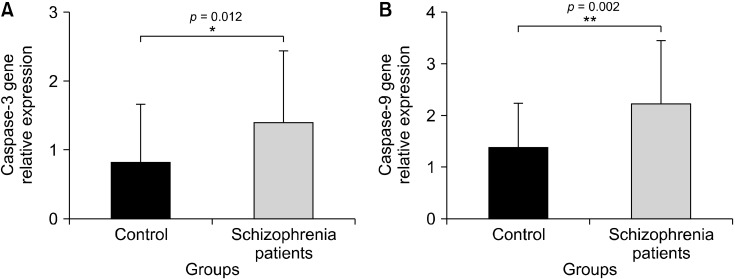
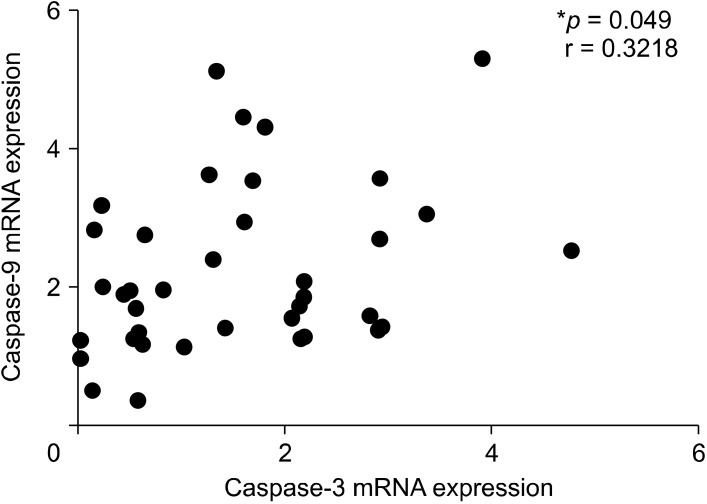
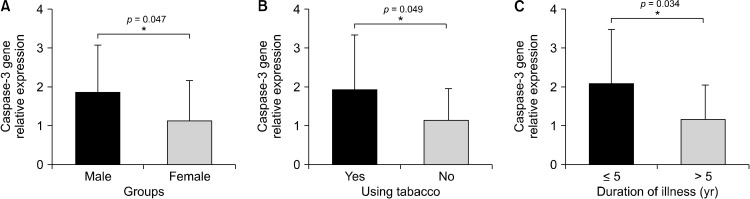
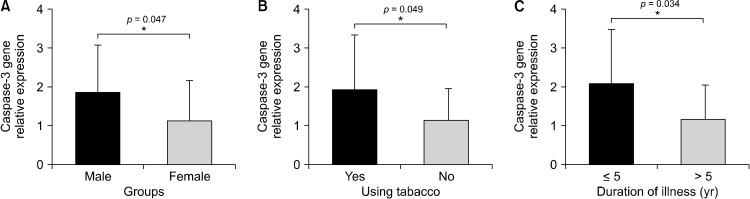
The expression of caspase-3 and caspase-9 genes was higher in schizophrenia patients than in healthy samples ( = 0.012, = 0.002, respectively). The increase in caspase-3 gene expression was significant with being male, smoking and with a duration of less than 6 years ( = 0.047, = 0.049, = 0.034, respectively). On the other hand, the increase in caspase-9 gene expression was significant in patients who is smoke, have children, and are under 33 years old ( = 0.040, = 0.043, = 0.045, respectively). A significant positive correlation was detected between the caspase-3 and caspase-9 gene expression (r = 0.3218, = 0.049).
Our findings indicate that caspase-3 and caspase-9 gene expression may activate cell death mechanisms by intrinsic apoptotic genes. Furthermore, caspase-3 and caspase-9 may play essential roles in different ways in schizophrenia. Hence there is a need to further study the apoptotic mechanism with expanded patient populations.
细胞凋亡是通过多种途径发生的程序性细胞死亡。半胱天冬酶-3由活性半胱天冬酶-9通过内源性途径诱导产生。本研究的目的是探讨半胱天冬酶-3和半胱天冬酶-9在精神分裂症患者及健康样本中的表达情况。
从39例精神分裂症患者及健康样本的外周血中提取RNA。合成cDNA后,采用实时荧光定量聚合酶链反应(RT-PCR)分析半胱天冬酶-3和半胱天冬酶-9基因的表达。使用精神分裂症阳性和阴性症状量表(PANSS)及临床总体印象量表(CGI)评估精神分裂症患者精神病理症状的严重程度。
精神分裂症患者中半胱天冬酶-3和半胱天冬酶-9基因的表达高于健康样本(分别为P = 0.012,P = 0.002)。半胱天冬酶-3基因表达的增加在男性、吸烟者及病程小于6年的患者中具有显著性(分别为P = 0.047,P = 0.049,P = 0.034)。另一方面,半胱天冬酶-9基因表达的增加在吸烟、有子女及年龄小于33岁的患者中具有显著性(分别为P = 0.040,P = 0.043,P = 0.045)。在半胱天冬酶-3和半胱天冬酶-9基因表达之间检测到显著的正相关(r = 0.3218,P = 0.049)。
我们的研究结果表明,半胱天冬酶-3和半胱天冬酶-9基因表达可能通过内源性凋亡基因激活细胞死亡机制。此外,半胱天冬酶-3和半胱天冬酶-9可能在精神分裂症中以不同方式发挥重要作用。因此,有必要扩大患者群体进一步研究凋亡机制。