The Scripps Research Institute, La Jolla, CA, 92037, USA.
Scripps Whittier Diabetes Institute, Scripps Health, San Diego, CA, USA.
Sci Rep. 2023 Jan 26;13(1):1450. doi: 10.1038/s41598-023-28095-0.
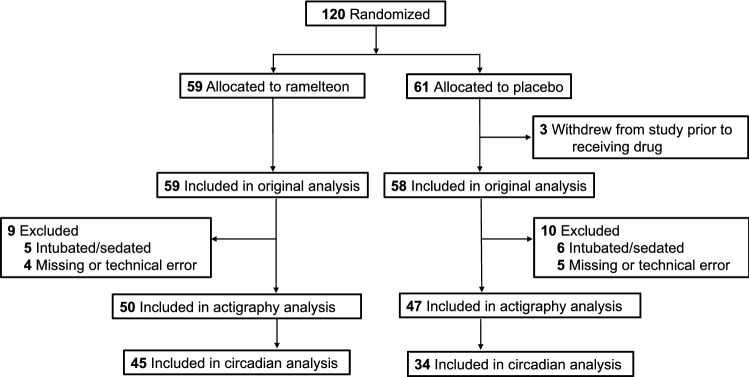
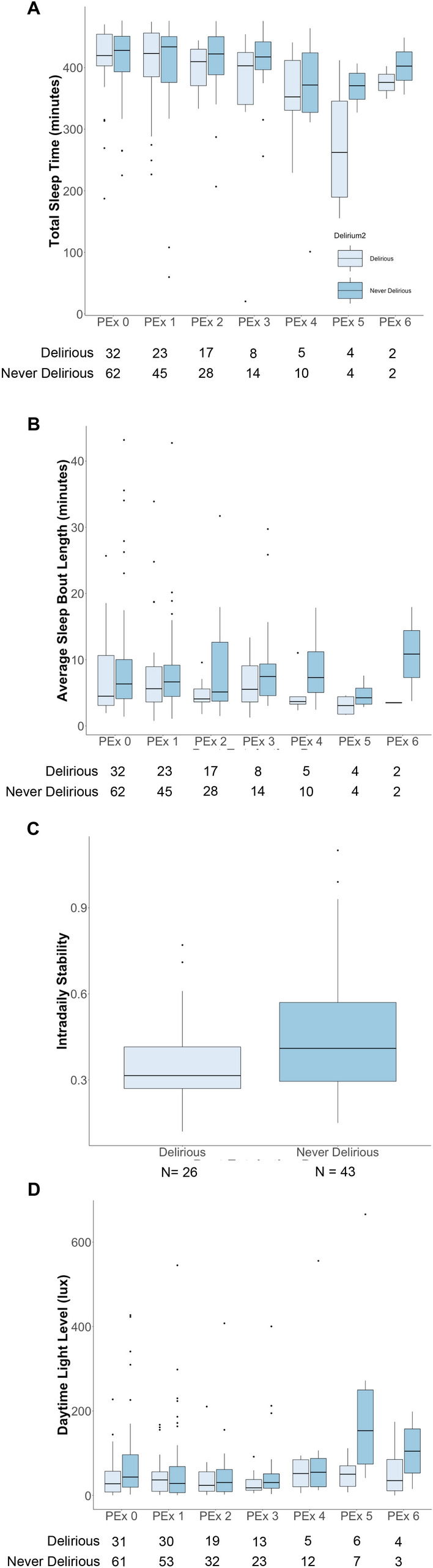
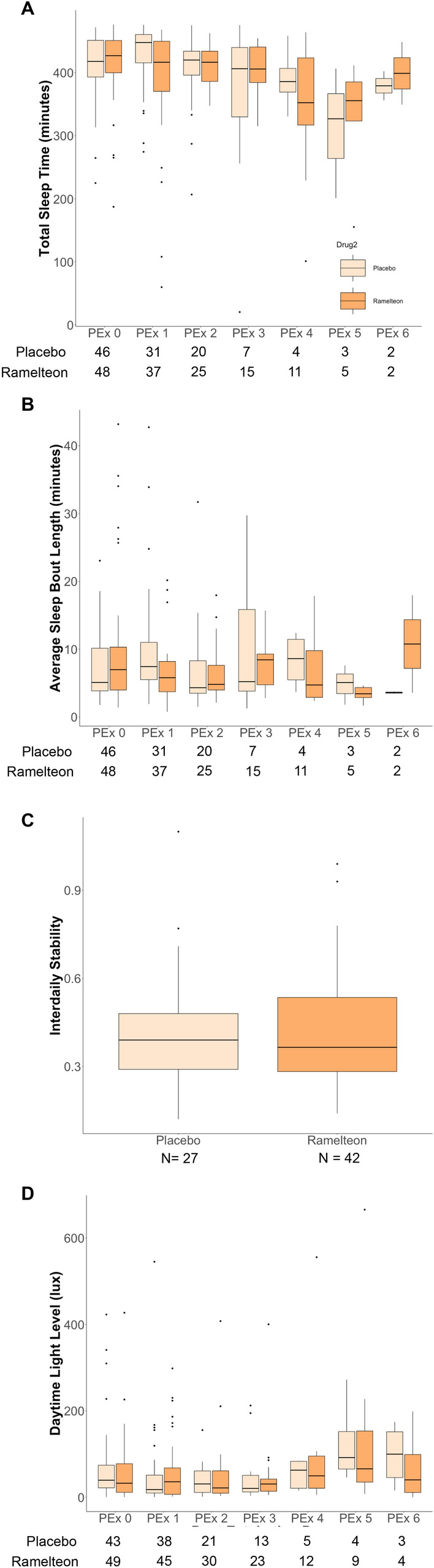
Patients in the ICU often sleep poorly for various reasons, which may predispose to delirium. We previously conducted a clinical trial in which we tested the efficacy of ramelteon, a melatonin-receptor agonist used to treat insomnia, versus placebo, in preventing ICU delirium in patients who underwent elective pulmonary thromboendarterectomy (PTE) surgery. Here we examine sleep, activity, and circadian patterns, measured with actigraphy, to understand changes in these metrics with our intervention and in those with and without delirium. Participants wore wrist actigraphy devices while recovering post-operatively in the ICU. For sleep analysis, we extracted total sleep time and sleep fragmentation metrics over the 22:00 to 06:00 period nightly, and daytime nap duration from the daytime period (0:600 to 22:00) for each participant. For activity analyses, we extracted the following metrics: total daytime activity count (AC), maximum daytime AC, total nighttime AC, and maximum nighttime AC. Next, we performed a nonparametric circadian analysis on ACs over each 24-h day and extracted the following: interdaily stability (IS), intra-daily variability (IV), relative amplitude (RA), and low and high periods of activity (L5 and M10) as well as their start times. These metrics were compared between patients who received ramelteon versus placebo, and between patients who became delirious versus those who did not develop delirium. We additionally made comparisons between groups for daytime and nighttime light levels. No differences in sleep, activity, circadian metrics or light levels were found between drug groups. Delirious patients, when compared to those who were never delirious, had a lower IS (0.35 ± 0.16 vs. 0.47 ± 0.23; P = 0.006). Otherewise, no differences in IV, L5, M10, or RA were found between groups. L5 and M10 activity values increased significantly over the post-extubation for the whole cohort. No differences were found for daytime or nighttime light levels between groups. Overall, ramelteon did not impact sleep or circadian metrics in this cohort. Consistent with clinical experience, delirious patients had less inter-daily stability in their rest-activity rhythms. These data suggest that actigraphy might have value for individual assessment of sleep in the ICU, and for determining and detecting the impact of interventions directed at improving sleep and circadian activity rhythms in the ICU.Trial registration: REGISTERED at CLINICALTRIALS.GOV: NCT02691013. Registered on February 24, 2016 by principal investigator, Dr. Robert L. Owens.
重症监护病房(ICU)的患者常因各种原因而睡眠不佳,这可能导致谵妄。我们之前进行了一项临床试验,比较了褪黑素受体激动剂雷美替胺与安慰剂治疗择期肺动脉血栓内膜切除术(PTE)患者术后 ICU 谵妄的疗效。在此,我们通过活动记录仪检查睡眠、活动和昼夜节律模式,以了解干预后以及发生和未发生谵妄的患者这些指标的变化。参与者在 ICU 术后恢复期间佩戴腕部活动记录仪。对于睡眠分析,我们从每个参与者的白天时段(0:600 至 22:00)提取了 22:00 至 06:00 期间每晚的总睡眠时间和睡眠片段化指标,以及日间小睡持续时间。对于活动分析,我们提取了以下指标:总白天活动计数(AC)、最大白天 AC、总夜间 AC 和最大夜间 AC。接下来,我们对每个 24 小时的白天 AC 进行了非参数昼夜节律分析,并提取了以下指标:日间稳定性(IS)、日内可变性(IV)、相对幅度(RA)以及活动的低和高期(L5 和 M10)及其开始时间。将接受雷美替胺与安慰剂的患者、发生谵妄与未发生谵妄的患者进行比较。我们还比较了两组日间和夜间光照水平。药物组之间的睡眠、活动、昼夜节律指标或光照水平无差异。与从未发生过谵妄的患者相比,谵妄患者的 IS 较低(0.35±0.16 与 0.47±0.23;P=0.006)。其他方面,组间 IV、L5、M10 或 RA 无差异。整个队列拔管后,L5 和 M10 活动值显著增加。组间日间或夜间光照水平无差异。总体而言,雷美替胺对该队列的睡眠或昼夜节律指标没有影响。与临床经验一致,谵妄患者的静息活动节律日间稳定性较差。这些数据表明,活动记录仪可能对 ICU 患者的睡眠进行个体评估以及确定和检测改善 ICU 睡眠和昼夜活动节律的干预措施的影响具有价值。试验注册:在 CLINICALTRIALS.GOV 注册:NCT02691013。由首席研究员罗伯特·L·欧文斯博士于 2016 年 2 月 24 日注册。