Bektay Muhammed Yunus, Sancar Mesut, Okyaltirik Fatmanur, Durdu Bulent, Izzettin Fikret Vehbi
Clinical Pharmacy Department, Faculty of Pharmacy, Bezmialem University, Istanbul, Turkey.
Clinical Pharmacy Department, Health Science Institute, Marmara University, Istanbul, Turkey.
Front Pharmacol. 2023 Jan 10;13:1049289. doi: 10.3389/fphar.2022.1049289. eCollection 2022.
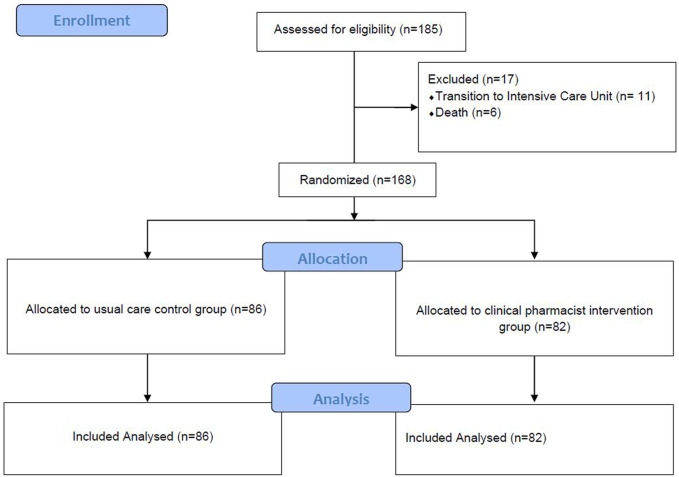
According to the World Health Organization (WHO), chest diseases are among the 10 diseases that cause the highest mortality worldwide. Drug-related problems (DRPs), readmission, and antimicrobial resistance are critical problems in chest disease wards. Active involvement of clinical pharmacists (CPs) who are focused on reducing the risks of potential problems is needed. The aim of this study is to investigate the effects of pharmaceutical care (PC) services on the pulmonology service. A randomized controlled trial at a university hospital in Istanbul was conducted between June 2020 and December 2021. The participants were randomized into the control group (CG) and intervention group (IG). In the CG, CPs identified and classified the DRPs according to Pharmaceutical Care Network Europe v9.0 (PCNE) and provided solutions to DRPs for the IG. The effect of PC services was evaluated by the number and classification of DRPs, and readmissions within 30 days were compared between the two groups. Out of 168 patients, 82 were assigned to the IG. The average number of medicines administered per patient in the CG and IG was 14.45 ± 7.59 and 15.5 ± 6.18, respectively. In the CG and IG, the numbers of patients with DRPs were 62 and 46, respectively. The total number of DRPs was 160 for CG and 76 for IG. A statistically significant difference was found in favor of the IG, in terms of the number of patients with DRPs, the total number of DRPs, and readmission within 30 days ( < 0.05). In this study, CP recommendations were highly accepted by the healthcare team. Pharmaceutical care services provided by CPs would decrease possible DRPs and led to positive therapeutic outcomes. Cognitive clinical pharmacy services have beneficial effects on health care, and these services should be expanded in all settings where patients and pharmacists are present.
根据世界卫生组织(WHO)的数据,胸部疾病是全球导致死亡率最高的10种疾病之一。药物相关问题(DRPs)、再入院和抗菌药物耐药性是胸部疾病病房中的关键问题。需要专注于降低潜在问题风险的临床药师(CPs)积极参与。本研究的目的是调查药学服务(PC)对肺病服务的影响。2020年6月至2021年12月期间,在伊斯坦布尔的一家大学医院进行了一项随机对照试验。参与者被随机分为对照组(CG)和干预组(IG)。在CG组中,临床药师根据欧洲药学服务网络v9.0(PCNE)对药物相关问题进行识别和分类,并为IG组提供药物相关问题的解决方案。通过药物相关问题的数量和分类来评估药学服务的效果,并比较两组在30天内的再入院情况。在168名患者中,82名被分配到IG组。CG组和IG组中每位患者平均用药数量分别为14.45±7.59和15.5±6.18。在CG组和IG组中,发生药物相关问题的患者数量分别为62例和46例。CG组的药物相关问题总数为160个,IG组为76个。在发生药物相关问题的患者数量、药物相关问题总数以及30天内的再入院情况方面,发现IG组具有统计学显著差异(<0.05)。在本研究中,临床药师的建议得到了医疗团队的高度认可。临床药师提供的药学服务将减少可能出现的药物相关问题,并带来积极的治疗效果。认知临床药学服务对医疗保健有有益影响,这些服务应在有患者和药师的所有环境中扩大。