Neuroendocrine Unit, Division of Endocrinology and Metabolism, Hospital das Clinicas, University of Sao Paulo Medical School, São Paulo, SP, Brazil.
Laboratory of Cellular and Molecular Endocrinology LIM-25, University of Sao Paulo Medical School, São Paulo, SP, Brazil.
Front Endocrinol (Lausanne). 2023 Jan 10;13:1018090. doi: 10.3389/fendo.2022.1018090. eCollection 2022.
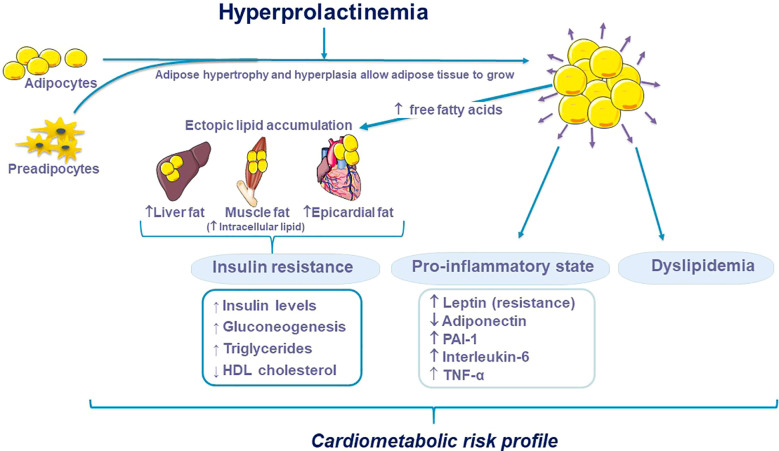
Hyperprolactinemia can be caused by several conditions and its effects on the hypothalamic-pituitary-gonadal axis are understood in more detail. Nevertheless, in recent decades, other metabolic effects have been studied and data pointed to a potential increased cardiovascular disease (CVD) risk. A recent study showed a decrease in total and LDL- cholesterol only in men with prolactinoma treated with dopamine agonists (DA) supporting the previous results of a population study with increased CVD risk in men harboring prolactinoma. However, other population studies did not find a correlation between prolactin (PRL) levels and CVD risk or mortality. There is also data pointing to an increase in high-density lipoprotein levels, and decreases in triglycerides, carotid-intima-media thickness, C-reactive protein, and homocysteine levels in patients with prolactinoma on DA treatment. PRL was also implicated in endothelial dysfunction in pre and postmenopausal women. Withdrawal of DA resulted in negative changes in vascular parameters and an increase in plasma fibrinogen. It has been shown that PRL levels were positively correlated with blood pressure and inversely correlated with dilatation of the brachial artery and insulin sensitivity, increased homocysteine levels, and elevated D-dimer levels. Regarding possible mechanisms for the association between hyperprolactinemia and CVD risk, they include a possible direct effect of PRL, hypogonadism, and even effects of DA treatment, independently of changes in PRL levels. In conclusion, hyperprolactinemia seems to be associated with impaired endothelial function and DA treatment could improve CVD risk. More studies evaluating CVD risk in hyperprolactinemic patients are important to define a potential indication of treatment beyond hypogonadism.
高催乳素血症可由多种情况引起,其对下丘脑-垂体-性腺轴的影响已得到更详细的了解。然而,近几十年来,人们研究了其他代谢效应,并指出催乳素可能会增加心血管疾病(CVD)的风险。最近的一项研究表明,仅在接受多巴胺激动剂(DA)治疗的催乳素瘤男性中,总胆固醇和 LDL-胆固醇降低,这支持了先前的研究结果,即患有催乳素瘤的男性 CVD 风险增加。然而,其他人群研究并未发现催乳素(PRL)水平与 CVD 风险或死亡率之间存在相关性。还有数据表明,在接受 DA 治疗的催乳素瘤患者中,高密度脂蛋白水平升高,甘油三酯、颈动脉内膜中层厚度、C 反应蛋白和同型半胱氨酸水平降低。PRL 还与绝经前和绝经后妇女的内皮功能障碍有关。DA 的停药导致血管参数的负面变化和血浆纤维蛋白原的增加。已经表明,PRL 水平与血压呈正相关,与肱动脉扩张和胰岛素敏感性呈负相关,同型半胱氨酸水平升高,D-二聚体水平升高。关于高催乳素血症与 CVD 风险之间关联的可能机制,它们包括 PRL 可能的直接作用、性腺功能减退症,甚至是 DA 治疗的作用,而与 PRL 水平的变化无关。总之,高催乳素血症似乎与内皮功能障碍有关,DA 治疗可以改善 CVD 风险。评估高催乳素血症患者 CVD 风险的更多研究对于确定除性腺功能减退症之外的潜在治疗适应症非常重要。