Naamala Judith, Msimbira Levini A, Subramanian Sowmyalakshmi, Smith Donald L
Department of Plant Science, McGill University, Montreal, QC, Canada.
Front Microbiol. 2023 Jan 10;13:1075633. doi: 10.3389/fmicb.2022.1075633. eCollection 2022.
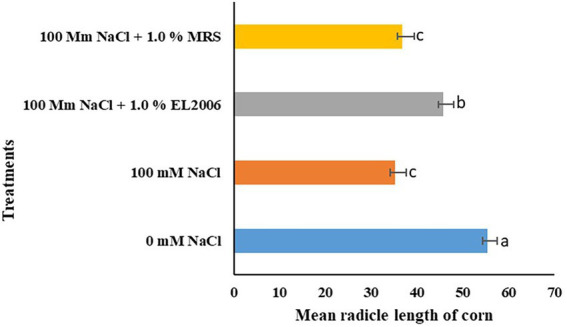
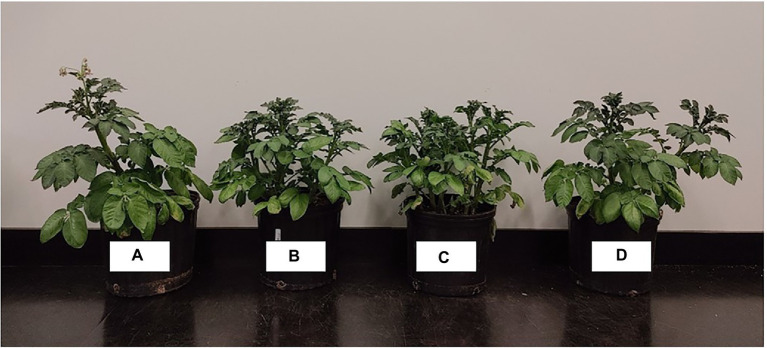
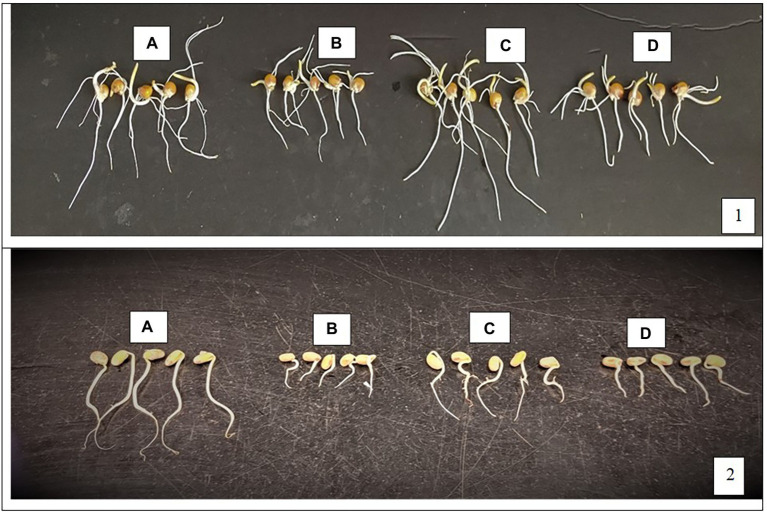
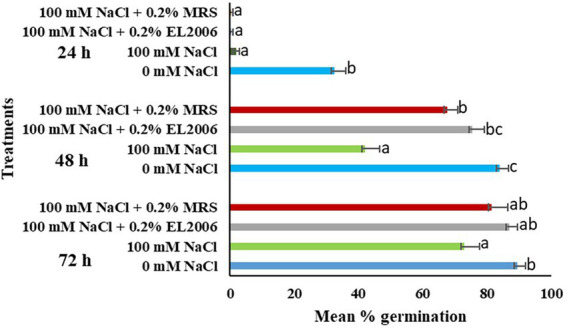
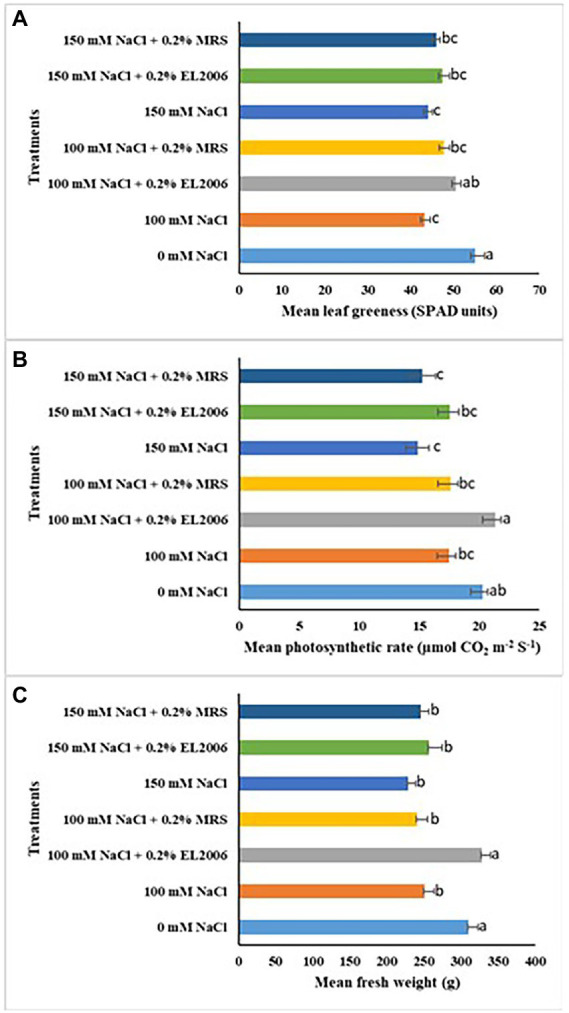
Plant growth promoting microorganisms and their derived compounds, such as cell-free supernatant (CFS), enhance plant growth under stressed and non stressed conditions. Such technology is sustainable and environmentally friendly, which is desirable amidst the climate change threat. The current study evaluated the effect of CFS obtained from EL2006H on its ability to enhance mean percentage germination and mean radicle length of corn and soybean, as well as growth parameters of potato, using treatment formulations that consisted of 0.2 and 1.0% [v/v] EL2006H CFS concentrations and 100 mM NaCl and 150 mM NaCl levels. Results show that treatment with 100 mM NaCl lowered percentage germination of corn by 52.63%, at 72 h, and soybean by 50%, at 48 h. Treatment with 100 NaCl +0.2% EL2006H enhanced percentage germination of soybean by 44.37%, at 48 h, in comparison to that of the 100 mM NaCl control. One hundred mM NaCl lowered radicle length of corn and soybean by 38.58 and 36.43%, respectively. Treatment with 100 Mm NaCl +1.0% EL2006H significantly increased radicle length of corn by 23.04%. Treatment with 100 mM NaCl +0.2% EL2006H significantly increased photosynthetic rate, leaf greenness and fresh weight of potato. Increasing NaCl concentration to 150 NaCl lowered the effectiveness of the 0.2% EL2006H CFS on the same growth variables of potato. In general, the lower CFS concentration of 0.2% was more efficient at enhancing germination in soybean while the higher concentration of 1.0% was more efficient at enhancing radicle length of corn. There was an observed variation in the effectiveness of EL2006H CFS across the different CFS concentrations, NaCl levels and crop species studied. In conclusion, based on findings of this study, CFS obtained from can be used as a bio stimulant to enhance growth of corn, soybean and potato. However, further studies need to be conducted, for validation, especially under field conditions, for commercial application.
促进植物生长的微生物及其衍生化合物,如无细胞上清液(CFS),可在胁迫和非胁迫条件下促进植物生长。这类技术具有可持续性且环保,在气候变化威胁的背景下是理想之选。本研究评估了从EL2006H获得的CFS对提高玉米和大豆平均发芽率及平均胚根长度的能力,以及对马铃薯生长参数的影响,使用了由0.2%和1.0%[v/v]的EL2006H CFS浓度以及100 mM NaCl和150 mM NaCl水平组成的处理配方。结果表明,在72小时时,用100 mM NaCl处理使玉米的发芽率降低了52.63%,在48小时时,使大豆的发芽率降低了50%。与100 mM NaCl对照组相比,用100 NaCl + 0.2% EL2006H处理在48小时时使大豆的发芽率提高了44.37%。100 mM NaCl使玉米和大豆的胚根长度分别降低了38.58%和36.43%。用100 Mm NaCl + 1.0% EL2006H处理使玉米的胚根长度显著增加了23.04%。用100 mM NaCl + 0.2% EL2006H处理显著提高了马铃薯的光合速率、叶片绿度和鲜重。将NaCl浓度提高到150 NaCl会降低0.2% EL2006H CFS对马铃薯相同生长变量的有效性。总体而言,较低的0.2% CFS浓度在提高大豆发芽率方面更有效,而较高的1.0%浓度在提高玉米胚根长度方面更有效。在所研究的不同CFS浓度、NaCl水平和作物种类中,观察到EL2006H CFS的有效性存在差异。总之,基于本研究的结果,从EL2006H获得的CFS可作为一种生物刺激剂来促进玉米、大豆和马铃薯的生长。然而,需要进行进一步的研究以进行验证,特别是在田间条件下进行商业应用验证。