Urology Department, University Hospital of Angers, 49933 Angers cedex 9, Angers, France.
Health Faculty, University of Angers, Angers, France.
BMC Med Educ. 2023 Jan 28;23(1):69. doi: 10.1186/s12909-023-04050-5.
Recently, Objective Structured Clinical Examinations (OSCE) became an official evaluation modality for 6-year medical students in France. Before, standard examination modalities were: written progressive clinical cases (PCC), written critical reading of scientific articles (CRA), and internship evaluation (IE). The aim of this study was to assess the performances of 6-year medical students in their final faculty tests by comparing OSCE-exams with standard examination modalities.
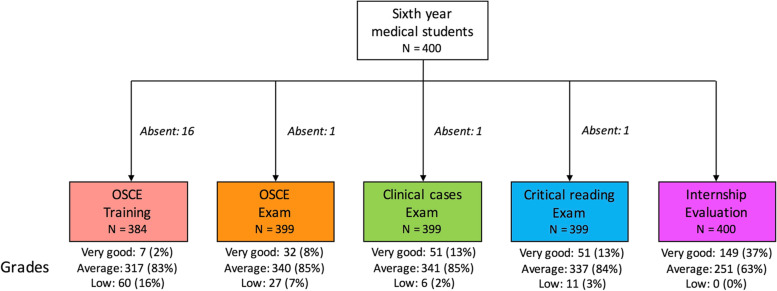
This was a prospective observational study. We included all 6-year medical students in our university from 2020 to 2021. The endpoints were the scores obtained at the following final faculty tests during the 6 year of medical studies: OSCE-training, OSCE-exams, written PCC, written CRA, and IE. All scores were compared in a paired-analysis.
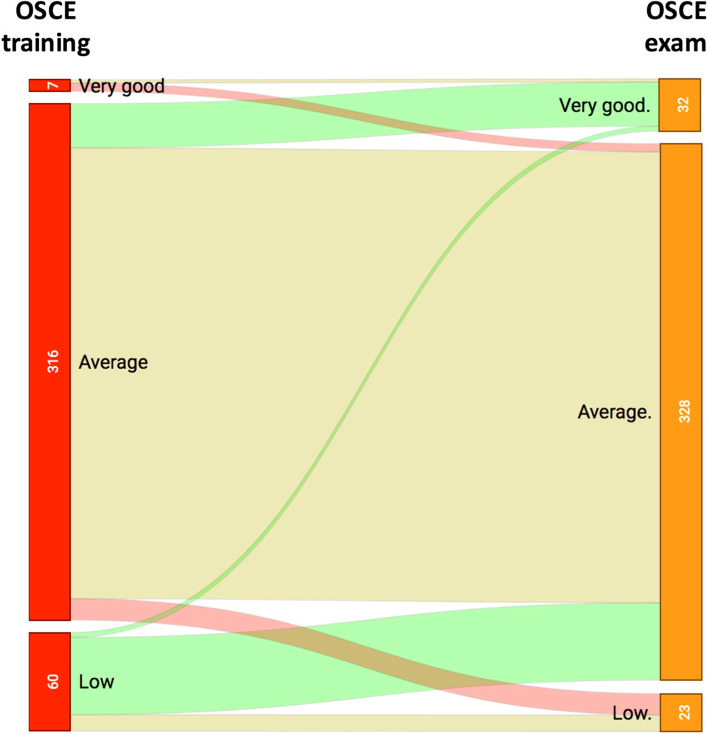
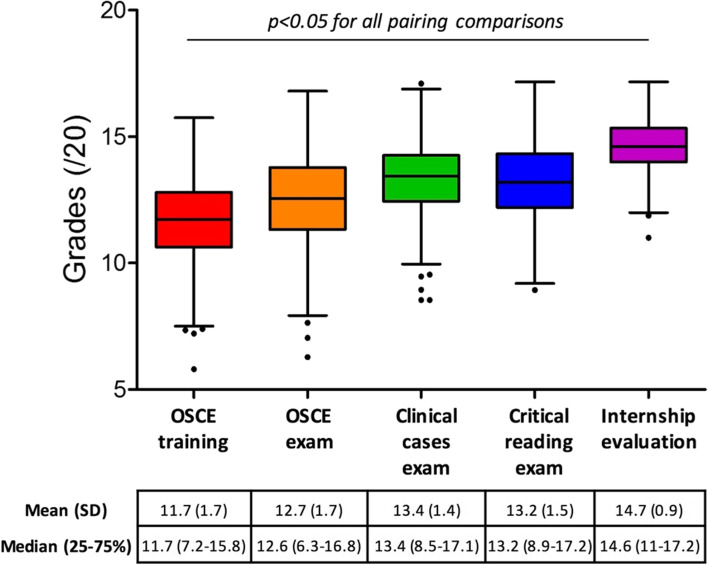
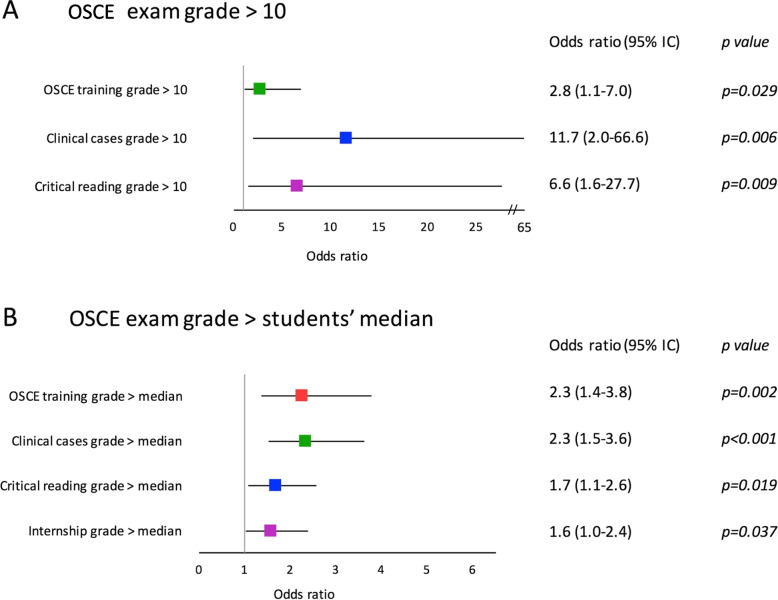
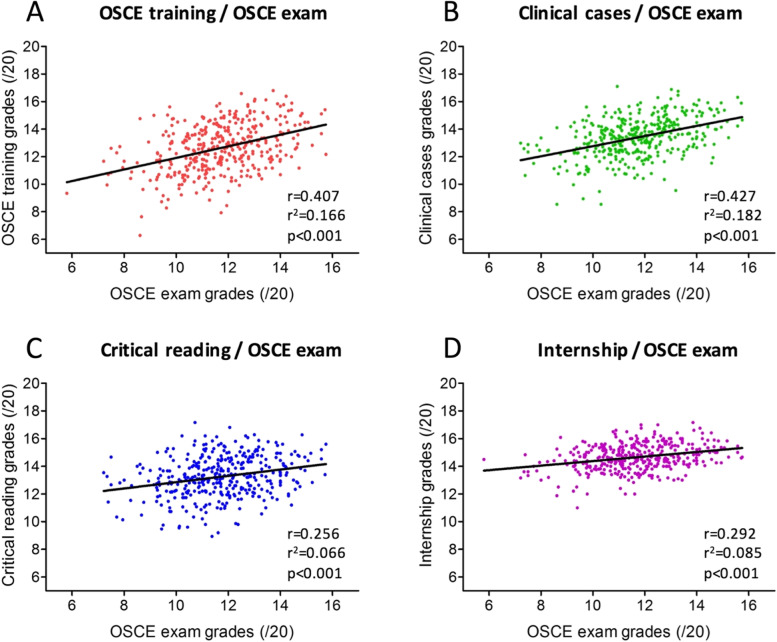
A total of 400 students were included in the study. No student was excluded in the final analysis. The mean scores obtained at the OSCE-exams were significantly different from those obtained at OSCE-training, PCC, CRA, and IE (12.6 ± 1.7, 11.7 ± 1.7, 13.4 ± 1.4, 13.2 ± 1.5, 14.7 ± 0.9, respectively; p < 0.001). OSCE-exams scores were moderately and significantly correlated with OSCE-training and PCC (Spearman rho coefficient = 0.4, p < 0.001); OSCE examination scores were lowly but significantly correlated with CRA and IE (Spearman rho coefficient = 0.3, p < 0.001). OSCE-scores significantly increased after an OSCE training session.
In our faculty, 6-year medical students obtained lower scores at OSCE exams compared to other standard evaluation modalities. The correlation was weak to moderate but significant. These results suggest that OSCE are not redundant with the other evaluation modalities. Interestingly, a single OSCE training session led to an improvement in OSCE scores underlining the importance of a specific training.
最近,客观结构化临床考试(OSCE)成为法国六年制医学生的官方评估模式。在此之前,标准的考试模式为:书面渐进式临床病例(PCC)、书面科学文章批判性阅读(CRA)和实习评估(IE)。本研究的目的是通过比较 OSCE 考试与标准考试模式来评估六年制医学生在最终的校内考试中的表现。
这是一项前瞻性观察研究。我们纳入了 2020 年至 2021 年期间我校所有的六年制医学生。研究终点为六年制医学学习期间以下最终校内考试的得分:OSCE 培训、OSCE 考试、书面 PCC、书面 CRA 和实习评估。所有分数均进行配对分析比较。
共有 400 名学生纳入研究,最终分析中无学生被排除。OSCE 考试中的平均得分与 OSCE 培训、PCC、CRA 和实习评估中的得分显著不同(分别为 12.6±1.7、11.7±1.7、13.4±1.4、13.2±1.5、14.7±0.9;p<0.001)。OSCE 考试得分与 OSCE 培训和 PCC 呈中度显著相关(Spearman rho 系数=0.4,p<0.001);OSCE 考试得分与 CRA 和实习评估呈低度显著相关(Spearman rho 系数=0.3,p<0.001)。经过 OSCE 培训后,OSCE 得分显著提高。
在我们的学院中,六年制医学生在 OSCE 考试中的得分低于其他标准评估模式。相关性为弱到中度但显著。这些结果表明 OSCE 与其他评估模式并不多余。有趣的是,单次 OSCE 培训课程可提高 OSCE 分数,这强调了特定培训的重要性。