Theunissen Luc J H J, Abdalrahim Reyan B E M, Dekker Lukas R C, Thijssen Eric J M, de Jong Sylvie F A M S, Polak Peter E, van de Voort Pepijn H, Smits Geert, Scheele Karin, Lucas Annelies, van Veghel Dennis P A, Cremers Henricus-Paul, van de Pol Jeroen A A, Kemps Hareld M C
Netherlands Heart Network, De Run 4600, 5504 DB, Veldhoven, The Netherlands.
Máxima Medical Centre, De Run 4600, 5504DB, Veldhoven, The Netherlands.
Eur Heart J Digit Health. 2022 Oct 3;3(4):570-577. doi: 10.1093/ehjdh/ztac055. eCollection 2022 Dec.
Despite general awareness that screening for atrial fibrillation (AF) could reduce health hazards, large-scale implementation is lagging behind technological developments. As the successful implementation of a screening programme remains challenging, this study aims to identify facilitating and inhibiting factors from healthcare providers' perspectives.
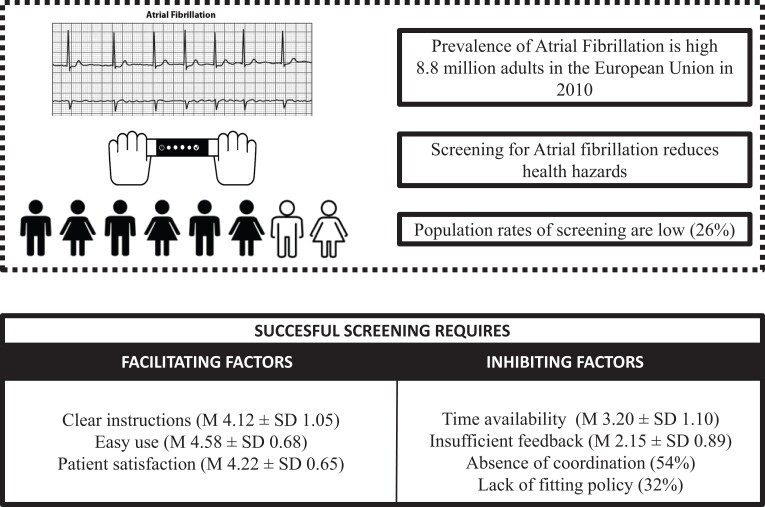
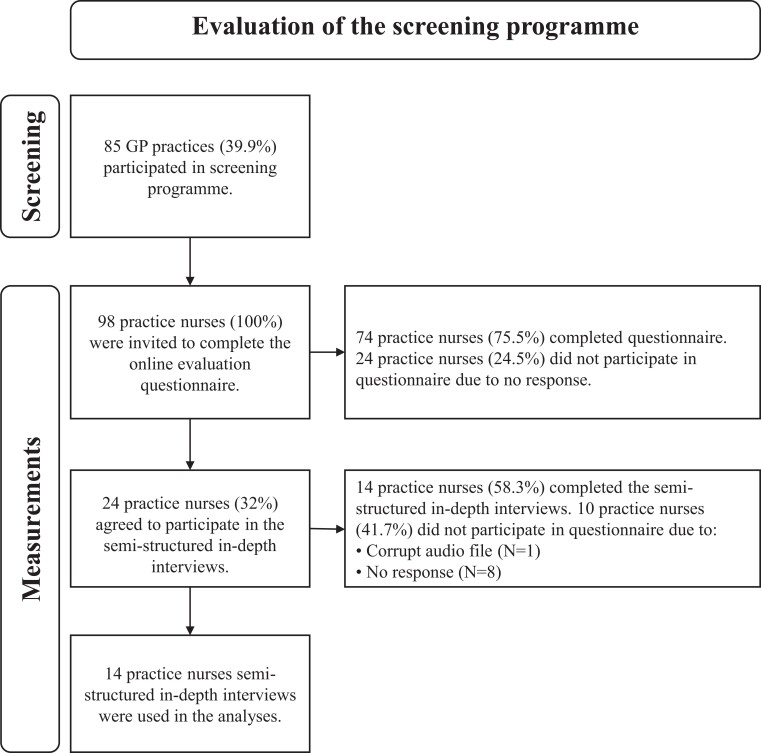
A mixed-methods approach was used to gather data among practice nurses in primary care in the southern region of the Netherlands to evaluate the implementation of an ongoing single-lead electrocardiogram (ECG)-based AF screening programme. Potential facilitating and inhibiting factors were evaluated using online questionnaires (N = 74/75%) and 14 (of 24) semi-structured in-depth interviews (58.3%). All analyses were performed using SPSS 26.0. In total, 16 682 screenings were performed on an eligible population of 64 000, and 100 new AF cases were detected. Facilitating factors included 'receiving clear instructions' (mean ± SD; 4.12 ± 1.05), 'easy use of the ECG-based device' (4.58 ± 0.68), and 'patient satisfaction' (4.22 ± 0.65). Inhibiting factors were 'time availability' (3.20 ± 1.10), 'insufficient feedback to the practice nurse' (2.15 ± 0.89), 'absence of coordination' (54%), and the 'lack of fitting policy' (32%).
Large-scale regional implementation of an AF screening programme in primary care resulted in a low participation of all eligible patients. Based on the perceived barriers by healthcare providers, future AF screening programmes should create preconditions to fit the intervention into daily routines, appointing an overall project lead and a General Practitioner (GP) as a coordinator within every GP practice.
尽管人们普遍认识到心房颤动(AF)筛查可降低健康风险,但大规模实施仍落后于技术发展。由于筛查计划的成功实施仍然具有挑战性,本研究旨在从医疗保健提供者的角度确定促进因素和抑制因素。
采用混合方法收集荷兰南部地区基层医疗执业护士的数据,以评估正在进行的基于单导联心电图(ECG)的AF筛查计划的实施情况。使用在线问卷(N = 74/75%)和24份中的14份半结构化深度访谈(58.3%)评估潜在的促进因素和抑制因素。所有分析均使用SPSS 26.0进行。在64000名符合条件的人群中总共进行了16682次筛查,检测到100例新发AF病例。促进因素包括“收到明确指示”(均值±标准差;4.12±1.05)、“基于ECG的设备易于使用”(4.58±0.68)和“患者满意度”(4.22±0.65)。抑制因素为“时间可用性”(3.20±1.10)、“对执业护士的反馈不足”(2.15±0.89)、“缺乏协调”(54%)和“缺乏合适的政策”(32%)。
基层医疗中AF筛查计划的大规模区域实施导致所有符合条件患者的参与率较低。基于医疗保健提供者意识到的障碍,未来的AF筛查计划应创造条件,使干预措施融入日常工作,在每个全科医生诊所指定一名总体项目负责人和一名全科医生(GP)作为协调员。