Pawelec Kendell M, Tu Ethan, Chakravarty Shatadru, Hix Jeremy Ml, Buchanan Lane, Kenney Legend, Buchanan Foster, Chatterjee Nandini, Das Subhashri, Alessio Adam, Shapiro Erik M
Michigan State University, Dept Radiology, East Lansing, MI 48823.
Michigan State University, Dept Biomedical Engineering, East Lansing, MI 48823.
bioRxiv. 2023 Jan 8:2023.01.06.523025. doi: 10.1101/2023.01.06.523025.
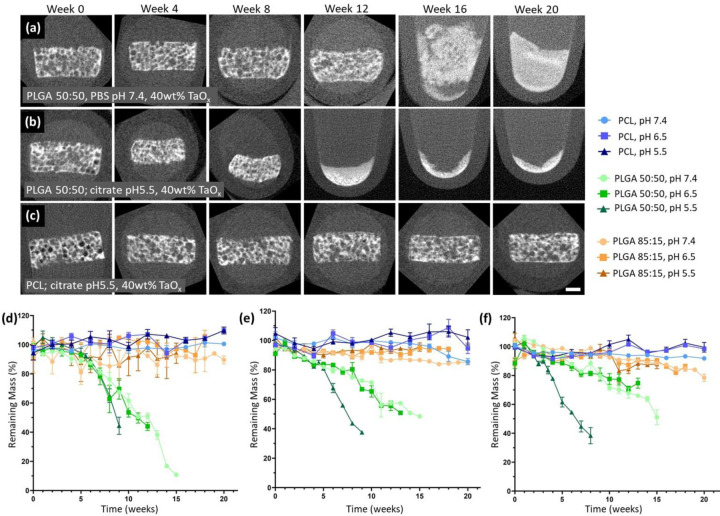
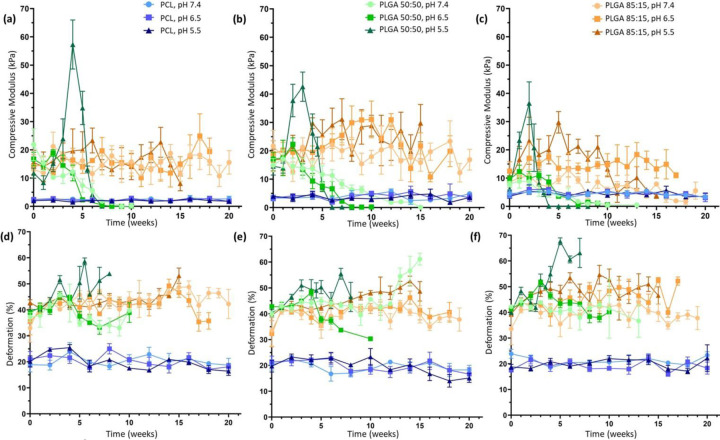
Longitudinal radiological monitoring of biomedical devices is increasingly important, driven by risk of device failure following implantation. Polymeric devices are poorly visualized with clinical imaging, hampering efforts to use diagnostic imaging to predict failure and enable intervention. Introducing nanoparticle contrast agents into polymers is a potential method for creating radiopaque materials that can be monitored via computed tomography. However, properties of composites may be altered with nanoparticle addition, jeopardizing device functionality. This, we investigated material and biomechanical response of model nanoparticle-doped biomedical devices (phantoms), created from 0-40wt% TaO nanoparticles in polycaprolactone, poly(lactide-co-glycolide) 85:15 and 50:50, representing non-, slow and fast degrading systems, respectively. Phantoms degraded over 20 weeks in vitro, in simulated physiological environments: healthy tissue (pH 7.4), inflammation (pH 6.5), and lysosomal conditions (pH 5.5), while radiopacity, structural stability, mechanical strength and mass loss were monitored. The polymer matrix determined overall degradation kinetics, which increased with lower pH and higher TaO content. Importantly, all radiopaque phantoms could be monitored for a full 20-weeks. Phantoms implanted in vivo and serially imaged, demonstrated similar results. An optimal range of 5-20wt% TaO nanoparticles balanced radiopacity requirements with implant properties, facilitating next-generation biomedical devices.
由于植入后设备故障的风险,生物医学设备的纵向放射学监测变得越来越重要。聚合物设备在临床成像中很难被清晰显示,这阻碍了利用诊断成像来预测故障并进行干预的努力。将纳米颗粒造影剂引入聚合物中是一种创建可通过计算机断层扫描进行监测的不透射线材料的潜在方法。然而,添加纳米颗粒可能会改变复合材料的性能,从而危及设备的功能。因此,我们研究了由聚己内酯、聚(丙交酯-共-乙交酯)85:15和50:50中0-40wt%的TaO纳米颗粒制成的模型纳米颗粒掺杂生物医学设备(模型体模)的材料和生物力学响应,分别代表非降解、缓慢降解和快速降解系统。在模拟生理环境(健康组织(pH 7.4)、炎症(pH 6.5)和溶酶体条件(pH 5.5))下,模型体模在体外降解20周,同时监测不透射线性能、结构稳定性、机械强度和质量损失。聚合物基质决定了整体降解动力学,其随较低的pH值和较高的TaO含量而增加。重要的是,所有不透射线的模型体模都可以被监测整整20周。植入体内并进行连续成像的模型体模显示了类似的结果。5-20wt%的TaO纳米颗粒的最佳范围在不透射线性能要求与植入物性能之间取得了平衡,为下一代生物医学设备提供了便利。