Shao Yu-Hsuan, Tsai Kevin, Kim Sinae, Wu Yu-Jen, Demissie Kitaw
Graduate Institute of Biomedical Informatics, College of Medical Science and Technology, Taipei Medical University, Taipei, Taiwan.
Clinical Big Data Research Center, Taipei Medical University Hospital, Taipei, Taiwan.
JNCI Cancer Spectr. 2019 Nov 14;4(1):pkz072. doi: 10.1093/jncics/pkz072. eCollection 2020 Feb.
Worldwide use of computed tomography (CT) scans has increased. However, the ionizing radiation from CT scans may increase the risk of cancer. This study examined the association between medical radiation from CT scans and the risk of thyroid cancer, lymphoma, and non-Hodgkin lymphoma (NHL) in adults.
We conducted a nested case-control study in a cohort constructed from a population-based universal health insurance dataset in Taiwan in 2000-2013. In total, 22 853 thyroid cancer, 13 040 leukemia, and 20 157 NHL cases with their matched controls were included. Median follow-up times were 9.29-9.90 years for the three case-control groups. Medical radiation from CT scans was identified through physician order codes in medical insurance data from the index date to 3 years before a cancer diagnosis. Conditional logistic regression modeling was used for the overall and subsets of the population defined by sex and age groups to estimate the odds ratio (OR) and 95% confidence interval (CI) of the cancer risk associated with medical radiation.
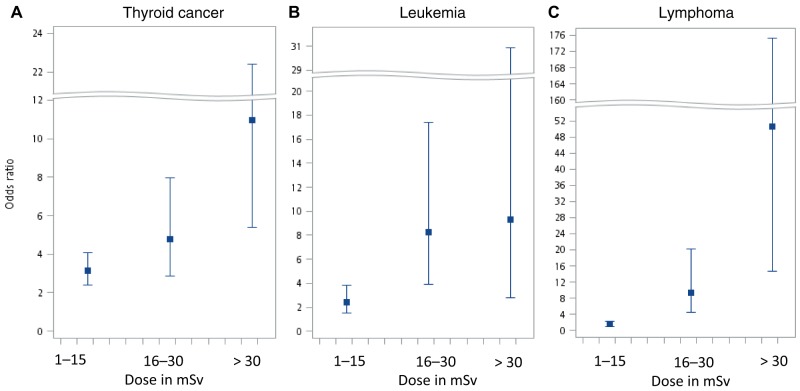
Exposure to medical radiation from CT scans was associated with elevated risk of thyroid cancer (OR = 2.55, 95% CI = 2.36 to 2.75) and leukemia (OR = 1.55, 95% CI = 1.42 to 1.68). The elevated risk of thyroid cancer and leukemia in association with medical CT was stronger in women than in men. No statistically significant association between the risk of cancer and CT scans was observed in overall patients with NHL (OR = 1.05, 95% CI = 0.98 to 1.12); however, increased risks were found in patients aged 45 years or younger. A clear dose-response relationship was observed in patients 45 years or younger for all three cancers.
CT scans may be associated with an increased risk of thyroid cancer and leukemia in adults and in those diagnosed with NHL at a younger age.
计算机断层扫描(CT)在全球范围内的使用有所增加。然而,CT扫描产生的电离辐射可能会增加患癌风险。本研究调查了成人CT扫描产生的医疗辐射与甲状腺癌、淋巴瘤和非霍奇金淋巴瘤(NHL)风险之间的关联。
我们在一个基于2000 - 2013年台湾地区全民健康保险数据集构建的队列中进行了一项巢式病例对照研究。总共纳入了22853例甲状腺癌、13040例白血病和20157例NHL病例及其匹配对照。三个病例对照组的中位随访时间为9.29 - 9.90年。通过医疗保险数据中从索引日期到癌症诊断前3年的医生医嘱代码来识别CT扫描产生的医疗辐射。使用条件逻辑回归模型对按性别和年龄组定义的总体人群及其子集进行分析,以估计与医疗辐射相关的癌症风险的比值比(OR)和95%置信区间(CI)。
CT扫描产生的医疗辐射与甲状腺癌风险升高相关(OR = 2.55,95% CI = 2.36至2.75)以及白血病风险升高相关(OR = 1.55,95% CI = 1.42至1.68)。与医疗CT相关的甲状腺癌和白血病风险升高在女性中比男性更强。在总体NHL患者中未观察到癌症风险与CT扫描之间存在统计学显著关联(OR = 1.05,95% CI = 0.98至1.12);然而,在45岁及以下的患者中发现风险增加。在45岁及以下的患者中,对于所有三种癌症均观察到明确的剂量反应关系。
CT扫描可能与成人以及年轻时被诊断为NHL的患者患甲状腺癌和白血病的风险增加有关。