• 文献检索
  • 文档翻译
  • 深度研究
  • 学术资讯
  • Suppr Zotero 插件Zotero 插件
  • 邀请有礼
  • 套餐&价格
  • 历史记录
应用&插件
Suppr Zotero 插件Zotero 插件浏览器插件Mac 客户端Windows 客户端微信小程序
定价
高级版会员购买积分包购买API积分包
服务
文献检索文档翻译深度研究API 文档MCP 服务
关于我们
关于 Suppr公司介绍联系我们用户协议隐私条款
关注我们

Suppr 超能文献

核心技术专利:CN118964589B侵权必究
粤ICP备2023148730 号-1Suppr @ 2026

文献检索

告别复杂PubMed语法,用中文像聊天一样搜索,搜遍4000万医学文献。AI智能推荐,让科研检索更轻松。

立即免费搜索

文件翻译

保留排版,准确专业,支持PDF/Word/PPT等文件格式,支持 12+语言互译。

免费翻译文档

深度研究

AI帮你快速写综述,25分钟生成高质量综述,智能提取关键信息,辅助科研写作。

立即免费体验

不同类型痴呆症患者死亡率的预测模型及特征

Predictive Models and Features of Patient Mortality across Dementia Types.

作者信息

Zhang Jimmy, Song Luo, Chan Kwun, Miller Zachary, Huang Kuan-Lin

机构信息

Icahn School of Medicine at Mount Sinai.

School of Medicine, The University of Queensland.

出版信息

Res Sq. 2023 Jan 20:rs.3.rs-2350961. doi: 10.21203/rs.3.rs-2350961/v1.

DOI:10.21203/rs.3.rs-2350961/v1
PMID:36711767
原文链接:https://pmc.ncbi.nlm.nih.gov/articles/PMC9882612/
Abstract

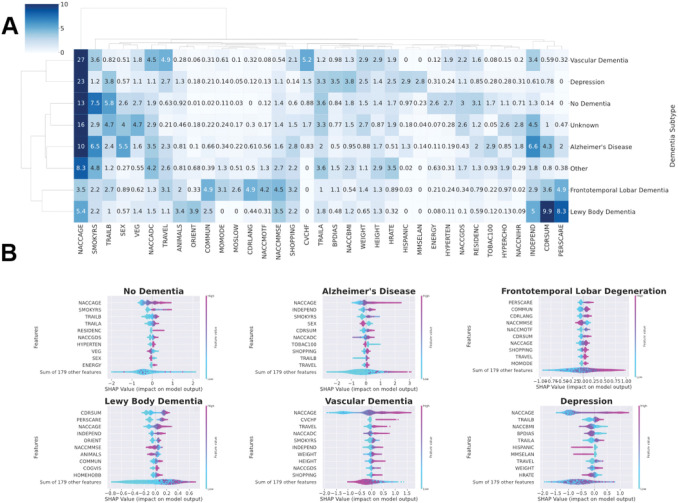
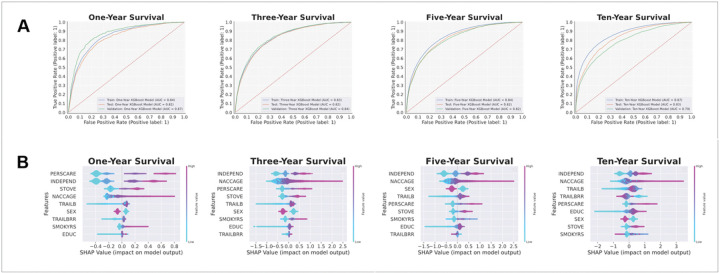
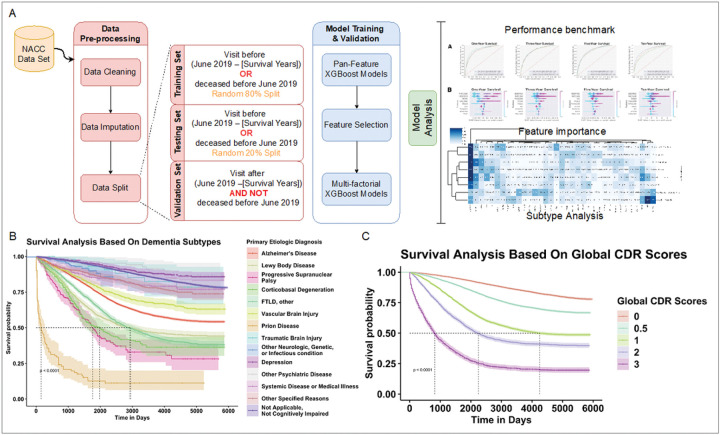
Dementia care is challenging due to the divergent trajectories in disease progression and outcomes. Predictive models are needed to identify patients at risk of near-term mortality. Here, we developed machine learning models predicting survival using a dataset of 45,275 unique participants and 163,782 visit records from the U.S. National Alzheimer's Coordinating Center (NACC). Our models achieved an AUC-ROC of over 0.82 utilizing nine parsimonious features for all one-, three-, five-, and ten-year thresholds. The trained models mainly consisted of dementia-related predictors such as specific neuropsychological tests and were minimally affected by other age-related causes of death, e.g., stroke and cardiovascular conditions. Notably, stratified analyses revealed shared and distinct predictors of mortality across eight dementia types. Unsupervised clustering of mortality predictors grouped vascular dementia with depression and Lewy body dementia with frontotemporal lobar dementia. This study demonstrates the feasibility of flagging dementia patients at risk of mortality for personalized clinical management.

摘要

由于疾病进展和预后的轨迹不同,痴呆症护理具有挑战性。需要预测模型来识别近期有死亡风险的患者。在此,我们利用来自美国国家阿尔茨海默病协调中心(NACC)的45275名独特参与者和163782次就诊记录的数据集,开发了预测生存的机器学习模型。我们的模型在所有1年、3年、5年和10年阈值下,利用9个简约特征实现了超过0.82的AUC-ROC。训练后的模型主要由与痴呆症相关的预测因素组成,如特定的神经心理学测试,并且受其他与年龄相关的死亡原因(如中风和心血管疾病)的影响最小。值得注意的是,分层分析揭示了八种痴呆类型中共同和不同的死亡预测因素。对死亡预测因素的无监督聚类将血管性痴呆与抑郁症归为一组,将路易体痴呆与额颞叶痴呆归为一组。这项研究证明了标记有死亡风险的痴呆症患者以进行个性化临床管理的可行性。
https://cdn.ncbi.nlm.nih.gov/pmc/blobs/5063/9882612/e8adfdb37848/nihpp-rs2350961v1-f0003.jpg
https://cdn.ncbi.nlm.nih.gov/pmc/blobs/5063/9882612/7e2cd7175641/nihpp-rs2350961v1-f0001.jpg
https://cdn.ncbi.nlm.nih.gov/pmc/blobs/5063/9882612/2d16b08a0561/nihpp-rs2350961v1-f0002.jpg
https://cdn.ncbi.nlm.nih.gov/pmc/blobs/5063/9882612/e8adfdb37848/nihpp-rs2350961v1-f0003.jpg
https://cdn.ncbi.nlm.nih.gov/pmc/blobs/5063/9882612/7e2cd7175641/nihpp-rs2350961v1-f0001.jpg
https://cdn.ncbi.nlm.nih.gov/pmc/blobs/5063/9882612/2d16b08a0561/nihpp-rs2350961v1-f0002.jpg
https://cdn.ncbi.nlm.nih.gov/pmc/blobs/5063/9882612/e8adfdb37848/nihpp-rs2350961v1-f0003.jpg

相似文献

1
Predictive Models and Features of Patient Mortality across Dementia Types.不同类型痴呆症患者死亡率的预测模型及特征
Res Sq. 2023 Jan 20:rs.3.rs-2350961. doi: 10.21203/rs.3.rs-2350961/v1.
2
Machine learning models identify predictive features of patient mortality across dementia types.机器学习模型可识别不同类型痴呆症患者死亡的预测特征。
Commun Med (Lond). 2024 Feb 28;4(1):23. doi: 10.1038/s43856-024-00437-7.
3
Predictors of Mortality in Individuals with Dementia in the National Alzheimer's Coordinating Center.国家阿尔茨海默病协调中心痴呆患者死亡的预测因素。
J Alzheimers Dis. 2022;86(4):1935-1946. doi: 10.3233/JAD-215587.
4
Cognitive trajectories preluding the onset of different dementia entities: a descriptive longitudinal study using the NACC database.认知轨迹先于不同痴呆实体的发病:使用 NACC 数据库的描述性纵向研究。
Aging Clin Exp Res. 2024 May 23;36(1):119. doi: 10.1007/s40520-024-02769-9.
5
Caregiver burden, sleep quality, depression, and anxiety in dementia caregivers: a comparison of frontotemporal lobar degeneration, dementia with Lewy bodies, and Alzheimer's disease.痴呆症照顾者的负担、睡眠质量、抑郁和焦虑:额颞叶变性、路易体痴呆和阿尔茨海默病的比较。
Int Psychogeriatr. 2018 Aug;30(8):1131-1138. doi: 10.1017/S1041610217002630. Epub 2017 Dec 10.
6
Factors affecting progression of non-Alzheimer dementia: a retrospective analysis with long-term follow-up.影响非阿尔茨海默病性痴呆进展的因素:一项长期随访的回顾性分析
Front Neurol. 2023 Oct 18;14:1240093. doi: 10.3389/fneur.2023.1240093. eCollection 2023.
7
The Relationship Between First Presenting Neuropsychiatric Symptoms in Older Adults and Autopsy-Confirmed Memory Disorders.老年人首次出现神经精神症状与尸检证实的记忆障碍之间的关系。
Am J Geriatr Psychiatry. 2024 Jun;32(6):754-764. doi: 10.1016/j.jagp.2024.01.015. Epub 2024 Jan 17.
8
Disease severity and mortality in Alzheimer's disease: an analysis using the U.S. National Alzheimer's Coordinating Center Uniform Data Set.阿尔茨海默病的疾病严重程度和死亡率:使用美国国家阿尔茨海默病协调中心统一数据集进行的分析。
BMC Neurol. 2023 Aug 14;23(1):302. doi: 10.1186/s12883-023-03353-w.
9
Development of a novel dementia risk prediction model in the general population: A large, longitudinal, population-based machine-learning study.普通人群中新型痴呆风险预测模型的开发:一项基于人群的大型纵向机器学习研究。
EClinicalMedicine. 2022 Sep 23;53:101665. doi: 10.1016/j.eclinm.2022.101665. eCollection 2022 Nov.
10
The graded multidimensional geometry of phenotypic variation and progression in neurodegenerative syndromes.神经退行性综合征中表型变异和进展的分级多维几何学。
Brain. 2025 Feb 3;148(2):448-466. doi: 10.1093/brain/awae233.

本文引用的文献

1
Machine Learning for the Preliminary Diagnosis of Dementia.用于痴呆症初步诊断的机器学习
Sci Program. 2020;2020:5629090. doi: 10.1155/2020/5629090. Epub 2020 Mar 7.
2
Time-to-event prediction using survival analysis methods for Alzheimer's disease progression.使用生存分析方法对阿尔茨海默病进展进行事件发生时间预测。
Alzheimers Dement (N Y). 2021 Dec 31;7(1):e12229. doi: 10.1002/trc2.12229. eCollection 2021.
3
Estimation of the global prevalence of dementia in 2019 and forecasted prevalence in 2050: an analysis for the Global Burden of Disease Study 2019.
2019 年全球痴呆症患病率估计及 2050 年预测患病率:2019 年全球疾病负担研究分析。
Lancet Public Health. 2022 Feb;7(2):e105-e125. doi: 10.1016/S2468-2667(21)00249-8. Epub 2022 Jan 6.
4
Machine learning for modeling the progression of Alzheimer disease dementia using clinical data: a systematic literature review.利用临床数据进行阿尔茨海默病痴呆症进展建模的机器学习:系统文献综述
JAMIA Open. 2021 Aug 2;4(3):ooab052. doi: 10.1093/jamiaopen/ooab052. eCollection 2021 Jul.
5
Evaluating the impact of multivariate imputation by MICE in feature selection.评估 MICE 进行多元插补对特征选择的影响。
PLoS One. 2021 Jul 28;16(7):e0254720. doi: 10.1371/journal.pone.0254720. eCollection 2021.
6
The Leading Causes of Death in the US for 2020.2020年美国的主要死因。
JAMA. 2021 May 11;325(18):1829-1830. doi: 10.1001/jama.2021.5469.
7
A comparison of machine learning methods for survival analysis of high-dimensional clinical data for dementia prediction.基于机器学习的高维临床数据生存分析方法在痴呆预测中的比较。
Sci Rep. 2020 Nov 23;10(1):20410. doi: 10.1038/s41598-020-77220-w.
8
Estimates of the Association of Dementia With US Mortality Levels Using Linked Survey and Mortality Records.利用关联调查和死亡率记录估计痴呆症与美国死亡率水平的关系。
JAMA Neurol. 2020 Dec 1;77(12):1543-1550. doi: 10.1001/jamaneurol.2020.2831.
9
Machine learning-based cognitive impairment classification with optimal combination of neuropsychological tests.基于机器学习的认知障碍分类与神经心理学测试的最佳组合
Alzheimers Dement (N Y). 2020 Jul 19;6(1):e12049. doi: 10.1002/trc2.12049. eCollection 2020.
10
Development and validation of an interpretable deep learning framework for Alzheimer's disease classification.用于阿尔茨海默病分类的可解释深度学习框架的开发与验证
Brain. 2020 Jun 1;143(6):1920-1933. doi: 10.1093/brain/awaa137.