Wooten Matthew, Takushi Brittany, Ahmad Kami, Henikoff Steven
Fred Hutchinson Cancer Center, Seattle, WA 98109-1024, USA.
Howard Hughes Medical Institute.
bioRxiv. 2023 Jan 10:2023.01.09.523323. doi: 10.1101/2023.01.09.523323.
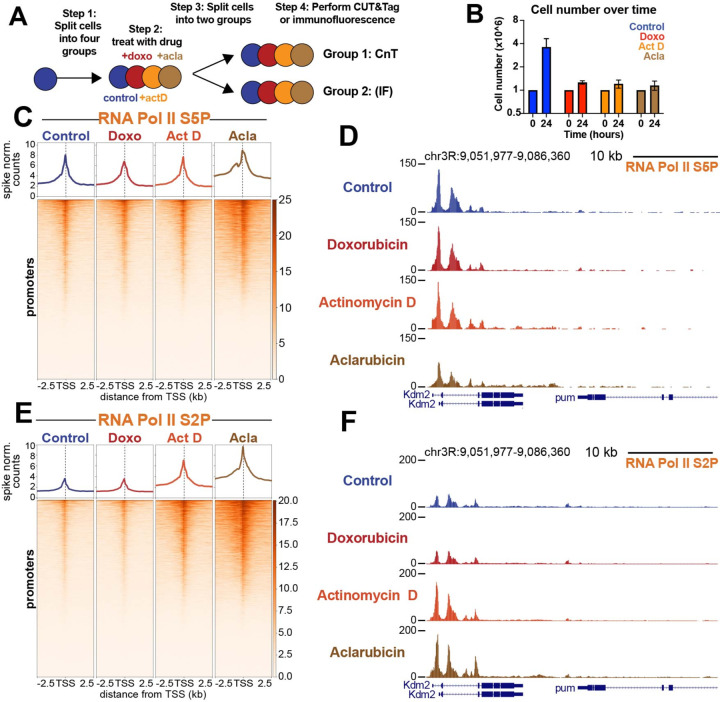
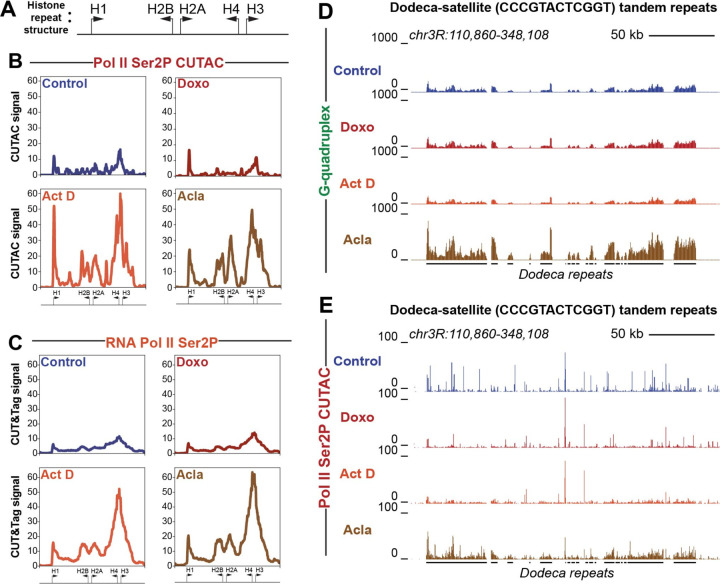
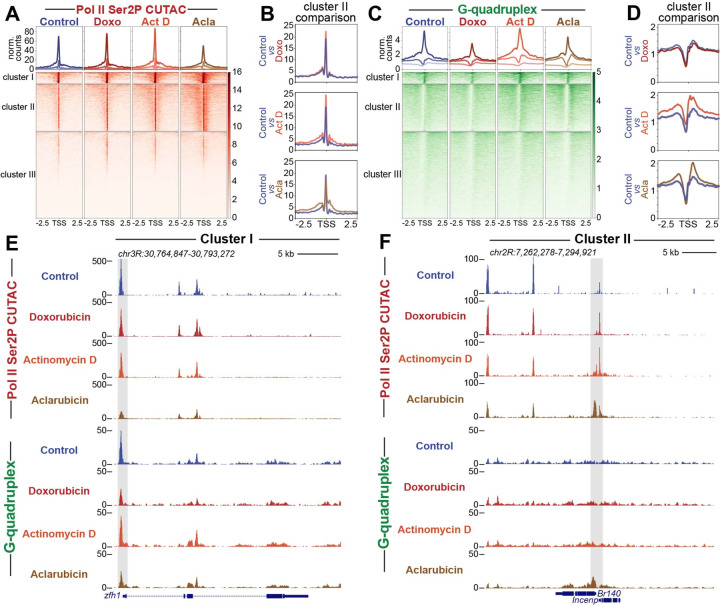
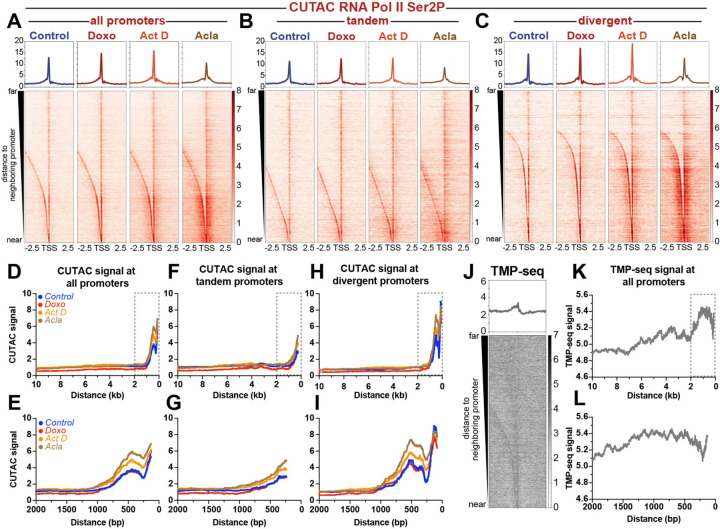
Anthracyclines are a class of widely prescribed anti-cancer drugs that disrupt chromatin by intercalating into DNA and enhancing nucleosome turnover. To understand the molecular consequences of anthracycline-mediated chromatin disruption, we utilized CUT&Tag to profile RNA polymerase II during anthracycline treatment in cells. We observed that treatment with the anthracycline aclarubicin leads to elevated levels of elongating RNA polymerase II and changes in chromatin accessibility. We found that promoter proximity and orientation impacts chromatin changes during aclarubicin treatment, as closely spaced divergent promoter pairs show greater chromatin changes when compared to codirectionally-oriented tandem promoters. We also found that aclarubicin treatment changes the distribution of non-canonical DNA G-quadruplex structures both at promoters and at G-rich pericentromeric repeats. Our work suggests that the anti-cancer activity of aclarubicin is driven by the effects of nucleosome disruption on RNA polymerase II, chromatin accessibility and DNA structures.
蒽环类药物是一类广泛使用的抗癌药物,它们通过嵌入DNA并增强核小体周转来破坏染色质。为了了解蒽环类药物介导的染色质破坏的分子后果,我们利用CUT&Tag技术在细胞中蒽环类药物处理期间对RNA聚合酶II进行分析。我们观察到,用阿柔比星这种蒽环类药物处理会导致延伸中的RNA聚合酶II水平升高以及染色质可及性的变化。我们发现,启动子的接近程度和方向会影响阿柔比星处理期间的染色质变化,因为与同向排列的串联启动子相比,紧密间隔的发散启动子对显示出更大的染色质变化。我们还发现,阿柔比星处理会改变启动子和富含G的着丝粒周围重复序列处非经典DNA G-四链体结构的分布。我们的工作表明,阿柔比星的抗癌活性是由核小体破坏对RNA聚合酶II、染色质可及性和DNA结构的影响所驱动的。