
证据的透明传达不会削弱公众对证据的信任。
Transparent communication of evidence does not undermine public trust in evidence.
作者信息
Kerr John R, Schneider Claudia R, Freeman Alexandra L J, Marteau Theresa, van der Linden Sander
机构信息
Department of Psychology, School of Biological Sciences, University of Cambridge, Downing Street, CB2 3EB Cambridge, UK.
Winton Centre for Risk and Evidence Communication, University of Cambridge, Wilberforce Road, CB3 0WA Cambridge, UK.
出版信息
PNAS Nexus. 2022 Dec 7;1(5):pgac280. doi: 10.1093/pnasnexus/pgac280. eCollection 2022 Nov.
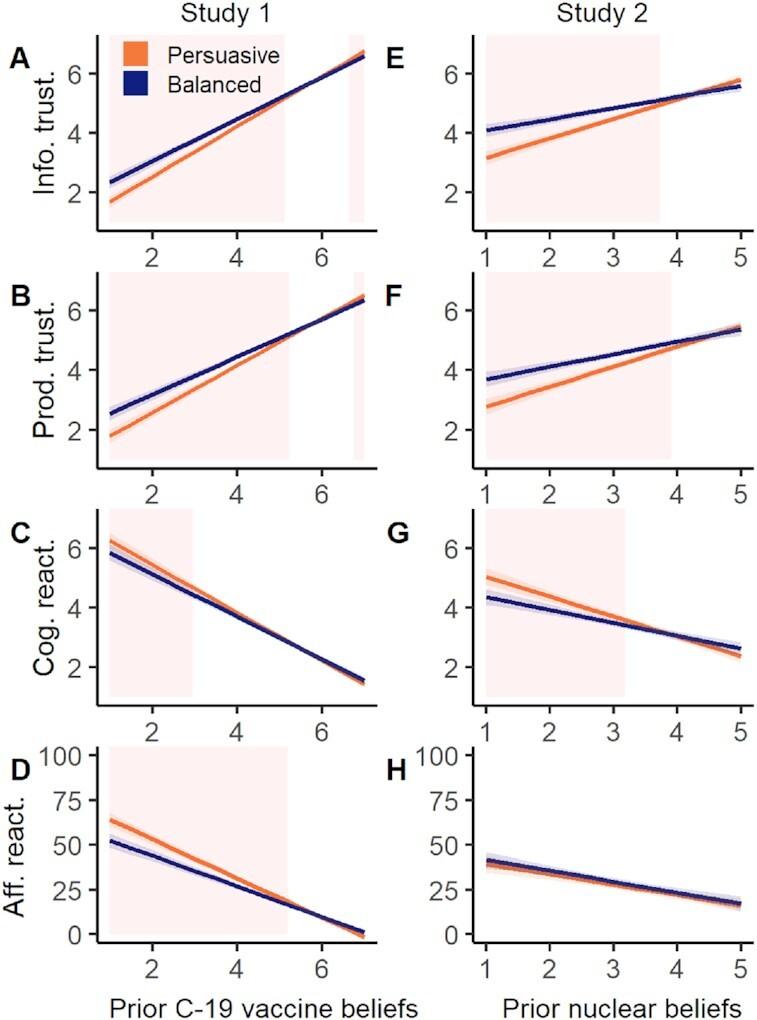
Does clear and transparent communication of risks, benefits, and uncertainties increase or undermine public trust in scientific information that people use to guide their decision-making? We examined the impact of reframing messages written in traditional persuasive style to align instead with recent "evidence communication" principles, aiming to inform decision-making: communicating a balance of risks and benefits, disclosing uncertainties and evidence quality, and prebunking misperceptions. In two pre-registered experiments, UK participants read either a persuasive message or a balanced and informative message adhering to evidence communication recommendations about COVID-19 vaccines (Study 1) or nuclear power plants (Study 2). We find that balanced messages are either perceived as trustworthy as persuasive messages (Study 1), or more so (Study 2). However, we note a moderating role of prior beliefs such that balanced messages were consistently perceived as more trustworthy among those with negative or neutral prior beliefs about the message content. We furthermore note that participants who had read the persuasive message on nuclear power plants voiced significantly stronger support for nuclear power than those who had read the balanced message, despite rating the information as less trustworthy. There was no difference in vaccination intentions between groups reading the different vaccine messages.
对风险、益处和不确定性进行清晰透明的沟通,会增加还是削弱公众对人们用于指导决策的科学信息的信任?我们研究了将传统说服风格的信息重新组织,使其符合最近的“证据沟通”原则的影响,目的是为决策提供信息:传达风险与益处的平衡、披露不确定性和证据质量,以及预先消除误解。在两项预先注册的实验中,英国参与者阅读了一条说服性信息,或者一条遵循关于新冠疫苗(研究1)或核电站(研究2)的证据沟通建议的平衡且信息丰富的信息。我们发现,平衡的信息要么被认为与说服性信息一样值得信赖(研究1),要么更值得信赖(研究2)。然而,我们注意到先验信念的调节作用,即在对信息内容持负面或中性先验信念的人群中,平衡的信息一直被认为更值得信赖。我们还注意到,尽管认为信息不太值得信赖,但阅读了关于核电站的说服性信息的参与者对核电的支持明显强于阅读了平衡信息的参与者。阅读不同疫苗信息的组之间在接种疫苗意愿上没有差异。

 Zotero 插件