Palmos Alish B, Hübel Christopher, Lim Kai Xiang, Hunjan Avina K, Coleman Jonathan R I, Breen Gerome
Social, Genetic and Developmental Psychiatry Centre, Institute of Psychiatry, Psychology & Neuroscience, King's College London, London, United Kingdom.
UK National Institute for Health Research Biomedical Research Centre for Mental Health, South London and Maudsley Hospital, London, United Kingdom.
Biol Psychiatry Glob Open Sci. 2022 Jan 28;3(1):110-118. doi: 10.1016/j.bpsgos.2022.01.003. eCollection 2023 Jan.
Traumatic experiences are described as the strongest predictors of major depressive disorder (MDD), with inflammation potentially mediating the association between trauma and symptom onset. However, several studies indicate that body mass index (BMI) exerts a large confounding effect on both inflammation and MDD.
First, we sought to replicate previously reported associations between these traits in a large subset of the UK Biobank, using regression models with C-reactive protein (CRP) and MDD and as the outcome variables in 113,481 and 30,137 individuals, respectively. Second, we ran bidirectional Mendelian randomization analyses between these traits to establish a potential causal framework between BMI, MDD, reported childhood trauma, and inflammation.
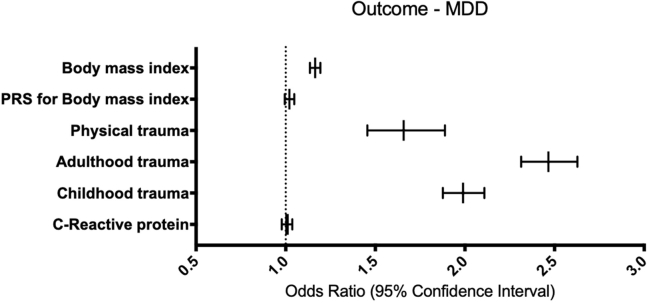
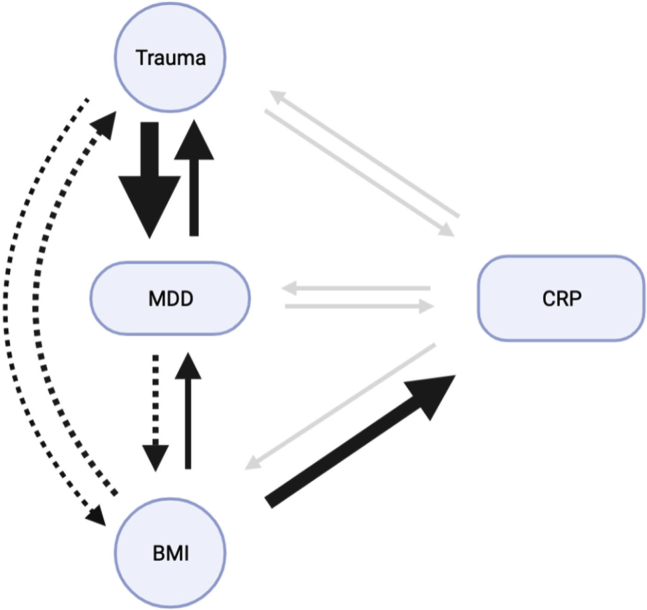
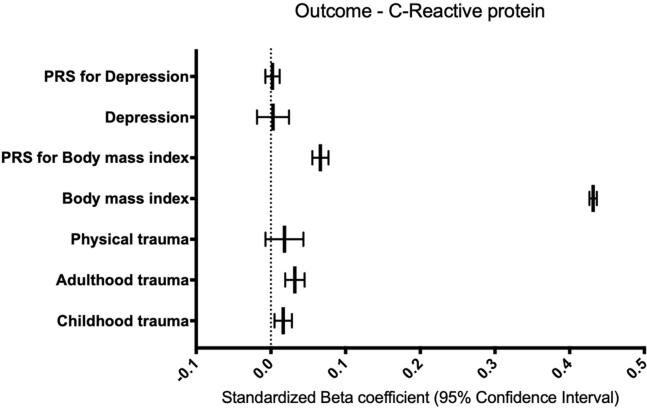
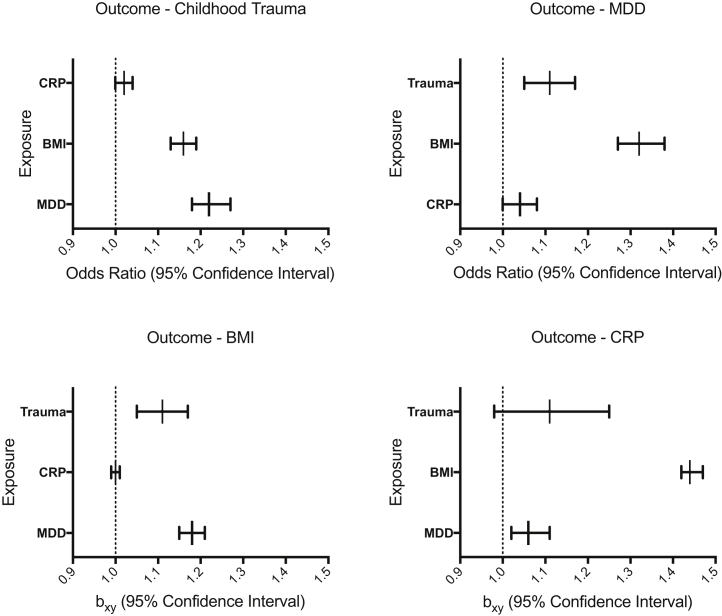
Our phenotypic analyses revealed no association between CRP and MDD but did suggest a strong effect of BMI and reported trauma on both CRP (BMI: β = 0.43, 95% CI = 0.43-0.43, ≤ .001; childhood trauma: β = 0.02, 95% CI = 0.00-0.03, = .006) and MDD (BMI: odds ratio [OR] = 1.16, 95% CI = 1.14-1.19, ≤ .001; childhood trauma: OR = 1.99, 95% CI = 1.88-2.11, ≤ .001). Our Mendelian randomization analyses confirmed a lack of causal relationship between CRP and MDD but showed evidence consistent with a strong causal influence of higher BMI on increased CRP (β = 0.37, 95% CI = 0.36-0.39, ≤ .001) and a bidirectional influence between reported trauma and MDD (OR trauma-MDD = 1.75, 95% CI = 1.49-2.07, ≤ .001; OR MDD-trauma = 1.22, 95% CI = 1.18-1.27, ≤ .001).
Our findings highlight the importance of controlling for both BMI and trauma when studying MDD in the context of inflammation. They also suggest that the experience of traumatic events can increase the risk for MDD and that MDD can increase the experience of traumatic events.
创伤经历被认为是重度抑郁症(MDD)最强的预测因素,炎症可能介导了创伤与症状发作之间的关联。然而,多项研究表明,体重指数(BMI)对炎症和MDD均有较大的混杂效应。
首先,我们试图在英国生物银行的一个大型子集中重复先前报道的这些特征之间的关联,分别在113481名和30137名个体中使用以C反应蛋白(CRP)和MDD为结果变量的回归模型。其次,我们对这些特征进行双向孟德尔随机化分析,以建立BMI、MDD、报告的童年创伤和炎症之间的潜在因果框架。
我们的表型分析显示CRP与MDD之间无关联,但确实表明BMI和报告的创伤对CRP(BMI:β = 0.43,95%CI = 0.43 - 0.43,P ≤.001;童年创伤:β = 0.02,95%CI = 0.00 - 0.03,P =.006)和MDD(BMI:比值比[OR] = 1.16,95%CI = 1.14 - 1.19,P ≤.001;童年创伤:OR = 1.99,95%CI = 1.88 - 2.11,P ≤.001)均有显著影响。我们的孟德尔随机化分析证实CRP与MDD之间缺乏因果关系,但显示出证据表明较高的BMI对CRP升高有强烈的因果影响(β = 0.37,95%CI = 0.36 - 0.39,P ≤.001),以及报告的创伤与MDD之间存在双向影响(创伤 - MDD的OR = 1.75,95%CI = 1.49 - 2.07,P ≤.001;MDD - 创伤的OR = 1.22,95%CI = 1.18 - 1.27,P ≤.001)。
我们的研究结果强调了在炎症背景下研究MDD时控制BMI和创伤的重要性。它们还表明,创伤事件的经历会增加患MDD的风险,并且MDD会增加创伤事件的经历。