Sadeh Ben, Merdler Ilan, Sadon Sapir, Lupu Lior, Borohovitz Ariel, Ghantous Eihab, Taieb Philippe, Granot Yoav, Goldstein Orit, Soriano Jonathan Calderón, Rubio-Oliver Ricardo, Ruiz-Rivas Joaquin, Zalevsky Zeev, Garcia-Monreal Javier, Shatsky Maxim, Polani Sagi, Arbel Yaron
Department of Cardiology, Tel Aviv Medical Center, Sackler Faculty of Medicine, affiliated Tel Aviv University, Tel Aviv, Israel.
Donisi Health (formerly ContinUse Biometrics Ltd.), HaNechoshet 6, Tel Aviv, 6971070, Israel.
Eur Heart J Digit Health. 2021 Dec 31;3(1):105-113. doi: 10.1093/ehjdh/ztab108. eCollection 2022 Mar.
Atrial fibrillation (AF) is a major cause of morbidity and mortality. Current guidelines support performing electrocardiogram (ECG) screenings to spot AF in high-risk patients. The purpose of this study was to validate a new algorithm aimed to identify AF in patients measured with a recent FDA-cleared contact-free optical device.
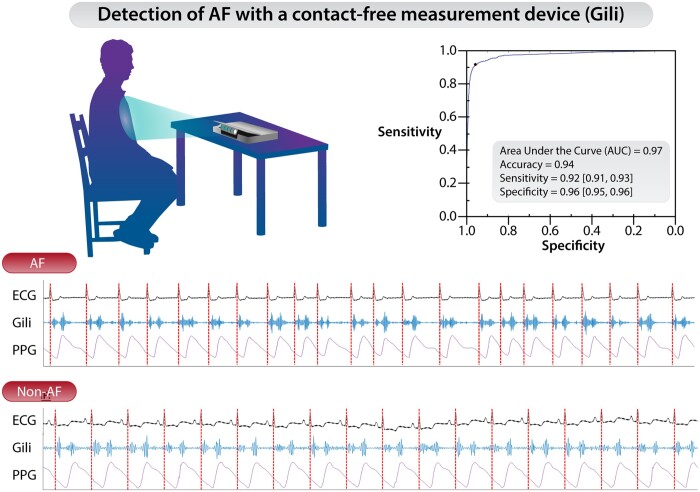
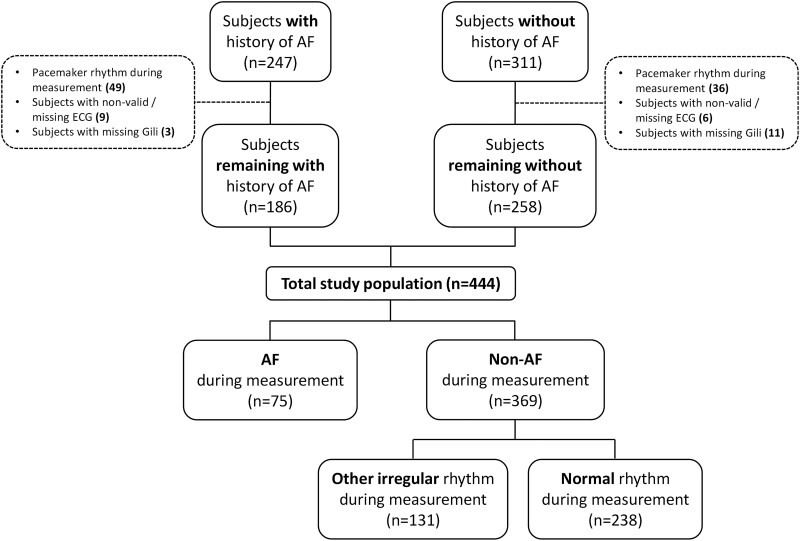
Study participants were measured simultaneously using two devices: a contact-free optical system that measures chest motion vibrations (investigational device, 'Gili') and a standard reference bed-side ECG monitor (Mindray). Each reference ECG was evaluated by two board certified cardiologists that defined each trace as: regular rhythm, AF, other irregular rhythm or indecipherable/missing. A total of 3582, 30-s intervals, pertaining to 444 patients (41.9% with a history of AF) were made available for analysis. Distribution of patients with active AF, other irregular rhythm, and regular rhythm was 16.9%, 29.5%, and 53.6% respectively. Following application of cross-validated machine learning approach, the observed sensitivity and specificity were 0.92 [95% confidence interval (CI): 0.91-0.93] and 0.96 (95% CI: 0.95-0.96), respectively.
This study demonstrates for the first time the efficacy of a contact-free optical device for detecting AF.
心房颤动(AF)是发病和死亡的主要原因。当前指南支持进行心电图(ECG)筛查以发现高危患者中的房颤。本研究的目的是验证一种新算法,该算法旨在识别使用最近获得美国食品药品监督管理局(FDA)批准的非接触式光学设备测量的患者中的房颤。
研究参与者同时使用两种设备进行测量:一种测量胸部运动振动的非接触式光学系统(研究设备,“吉利”)和一台标准参考床边心电图监测仪(迈瑞)。两名经过董事会认证的心脏病专家对每份参考心电图进行评估,将每条心电图定义为:规则心律、房颤、其他不规则心律或无法解读/缺失。共有3582个30秒的间隔,涉及444名患者(41.9%有房颤病史)可供分析。有活动性房颤、其他不规则心律和规则心律的患者分布分别为16.9%、29.5%和53.6%。应用交叉验证的机器学习方法后,观察到的敏感性和特异性分别为0.92 [95%置信区间(CI):0.91 - 0.93]和0.96(95% CI:0.95 - 0.96)。
本研究首次证明了非接触式光学设备检测房颤的有效性。