Romero-Rodríguez Esperanza, Pérula-Jiménez Celia, Fernández-López Sara, Cabello-Gracia Gregorio, Fernández-García José Ángel, Pérula-de Torres Luis Ángel, Roldán-Villalobos Ana, Leiva-Cepas Fernando, Fernández-Márquez Rodrigo, Parras-Rejano Juan Manuel
Reina Sofia University Hospital, Maimonides Biomedical Research Institute of Cordoba (IMIBIC), University of Córdoba, Córdoba, Spain.
Multiprofessional Teaching Unit of Family and Community Care of Córdoba, Health District of Córdoba and Guadalquivir, Córdoba, Spain.
Front Med (Lausanne). 2023 Jan 13;9:1008832. doi: 10.3389/fmed.2022.1008832. eCollection 2022.
Motivational interviewing (MI) could be a method for minimizing alcohol-related harm. The study aims to assess the effectiveness of a brief intervention, based on a MI, in patients with risky alcohol use attended in Primary Care (PC).
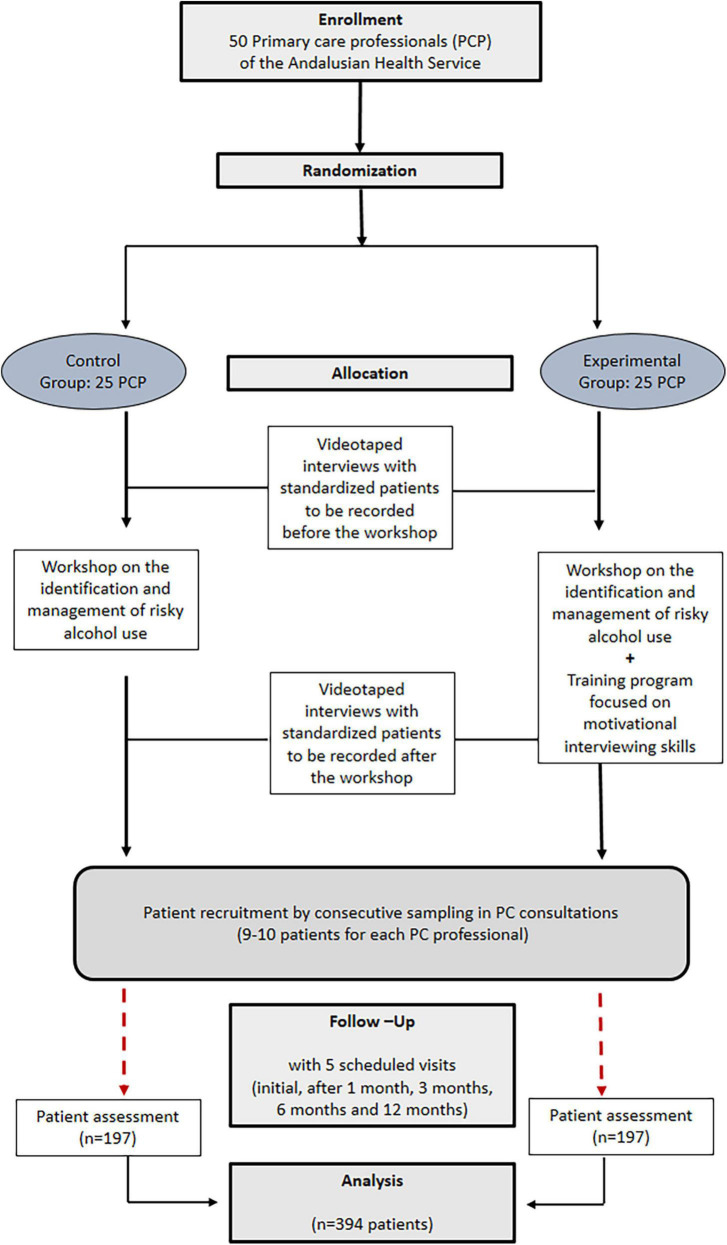
A cluster-randomized, two-arm parallel, multicenter, open-label, controlled clinical trial. Fifty PC healthcare professionals from the province of Córdoba (Spain) will be randomized to one of the two study groups: (1) Experimental Group (EG): MI-based approach; (2) Control Group (CG): Usual care based on health advice. EG intervention: Professionals will receive a training program focused on MI, consisting of a training workshop and the use of pre- and post-workshop questionnaires to measure knowledge and skills acquired, as well as the degree of empathy, with a videotape of the health professionals with standardized patients, before and after the workshop, and subsequent training feedback. CG intervention: Workshop on the management of risky alcohol use based on health advice; participants will also complete the pre-and post-workshop questionnaires and be videotaped. Study population: Patients ≥ 14 years old with risky alcohol consumption (28 Standard Drink Units-SDU-/week in men and 17 SDU/week in women) or excessive alcohol use (≥ 6 SDU in men or ≥ 4 SDU in women, in less than 2 h). It would be necessary to include 110 subjects/group to find a difference of 20% between the percentage of patients in abstinence between EG (37%) and CG (20%), alpha error of 5%, and statistical power of 80%. Assuming a loss rate of 5% and the cluster design effect, the number of subjects to be recruited is estimated at 197/group. The follow-up period will be 12 months. The primary outcome variables will be the self-reported alcohol use level and the Alcohol Use Disorders Identification Test (AUDIT) questionnaire score.
The study aims to demonstrate the effectiveness of the motivational approach in the comprehensive treatment of the patient with risky alcohol use, improving the empathy of the healthcare professionals and strengthening the healthcare professional-patient relationship to achieve the behavioral change of the patients with this problem in primary care consultations.
ClinicalTrials.gov.
动机性访谈(MI)可能是一种将与酒精相关的危害降至最低的方法。本研究旨在评估基于MI的简短干预对初级保健(PC)中存在危险饮酒行为患者的有效性。
一项整群随机、双臂平行、多中心、开放标签的对照临床试验。来自科尔多瓦省(西班牙)的50名PC医护人员将被随机分为两个研究组之一:(1)实验组(EG):基于MI的方法;(2)对照组(CG):基于健康建议的常规护理。EG干预:专业人员将接受专注于MI的培训计划,包括一个培训工作坊以及使用工作坊前后的问卷来测量所获得的知识和技能,以及同理心程度,在工作坊前后分别与标准化患者一起对医护人员进行录像,并提供后续培训反馈。CG干预:基于健康建议的危险饮酒管理工作坊;参与者也将完成工作坊前后的问卷并进行录像。研究人群:年龄≥14岁且有危险饮酒行为(男性每周28个标准饮酒单位 - SDU,女性每周17个SDU)或过度饮酒(男性在不到2小时内≥6个SDU或女性≥4个SDU)的患者。为了在EG(37%)和CG(20%)的戒酒患者百分比之间找到20%的差异,α错误为5%,统计功效为80%,每组需要纳入110名受试者。假设失访率为5%以及整群设计效应,估计每组招募的受试者数量为197名。随访期为12个月。主要结局变量将是自我报告的饮酒水平和酒精使用障碍识别测试(AUDIT)问卷得分。
本研究旨在证明动机性方法在对存在危险饮酒行为患者的综合治疗中的有效性,提高医护人员的同理心并加强医护人员与患者的关系,以在初级保健咨询中实现有此问题患者的行为改变。
ClinicalTrials.gov。