Naka Kinen Clinic, Ibaraki, Japan.
Front Endocrinol (Lausanne). 2023 Jan 11;13:1042061. doi: 10.3389/fendo.2022.1042061. eCollection 2022.
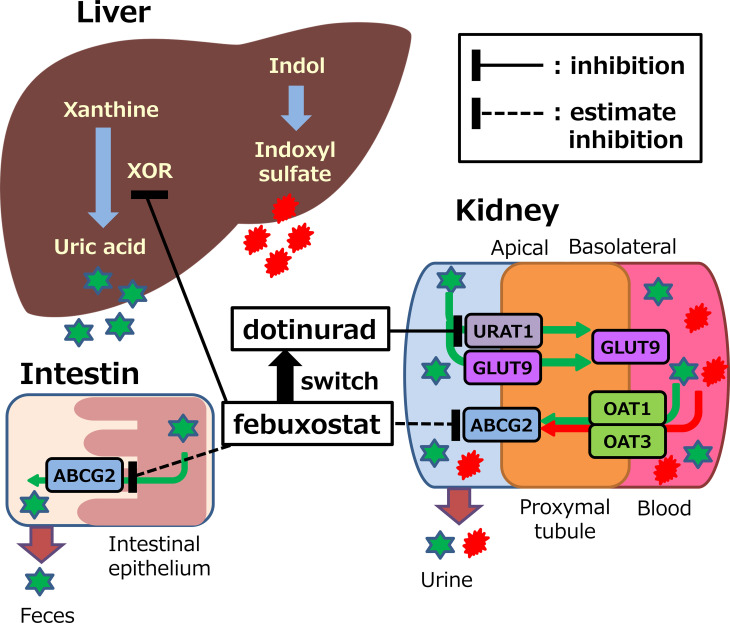
Dotinurad is a novel uricosuric drug in Japan with selective and potent urate transporter 1 (URAT1) inhibitory activity. This study aims to evaluate the efficacy and safety of dotinurad in hyperuricemic patients with type 2 diabetic kidney disease by comparing serum levels of urate and plasma and urinary levels of indoxyl sulfate excreted the urate excretion transporter ATP binding cassette subfamily G member 2 (ABCG2), as indices, with baseline levels after switching from febuxostat to dotinurad.
This single-center, single-arm, open-label, prospective, exploratory study aims to evaluate the effect of switching from febuxostat to dotinurad on serum urate levels and its background factors. The study will include 50 hyperuricemic patients with type 2 diabetic kidney disease and urate levels exceeding 6 mg/dL despite administration of febuxostat 20 mg/day for at least 3 months. The primary outcome is the achievement rate of serum urate levels of ≤6 mg/dL after 24 weeks of treatment with dotinurad at 0.5 mg to a maximum of 4 mg once daily. Secondary outcomes include the changes in serum urate levels, plasma and urinary indoxyl sulfate levels, and renal injury-related markers from baseline to observation points at weeks 4, 12, and 24.
The study hypothesizes that switching to dotinurad may reduce the plasma levels of indoxyl sulfate and increase its urinary levels in patients with hyperuricemia. These suggest that dotinurad can potently lower the serum urate level by inhibiting URAT1 without adversely affecting ABCG2. Thus, findings of this study are expected to provide useful insights into the treatment of hyperuricemia associated with type 2 diabetic kidney disease and the discovery of new possibilities for dotinurad.
Prior to the study, its study protocol was scientifically and ethically reviewed and approved by the Japan Physicians Association Clinical Research Review Board (approval number: JPA007-2204-02). In addition, patients who provide written informed consent will participate in the study. The results of this study will be published through submission to a peer-reviewed scientific journal.
https://jrct.niph.go.jp/en-latest-detail/jRCTs031220080, identifier jRCTs031220080.
多尼尿酸是一种新型的促尿酸排泄药物,在日本具有选择性和强效的尿酸转运蛋白 1(URAT1)抑制活性。本研究旨在通过比较血清尿酸水平和血浆及尿中吲哚硫酸(indoxyl sulfate)排泄水平,评估将别嘌醇转换为多尼尿酸治疗 2 型糖尿病肾病合并高尿酸血症患者的疗效和安全性,以尿酸排泄转运体 ATP 结合盒亚家族 G 成员 2(ABCG2)为指标。
本单中心、单臂、开放标签、前瞻性、探索性研究旨在评估将别嘌醇转换为多尼尿酸对血清尿酸水平及其背景因素的影响。该研究将纳入 50 例 2 型糖尿病肾病合并高尿酸血症患者,尽管已接受别嘌醇 20mg/天治疗至少 3 个月,但尿酸水平仍超过 6mg/dL。主要终点为多尼尿酸 0.5mg 至最大 4mg 每日一次治疗 24 周后,血清尿酸水平达到≤6mg/dL 的达标率。次要终点包括从基线到第 4、12 和 24 周观察点时血清尿酸水平、血浆和尿中吲哚硫酸水平以及与肾损伤相关标志物的变化。
该研究假设转换为多尼尿酸可能会降低高尿酸血症患者的血浆吲哚硫酸水平并增加其尿中吲哚硫酸水平。这表明多尼尿酸可通过抑制 URAT1 强力降低血清尿酸水平,而不影响 ABCG2。因此,本研究的结果有望为 2 型糖尿病肾病合并高尿酸血症的治疗提供有用的见解,并为多尼尿酸的新应用提供可能性。
在研究开始前,其研究方案已由日本医师协会临床研究审查委员会(编号:JPA007-2204-02)进行了科学和伦理审查与批准。此外,提供书面知情同意书的患者将参与该研究。本研究结果将通过向同行评议的科学期刊投稿发表。
https://jrct.niph.go.jp/en-latest-detail/jRCTs031220080,标识符 jRCTs031220080。