VA Healthcare System, University of California, San Diego, CA, USA.
Department of Medicine, University of Alabama at Birmingham, Birmingham, AL, USA.
Rheumatology (Oxford). 2019 Jan 1;58(1):61-69. doi: 10.1093/rheumatology/key245.
Lesinurad (LESU) is a selective urate reabsorption inhibitor approved at 200 mg daily for use with a xanthine oxidase inhibitor (XOI) to treat hyperuricaemia in gout patients failing to achieve target serum urate on XOI. The aim of the study was to investigate the long-term safety of LESU + XOI therapy.
Safety data were pooled from three 12-month phase III (core) trials evaluating LESU 200 and 400 mg/day combined with an XOI (LESU200+XOI and LESU400+XOI), and two 12-month extension studies using descriptive statistics. To adjust for treatment duration, treatment-emergent adverse events (TEAEs) were expressed as exposure-adjusted incidence rates (patients with events per 100 person-years).
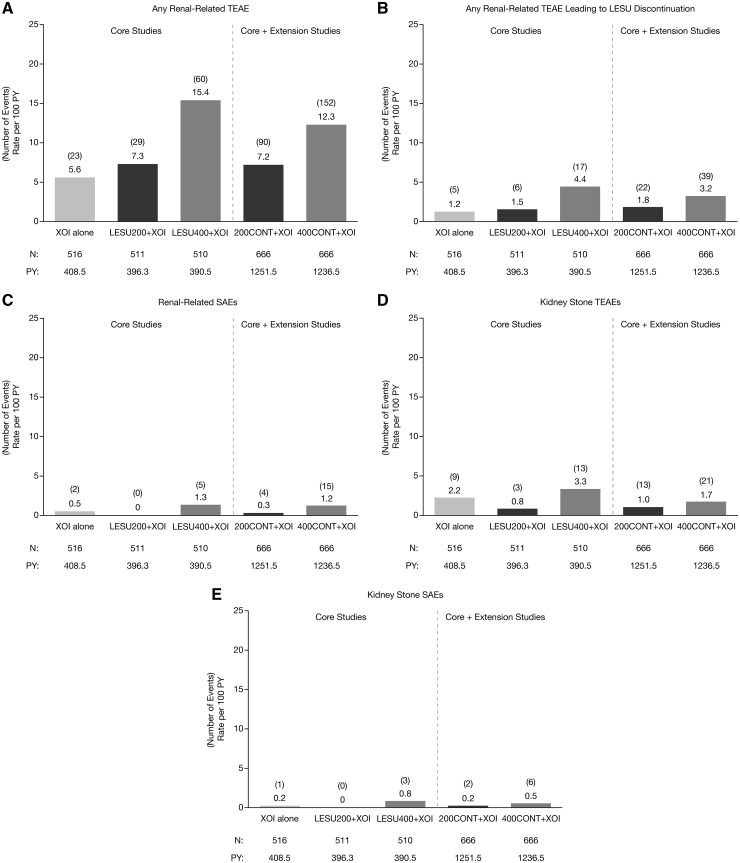
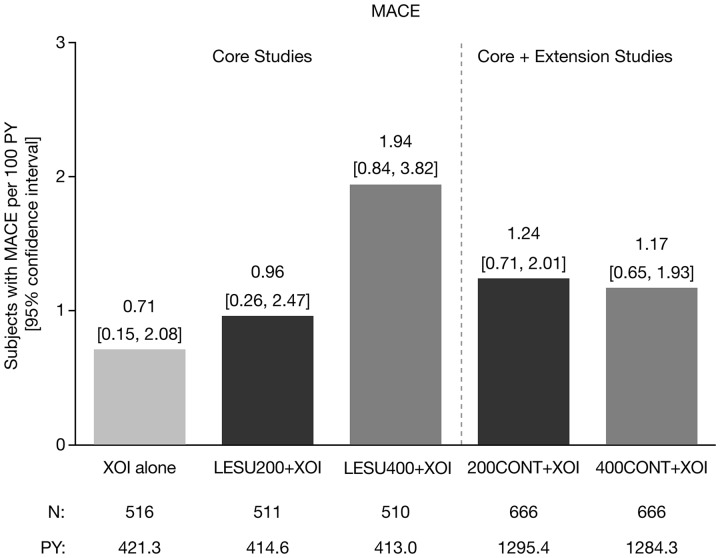
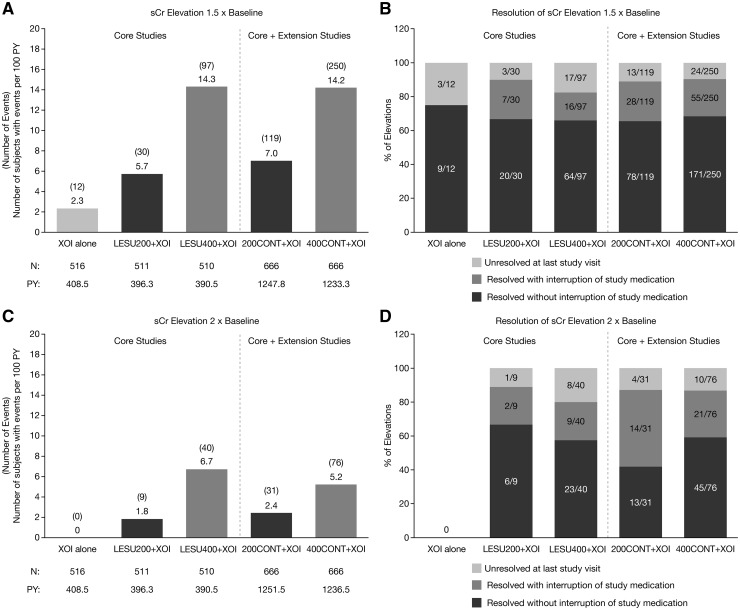
In the core studies, exposure-adjusted incidence rates for total and total renal-related TEAEs were comparable for XOI alone and LESU200+XOI but higher with LESU400+XOI. Exposure-adjusted incidence rates for serum creatinine (sCr) elevations ⩾1.5×baseline were 2.9, 7.3 and 18.7, respectively. Resolution (sCr ⩽1.2×baseline) occurred in 75-90% of all events, with 66-75% occurring without any study medication interruption. Major adverse cardiovascular events were 3, 4 and 9 with XOI, LESU200+XOI and LESU400+XOI, respectively. Longer exposure in core+extension studies did not increase rates for any safety signals.
At the approved dose of 200 mg once-daily combined with an XOI, LESU did not increase renal, cardiovascular or other adverse events compared with XOI alone, except for sCr elevations. With extended exposure in the core+extension studies, the safety profile was consistent with that observed in the core studies, and no new safety concerns were identified.
Lesinurad(LESU)是一种选择性尿酸重吸收抑制剂,每日批准剂量为 200mg,与黄嘌呤氧化酶抑制剂(XOI)联合用于治疗 XOI 未能使血尿酸达标痛风患者的高尿酸血症。本研究旨在评估 LESU+XOI 治疗的长期安全性。
安全性数据来自三项评估 LESU 200mg/天和 400mg/天联合 XOI(LESU200+XOI 和 LESU400+XOI)的为期 12 个月的 III 期(核心)试验以及两项为期 12 个月的扩展研究,采用描述性统计方法进行分析。为了调整治疗持续时间,将治疗期间出现的不良事件(TEAEs)表示为暴露调整后的发生率(每 100 人年出现事件的患者人数)。
在核心研究中,XOI 单药治疗和 LESU200+XOI 治疗的总 TEAE 和总肾脏相关 TEAE 的暴露调整发生率相当,但 LESU400+XOI 治疗的发生率更高。血清肌酐(sCr)升高 ⩾1.5×基线的暴露调整发生率分别为 2.9、7.3 和 18.7。所有事件中,75%-90%的事件得到缓解(sCr ⩽1.2×基线),66%-75%的事件在不中断任何研究药物的情况下得到缓解。XOI、LESU200+XOI 和 LESU400+XOI 组的主要不良心血管事件分别为 3、4 和 9。
在批准的 200mg 每日一次剂量与 XOI 联合使用时,与单独使用 XOI 相比,LESU 不会增加肾脏、心血管或其他不良事件,除了 sCr 升高。在核心+扩展研究中延长暴露时间并未增加任何安全性信号的发生率。在核心+扩展研究中,安全性特征与核心研究一致,未发现新的安全性问题。