Institute of Human Centered Engineering HuCE, Bern University of Applied Sciences, Biel, Switzerland.
Sitem Center for Translational Medicine and Biomedical Entrepreneurship, University of Bern, Bern, Switzerland.
Biomed Eng Online. 2023 Jan 30;22(1):5. doi: 10.1186/s12938-023-01071-5.
Every year, more than 2.5 million critically ill patients in the ICU are dependent on mechanical ventilation. The positive pressure in the lungs generated by the ventilator keeps the diaphragm passive, which can lead to a loss of myofibers within a short time. To prevent ventilator-induced diaphragmatic dysfunction (VIDD), phrenic nerve stimulation may be used.
The goal of this study is to show the feasibility of transesophageal phrenic nerve stimulation (TEPNS). We hypothesize that selective phrenic nerve stimulation can efficiently activate the diaphragm with reduced co-stimulations.
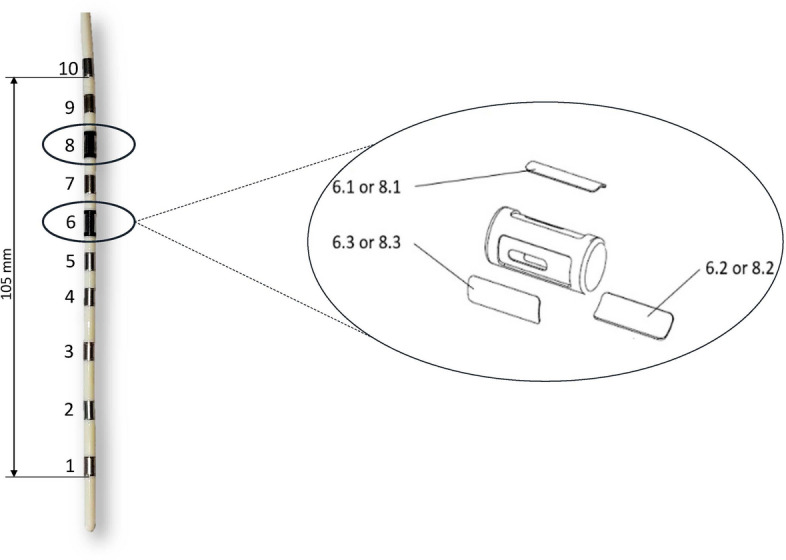
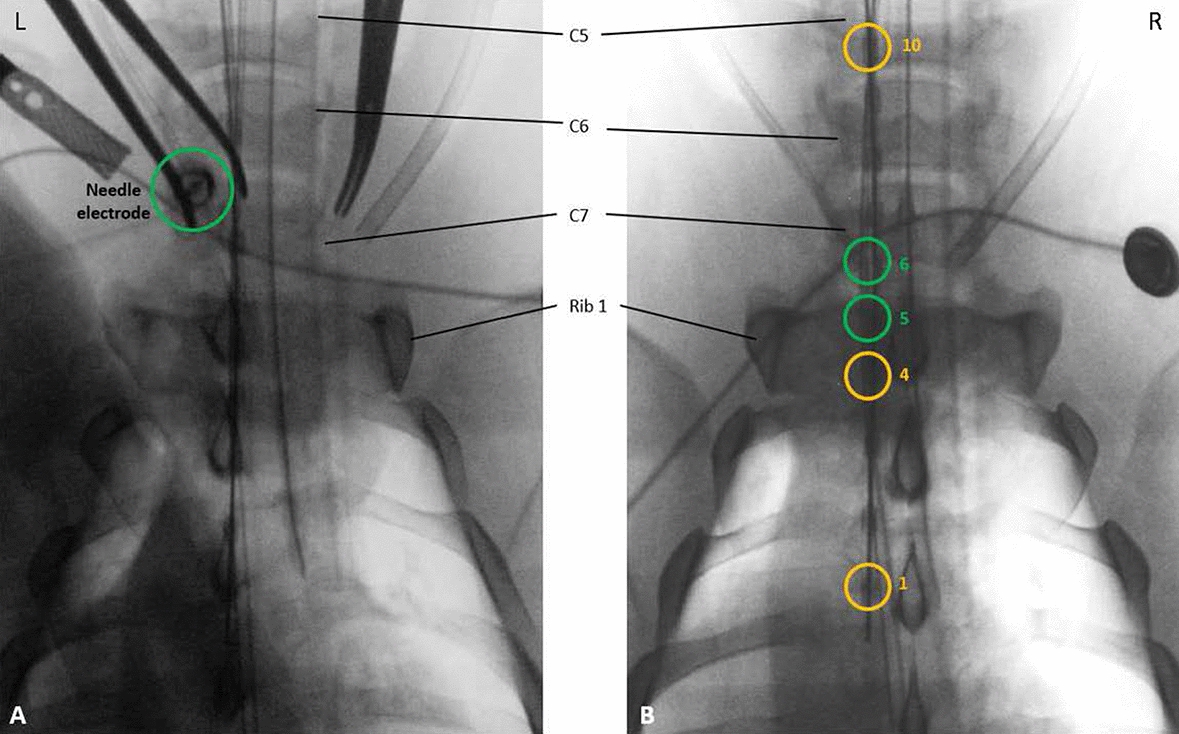
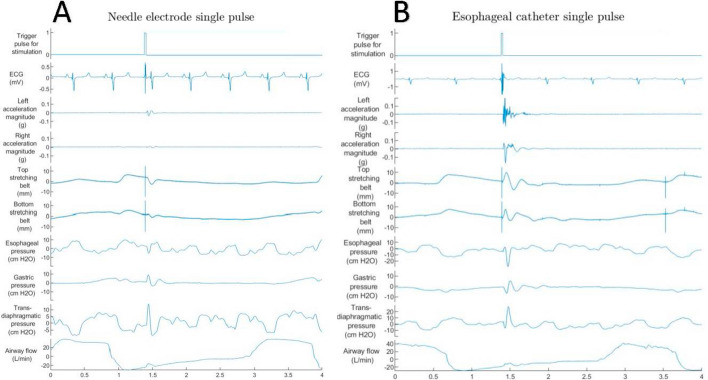
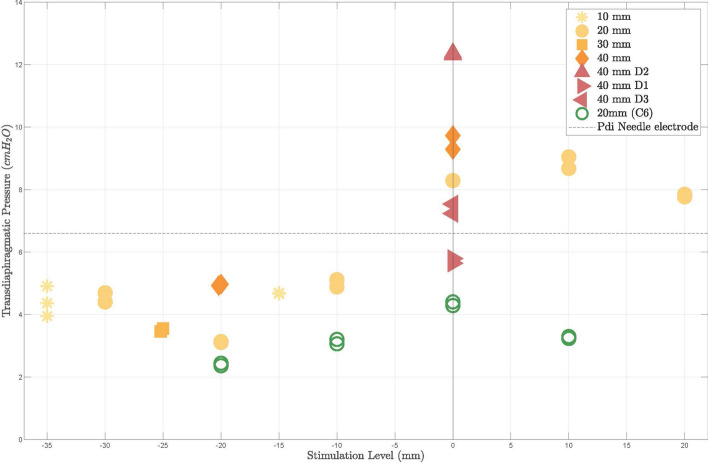
An in vitro study in saline solution combined with anatomical findings was performed to investigate relevant stimulation parameters such as inter-electrode spacing, range to target site, or omnidirectional vs. sectioned electrodes. Subsequently, dedicated esophageal electrodes were inserted into a pig and single stimulation pulses were delivered simultaneously with mechanical ventilation. Various stimulation sites and response parameters such as transdiaphragmatic pressure or airway flow were analyzed to establish an appropriate stimulation setting.
Phrenic nerve stimulation with esophageal electrodes has been demonstrated. With a current amplitude of 40 mA, similar response figures of the diaphragm activation as compared to conventional stimulation with needle electrodes at 10mA were observed. Directed electrodes best aligned with the phrenic nerve resulted in up to 16.9 % higher amplitude at the target site in vitro and up to 6 cmH20 higher transdiaphragmatic pressure in vivo as compared to omnidirectional electrodes. The activation efficiency was more sensitive to the stimulation level inside the esophagus than to the inter-electrode spacing. Most effective and selective stimulation was achieved at the level of rib 1 using sectioned electrodes 40 mm apart.
Directed transesophageal phrenic nerve stimulation with single stimuli enabled diaphragm activation. In the future, this method might keep the diaphragm active during, and even support, artificial ventilation. Meanwhile, dedicated sectioned electrodes could be integrated into gastric feeding tubes.
每年有超过 250 万 ICU 中的危重症患者依赖于机械通气。呼吸机产生的肺部正压使膈肌被动,这可能导致短时间内肌纤维丢失。为了预防呼吸机相关性膈肌功能障碍(VIDD),可能会使用膈神经刺激。
本研究旨在展示经食管膈神经刺激(TEPNS)的可行性。我们假设选择性膈神经刺激可以有效地激活膈肌,同时减少共刺激。
在生理盐水溶液中进行了一项体外研究,并结合解剖学发现,以研究相关的刺激参数,例如电极之间的间距、到达目标部位的范围、或全方位与分段电极。随后,将专用食管电极插入猪体内,并在机械通气的同时同时输送单刺激脉冲。分析各种刺激部位和反应参数,如膈膜跨膈压或气道流量,以建立适当的刺激设置。
已经证明了使用食管电极进行膈神经刺激。在电流幅度为 40mA 时,与在 10mA 时使用针电极进行常规刺激相比,观察到类似的膈激活反应参数。与全方位电极相比,在体外最佳对准膈神经的定向电极可使目标部位的幅度增加高达 16.9%,在体内的膈膜跨膈压增加高达 6cmH20。与电极之间的间距相比,激活效率对食管内的刺激水平更为敏感。使用分段电极,电极之间相距 40mm,在第 1 肋骨水平实现了最有效和选择性的刺激。
使用单个刺激的定向经食管膈神经刺激能够激活膈膜。在未来,这种方法可能会在人工通气期间甚至支持膈膜的活动。同时,专用的分段电极可以集成到胃饲管中。