• 文献检索
  • 文档翻译
  • 深度研究
  • 学术资讯
  • Suppr Zotero 插件Zotero 插件
  • 邀请有礼
  • 套餐&价格
  • 历史记录
应用&插件
Suppr Zotero 插件Zotero 插件浏览器插件Mac 客户端Windows 客户端微信小程序
定价
高级版会员购买积分包购买API积分包
服务
文献检索文档翻译深度研究API 文档MCP 服务
关于我们
关于 Suppr公司介绍联系我们用户协议隐私条款
关注我们

Suppr 超能文献

核心技术专利:CN118964589B侵权必究
粤ICP备2023148730 号-1Suppr @ 2026

文献检索

告别复杂PubMed语法,用中文像聊天一样搜索,搜遍4000万医学文献。AI智能推荐,让科研检索更轻松。

立即免费搜索

文件翻译

保留排版,准确专业,支持PDF/Word/PPT等文件格式,支持 12+语言互译。

免费翻译文档

深度研究

AI帮你快速写综述,25分钟生成高质量综述,智能提取关键信息,辅助科研写作。

立即免费体验

利用手臂加速度计数据推导和验证一种卒中检测算法。

Derivation and Validation of an Algorithm to Detect Stroke Using Arm Accelerometry Data.

机构信息

Department of Neurology University of Pennsylvania Philadelphia PA.

Department of Surgery University of Pennsylvania Philadelphia PA.

出版信息

J Am Heart Assoc. 2023 Feb 7;12(3):e028819. doi: 10.1161/JAHA.122.028819. Epub 2023 Jan 31.

DOI:10.1161/JAHA.122.028819
PMID:36718858
原文链接:https://pmc.ncbi.nlm.nih.gov/articles/PMC9973644/
Abstract

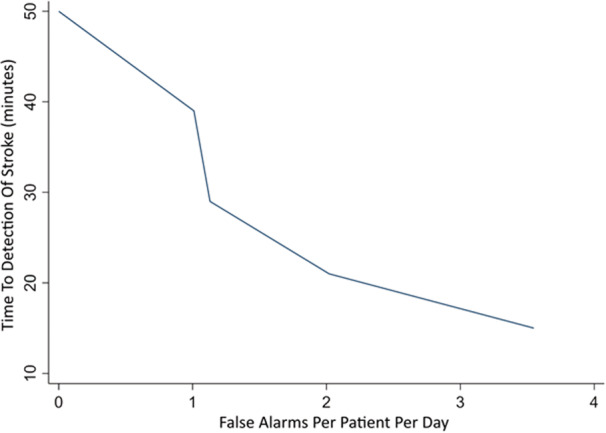
Background Early diagnosis is essential for effective stroke therapy. Strokes in hospitalized patients are associated with worse outcomes compared with strokes in the community. We derived and validated an algorithm to identify strokes by monitoring upper limb movements in hospitalized patients. Methods and Results A prospective case-control study in hospitalized patients evaluated bilateral arm accelerometry from patients with acute stroke with lateralized weakness and controls without stroke. We derived a stroke classifier algorithm from 123 controls and 77 acute stroke cases and then validated the performance in a separate cohort of 167 controls and 33 acute strokes, measuring false alarm rates in nonstroke controls and time to detection in stroke cases. Faster detection time was associated with more false alarms. With a median false alarm rate among nonstroke controls of 3.6 (interquartile range [IQR], 2.1-5.0) alarms per patient per day, the median time to detection was 15.0 (IQR, 8.0-73.5) minutes. A median false alarm rate of 1.1 (IQR. 0-2.2) per patient per day was associated with a median time to stroke detection of 29.0 (IQR, 11.0-58.0) minutes. There were no differences in algorithm performance for subgroups dichotomized by age, sex, race, handedness, nondominant hemisphere involvement, intensive care unit versus ward, or daytime versus nighttime. Conclusions Arm movement data can be used to detect asymmetry indicative of stroke in hospitalized patients with a low false alarm rate. Additional studies are needed to demonstrate clinical usefulness.

摘要

背景

早期诊断对于有效的中风治疗至关重要。与社区中风相比,住院患者的中风与更差的预后相关。我们通过监测住院患者的上肢运动,得出并验证了一种识别中风的算法。

方法和结果

一项前瞻性病例对照研究纳入了急性单侧肢体无力的中风患者和无中风的对照患者,评估其双侧手臂加速度计。我们从 123 名对照和 77 名急性中风病例中得出中风分类器算法,然后在一个包含 167 名对照和 33 名急性中风病例的独立队列中验证其性能,衡量非中风对照者的假警报率和中风病例的检测时间。更快的检测时间与更多的假警报相关。在非中风对照组中,中位数的假警报率为 3.6(四分位距[IQR],2.1-5.0)次/患者/天,中位数的检测时间为 15.0(IQR,8.0-73.5)分钟。中位数的假警报率为 1.1(IQR,0-2.2)次/患者/天,与中风检测的中位数时间为 29.0(IQR,11.0-58.0)分钟相关。按年龄、性别、种族、惯用手、非优势半球受累、重症监护病房与病房、白天与夜间分为亚组后,算法的性能无差异。

结论

手臂运动数据可用于检测住院患者的不对称性,提示中风发生,且假警报率低。需要进一步研究来证明其临床应用价值。

https://cdn.ncbi.nlm.nih.gov/pmc/blobs/675e/9973644/06fdca7fcc4b/JAH3-12-e028819-g001.jpg
https://cdn.ncbi.nlm.nih.gov/pmc/blobs/675e/9973644/e87244435dc8/JAH3-12-e028819-g002.jpg
https://cdn.ncbi.nlm.nih.gov/pmc/blobs/675e/9973644/06fdca7fcc4b/JAH3-12-e028819-g001.jpg
https://cdn.ncbi.nlm.nih.gov/pmc/blobs/675e/9973644/e87244435dc8/JAH3-12-e028819-g002.jpg
https://cdn.ncbi.nlm.nih.gov/pmc/blobs/675e/9973644/06fdca7fcc4b/JAH3-12-e028819-g001.jpg

相似文献

1
Derivation and Validation of an Algorithm to Detect Stroke Using Arm Accelerometry Data.利用手臂加速度计数据推导和验证一种卒中检测算法。
J Am Heart Assoc. 2023 Feb 7;12(3):e028819. doi: 10.1161/JAHA.122.028819. Epub 2023 Jan 31.
2
Safety and usability of wearable accelerometers for stroke detection the STROKE ALARM PRO 1 study.穿戴式加速度计用于卒中检测的安全性和可用性:STROKE ALARM PRO 1 研究。
J Stroke Cerebrovasc Dis. 2022 Nov;31(11):106762. doi: 10.1016/j.jstrokecerebrovasdis.2022.106762. Epub 2022 Sep 15.
3
Wireless accelerometry is feasible in acute monitoring of upper limb motor recovery after ischemic stroke.无线加速度测量法在急性缺血性中风后上肢运动恢复的监测中是可行的。
Cerebrovasc Dis. 2014;37(5):336-41. doi: 10.1159/000360808. Epub 2014 Jun 5.
4
Quantifying Real-World Upper-Limb Activity in Nondisabled Adults and Adults With Chronic Stroke.量化非残疾成年人和慢性中风成年人的实际上肢活动情况。
Neurorehabil Neural Repair. 2015 Nov-Dec;29(10):969-78. doi: 10.1177/1545968315583720. Epub 2015 Apr 20.
5
Predictive value of upper-limb accelerometry in acute stroke with hemiparesis.上肢加速度计在急性偏瘫性卒中中的预测价值。
J Rehabil Res Dev. 2013;50(8):1099-106. doi: 10.1682/JRRD.2012.09.0166.
6
Detecting Tonic-Clonic Seizures in Multimodal Biosignal Data From Wearables: Methodology Design and Validation.可穿戴式多模态生物信号数据中的强直阵挛性癫痫发作检测:方法设计与验证。
JMIR Mhealth Uhealth. 2021 Nov 19;9(11):e27674. doi: 10.2196/27674.
7
Automated monitoring compared to standard care for the early detection of sepsis in critically ill patients.与标准护理相比,自动监测用于危重症患者脓毒症的早期检测
Cochrane Database Syst Rev. 2018 Jun 25;6(6):CD012404. doi: 10.1002/14651858.CD012404.pub2.
8
Automated False Alarm Reduction in a Real-Life Intensive Care Setting Using Motion Detection.使用运动检测减少真实重症监护环境中的自动误报。
Neurocrit Care. 2020 Apr;32(2):419-426. doi: 10.1007/s12028-019-00711-w.
9
A new method to estimate the real upper limit of the false alarm rate in a 3 accelerometry-based fall detector for the elderly.一种用于估算基于三轴加速度计的老年人跌倒探测器中误报率实际上限的新方法。
Annu Int Conf IEEE Eng Med Biol Soc. 2012;2012:244-7. doi: 10.1109/EMBC.2012.6345915.
10
Improving Accelerometry-Based Measurement of Functional Use of the Upper Extremity After Stroke: Machine Learning Versus Counts Threshold Method.提高脑卒中后上肢功能使用的基于加速度计的测量:机器学习与计数阈值法的比较。
Neurorehabil Neural Repair. 2020 Dec;34(12):1078-1087. doi: 10.1177/1545968320962483. Epub 2020 Nov 5.

引用本文的文献

1
Pre-hospital stroke monitoring past, present, and future: a perspective.院前卒中监测的过去、现在与未来:一种视角
Front Neurol. 2024 Mar 22;15:1341170. doi: 10.3389/fneur.2024.1341170. eCollection 2024.

本文引用的文献

1
Identifying Best Practices to Improve Evaluation and Management of In-Hospital Stroke: A Scientific Statement From the American Heart Association.确定改善住院脑卒中评估和管理的最佳实践:美国心脏协会的科学声明。
Stroke. 2022 Apr;53(4):e165-e175. doi: 10.1161/STR.0000000000000402. Epub 2022 Feb 9.
2
Delays in the Identification and Assessment of in-Hospital Stroke Patients.住院中风患者识别与评估的延迟
J Stroke Cerebrovasc Dis. 2022 Apr;31(4):106327. doi: 10.1016/j.jstrokecerebrovasdis.2022.106327. Epub 2022 Feb 2.
3
Comparison of eight prehospital stroke scales to detect intracranial large-vessel occlusion in suspected stroke (PRESTO): a prospective observational study.
比较 8 种院前卒中量表对疑似卒中患者颅内大血管闭塞的检出效果(PRESTO):一项前瞻性观察研究。
Lancet Neurol. 2021 Mar;20(3):213-221. doi: 10.1016/S1474-4422(20)30439-7. Epub 2021 Jan 7.
4
Guidelines for the Early Management of Patients With Acute Ischemic Stroke: 2019 Update to the 2018 Guidelines for the Early Management of Acute Ischemic Stroke: A Guideline for Healthcare Professionals From the American Heart Association/American Stroke Association.急性缺血性脑卒中患者早期管理指南:2018 年急性缺血性脑卒中早期管理指南的更新:美国心脏协会/美国卒中协会发布的医疗保健专业人员指南。
Stroke. 2019 Dec;50(12):e344-e418. doi: 10.1161/STR.0000000000000211. Epub 2019 Oct 30.
5
Systematic Review of Malpractice Litigation in the Diagnosis and Treatment of Acute Stroke.急性脑卒中诊治中医疗事故诉讼的系统评价。
Stroke. 2019 Oct;50(10):2858-2864. doi: 10.1161/STROKEAHA.119.025352. Epub 2019 Aug 19.
6
An interdisciplinary approach to inhospital stroke improves stroke detection and treatment time.采用跨学科方法治疗院内卒中可提高卒中检出率和治疗时间。
J Neurointerv Surg. 2019 Nov;11(11):1080-1084. doi: 10.1136/neurintsurg-2019-014890. Epub 2019 Apr 27.
7
Reducing Pulse Oximetry False Alarms Without Missing Life-Threatening Events.减少脉搏血氧饱和度仪误报且不遗漏危及生命的事件。
Smart Health (Amst). 2018 Dec;9-10:287-296. doi: 10.1016/j.smhl.2018.07.002. Epub 2018 Jul 7.
8
A call to alarms: Current state and future directions in the battle against alarm fatigue.敲响警钟:对抗警报疲劳的现状与未来方向
J Electrocardiol. 2018 Nov-Dec;51(6S):S44-S48. doi: 10.1016/j.jelectrocard.2018.07.024. Epub 2018 Jul 29.
9
Approaches to the field recognition of potential thrombectomy candidates.
Int J Stroke. 2017 Oct;12(7):698-707. doi: 10.1177/1747493017724585. Epub 2017 Aug 3.
10
In-Patient Code Stroke: A Quality Improvement Strategy to Overcome Knowledge-to-Action Gaps in Response Time.住院患者脑卒中代码:一种克服反应时间知识转化差距的质量改进策略。
Stroke. 2017 Aug;48(8):2176-2183. doi: 10.1161/STROKEAHA.117.017622. Epub 2017 Jun 27.