Department of Medicine Virginia Tech Carilion Roanoke VA.
Department of Medicine Johns Hopkins University School of Medicine Baltimore MD.
J Am Heart Assoc. 2023 Feb 7;12(3):e8023. doi: 10.1161/JAHA.122.026003. Epub 2023 Jan 31.
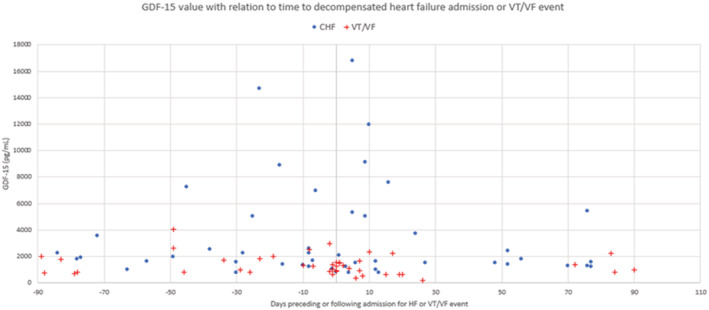
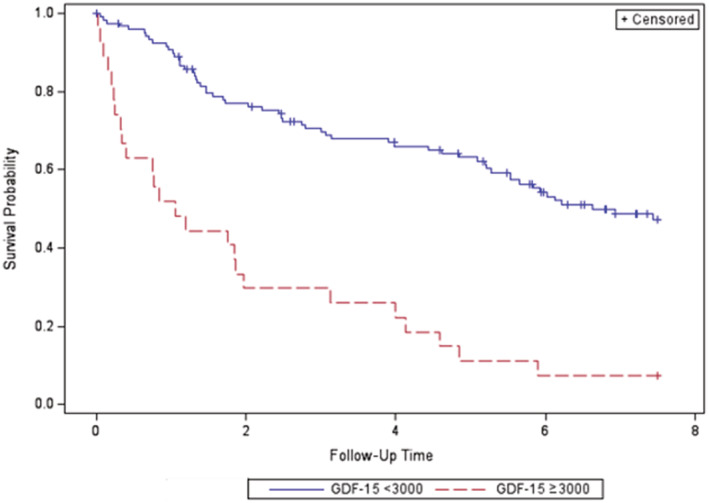
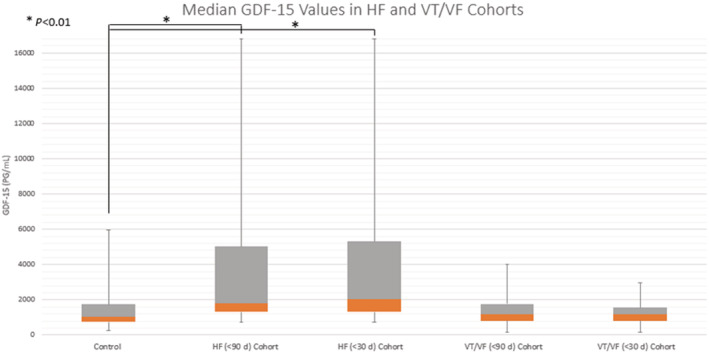
Background Heart failure (HF) has been increasing in prevalence, and a need exists for biomarkers with improved predictive and prognostic ability. GDF-15 (growth differentiation factor-15) is a novel biomarker associated with HF mortality, but no serial studies of GDF-15 have been conducted. This study aimed to investigate the association between GDF-15 levels over time and the occurrence of ventricular arrhythmias, HF hospitalizations, and all-cause mortality. Methods and Results We used a retrospective case-control design to analyze 148 patients with ischemic and nonischemic cardiomyopathies and primary prevention implantable cardioverter-defibrillator (ICD) from the PROSe-ICD (Prospective Observational Study of the ICD in Sudden Cardiac Death Prevention) cohort. Patients had blood drawn every 6 months and after each appropriate ICD therapy and were followed for a median follow-up of 4.6 years, between 2005 to 2019. We compared serum GDF-15 levels within ±90 days of an event among those with a ventricular tachycardia/fibrillation event requiring ICD therapies and those hospitalized for decompensated HF. A comparator/control group comprised patients with GDF-15 levels available during 2-year follow-up periods without events. Median follow-up was 4.6 years in the 148 patients studied (mean age 58±12, 27% women). The HF cohort had greater median GDF-15 values within 90 days (1797 pg/mL) and 30 days (2039 pg/mL) compared with the control group (1062 pg/mL, both <0.0001). No difference was found between the ventricular tachycardia/fibrillation subgroup within 90 days (1173 pg/mL, =0.60) or 30 days (1173 pg/mL, =0.78) and the control group. GDF-15 was also significantly predictive of mortality (hazard ratio, 3.17 [95% CI, 2.33-4.30]). Conclusions GDF-15 levels are associated with HF hospitalization and mortality but not ventricular arrhythmic events.
心力衰竭(HF)的患病率一直在增加,因此需要具有更好预测和预后能力的生物标志物。GDF-15(生长分化因子-15)是一种与 HF 死亡率相关的新型生物标志物,但尚未进行 GDF-15 的连续研究。本研究旨在探讨随时间推移 GDF-15 水平与室性心律失常、HF 住院和全因死亡率发生之间的关系。
我们使用回顾性病例对照设计分析了来自 PROSe-ICD(植入式心脏复律除颤器预防心源性猝死的前瞻性观察研究)队列的 148 例缺血性和非缺血性心肌病及一级预防植入式心脏复律除颤器(ICD)患者。患者每 6 个月采血一次,并在每次适当的 ICD 治疗后采血,并在 2005 年至 2019 年期间进行中位数为 4.6 年的随访。我们比较了那些因室性心动过速/颤动事件需要 ICD 治疗和因 HF 失代偿而住院的患者在事件发生前后±90 天内的血清 GDF-15 水平。对照组由在 2 年随访期间无事件发生且有 GDF-15 水平的患者组成。在 148 例研究患者中,中位随访时间为 4.6 年(平均年龄 58±12 岁,27%为女性)。HF 组在 90 天(1797pg/mL)和 30 天(2039pg/mL)的中位 GDF-15 值均高于对照组(1062pg/mL,均<0.0001)。在 90 天内(1173pg/mL,=0.60)或 30 天内(1173pg/mL,=0.78)的室性心动过速/颤动亚组与对照组之间未发现差异。GDF-15 也显著预测死亡率(风险比,3.17 [95%CI,2.33-4.30])。
GDF-15 水平与 HF 住院和死亡率相关,但与室性心律失常事件无关。